

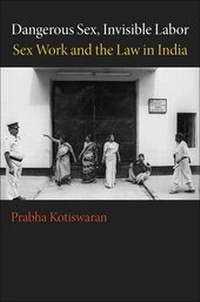
Dangerous Sex, Invisible Labor
Sex Work and the Law in India
Published on 25. July 2011
Book
Hardback
312 pages
978-0-691-14250-0 (ISBN)
Description
Popular representations of third-world sex workers as sex slaves and vectors of HIV have spawned abolitionist legal reforms that are harmful and ineffective, and public health initiatives that provide only marginal protection of sex workers' rights. In this book, Prabha Kotiswaran asks how we might understand sex workers' demands that they be treated as workers. She contemplates questions of redistribution through law within the sex industry by examining the political economies and legal ethnographies of two archetypical urban sex markets in India. Kotiswaran conducted in-depth fieldwork among sex workers in Sonagachi, Kolkata's largest red-light area, and Tirupati, a temple town in southern India. Providing new insights into the lives of these women - many of whom are demanding the respect and legal protection that other workers get - Kotiswaran builds a persuasive theoretical case for recognizing these women's sexual labor.
Moving beyond standard feminist discourse on prostitution, she draws on a critical genealogy of materialist feminism for its sophisticated vocabulary of female reproductive and sexual labor, and uses a legal realist approach to show why criminalization cannot succeed amid the informal social networks and economic structures of sex markets. Based on this, Kotiswaran assesses the law's redistributive potential by analyzing the possible economic consequences of partial decriminalization, complete decriminalization, and legalization. She concludes with a theory of sex work from a postcolonial materialist feminist perspective.
Moving beyond standard feminist discourse on prostitution, she draws on a critical genealogy of materialist feminism for its sophisticated vocabulary of female reproductive and sexual labor, and uses a legal realist approach to show why criminalization cannot succeed amid the informal social networks and economic structures of sex markets. Based on this, Kotiswaran assesses the law's redistributive potential by analyzing the possible economic consequences of partial decriminalization, complete decriminalization, and legalization. She concludes with a theory of sex work from a postcolonial materialist feminist perspective.
Reviews / Votes
Co-Winner of the 2012 Hart-SLSA Prize for Early Career Academics, Socio-Legal Studies Association "Dangerous Sex, Invisible Labor is a book that deserves respect for its painstaking efforts to present a view 'from below', and to incorporate the voice of the sex worker herself, not only that of the slave but also of the self-employed prostitute-housewife who earns much more than her unsuspecting husband. It provides a wealth of information about the organisation of prostitution and the law in India--a field with many keep-out signs for 'outsiders.' Only a courageous and sensitive researcher can find a way to get in."--Times Higher Education "[F]ascinating and illuminating... Dangerous Sex, Invisible Labor offers a sincere effort in presenting a genuinely contextualized understanding of sex work from sex worker's perspectives, and avoids abstractionist theorizing. This book offers a great thinking ground for readers by creating a remarkably large space for them to do their own theorizing."--Raadhika Gupta, Harvard Journal of Law & Gender "Drawing on perspectives of the sex worker movement in India, Kotiswaran advocates decriminalization of sex work along with self-organization in order for sex workers to realize their rights."--Choice "Kotiswaran's sophisticated and informative theoretical and legal perspective, while occasionally beyond the main boundaries of anthropology, sheds a great deal of light on a difficult and 'invisible' subject, and if it does not decisively point the way, it at least elucidates the contours and contradictions in the 'elusive quest for justice' for women performing sex work."--Jack David Eller, Anthropology Review DatabaseMore details
Language
English
Place of publication
New Jersey
United States
Target group
College/higher education
Professional and scholarly
Product notice
Trade binding
Illustrations
2 Maps
Dimensions
Height: 229 mm
Width: 152 mm
Weight
567 gr
ISBN-13
978-0-691-14250-0 (9780691142500)
Copyright in bibliographic data and cover images is held by Nielsen Book Services Limited or by the publishers or by their respective licensors: all rights reserved.
Schweitzer Classification
Other editions
Additional editions
Book
07/2011
Princeton University Press
€46.00
Shipment within 10-20 days
Person
Prabha Kotiswaran is lecturer in law at the School of Oriental and African Studies at the University of London.
Content
Acknowledgments ix Abbreviations xii Part One Theorizing Sex Work One Dangerous Sex, Invisible Labor: An Introduction 3 Two Revisiting the Material: Recasting the Sex Work Debates 24 Three Theorizing the Lumpen Proletariat: A Genealogy of Materialist Feminism on Sex Work 50 Part Two The Political Economy of Sex Markets Four Not on the Lord's Agenda: The Traveling Sex Workers of Tirupati 85 Five Born unto Brothels: Sex Work in a Kolkata Red-Light Area 137 Part Three Toward a Theory of Redistribution in Sex Markets Six Regulating Sex Markets: The Paradoxical Life of the Law 185 Seven Toward a Postcolonial Materialist Feminist Theory of Sex Work 212 Notes 251 References 265 Index 285