

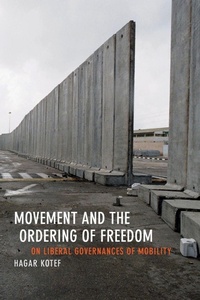
Movement and the Ordering of Freedom
On Liberal Governances of Mobility
Published on 6. March 2015
Book
Paperback/Softback
248 pages
978-0-8223-5855-8 (ISBN)
Description
We live within political systems that increasingly seek to control movement, organized around both the desire and ability to determine who is permitted to enter what sorts of spaces, from gated communities to nation-states. In Movement and the Ordering of Freedom, Hagar Kotef examines the roles of mobility and immobility in the history of political thought and the structuring of political spaces. Ranging from the writings of Locke, Hobbes, and Mill to the sophisticated technologies of control that circumscribe the lives of Palestinians in the Occupied West Bank, this book shows how concepts of freedom, security, and violence take form and find justification via "regimes of movement." Kotef traces contemporary structures of global (im)mobility and resistance to the schism in liberal political theory, which embodied the idea of "liberty" in movement while simultaneously regulating mobility according to a racial, classed, and gendered matrix of exclusions.
Reviews / Votes
"Hagar Kotef has written an insightful, thought-provoking and thoroughly engaging book that brings a fresh theoretical perspective on the intersections between borders, mobility and liberalism.... Movement and the Ordering of Freedom makes an impressive contribution to a literature spanning Border Studies, Mobility and Migration Studies, and a range of interdisciplinary efforts to come to terms with the spatial and architectural dimensions of power and governmentality.... I suspect this important work will be much cited as one that brings fresh historical perspective to the political stakes of human mobility and liberal governmental regimes." - Anne McNevin (Migration Studies) "This is not only a well researched and written book, it is also informed by a political-ethical commitment against injustice.... This provides a fascinating (re)reading of liberalism which is pursued through an intriguing twofold analysis: one focusing on the enactment of the regulation of movement in Israel and Palestine; the second exploring a genealogy of liberalism and mobility through the work of Hobbes, Locke, Mill (as well as William Blackstone and Hannah Arendt). This somewhat unorthodox approach to structuring a political theory text is one of the highlights of the book and opens it up to multiple audiences." - Joe Turner (Review of Politics) "It's a book written with both verve and the depth of close, careful reading; with an intellectual suppleness and playfulness and the utter seriousness of a conviction in the political relevance of theory; but more importantly a book that, even, or especially, when it delves into history, strikes with nothing less than the urgency of the present." - Nasser Abourahme (Journal of the Society for Contemporary Thought and the Islamicate World) "... Kotef 's book offers a nuanced critique of liberalism, exploring it as a political ideology articulated in terms of freedom and movement. Most important, the book's readings of settler colonialism in America and in Israel persuasively demonstrate that the colonial condition is not, and never has been, either geographically or theoretically external to liberalism. On the contrary, colonialism, as the book makes clear, is the foundational archive of liberalism." - Gil Hochberg (GLQ) "[O]riginal, concise, well written and well argued and certainly makes a new contribution to the fields of migration and mobility studies. . . . [It will] certainly be of interest to postgraduate students and professionals across the social sciences and humanities who are concerned with migration, mobility, identity, Israel/Palestine, political subjectivity and the liberal state-a thought-provoking read and one which comes highly recommended." - Lucy Mayblin (Journal of Colonialism & Colonial History) "Movement and the Ordering of Freedom offers a conceptually rich contribution that seeks to consider how mobility and movement might be conceived as central to the emergence of liberal models of governance. Kotef's text is a lucid and well-researched account of the historical context through which 'the liberal subject was formed in the image of moderation.'"- Jonathan Darling (Progress in Human Geography) "Kotef presents us with a rich and multi-faced contribution to contemporary theories on movement, migration, and border security." - Nanda Oudejans (Perspectives on Politics) "Hagar Kotef's enquiry into 'the politics of motion' is timely, excellently written and surely a must read for researchers not just of surveillance/control societies and of Israel-Palestine (the book's regional focus), but more broadly for scholars in cultural politics." - Marcelo Svirsky (Contemporary Political Theory)
More details
Series
Language
English
Place of publication
North Carolina
United States
Product notice
Paperback (trade)
Illustrations
12 illustrations
Dimensions
Height: 229 mm
Width: 152 mm
Thickness: 14 mm
Weight
368 gr
ISBN-13
978-0-8223-5855-8 (9780822358558)
Copyright in bibliographic data and cover images is held by Nielsen Book Services Limited or by the publishers or by their respective licensors: all rights reserved.
Schweitzer Classification
Other editions
Additional editions
E-Book
04/2015
1st Edition
De Gruyter
€198.99
Available for download
Person
Hagar Kotef is based at the Minerva Humanities Center at Tel Aviv University.
Content
Preface vii Acknowledgments xi Introduction 1 1. Between Imaginary Lines: Violence and Its Justifications at the Military Checkpoints in Occupied Palestine / Hagar Kotef and Merav Amir 27 2. An Interlude: A Tale of Two Roads-On Freedom and Movement 52 3. The Fence That "Ill Deserves the Name of Confinement": Locomotion and the Liberal Body 61 4. The Problem of "Excessive" Movement 87 5. The "Substance and Meaning of All Things Political": On Other Bodies 112 Conclusion 136 Notes 141 Bibliography 203 Index 217