

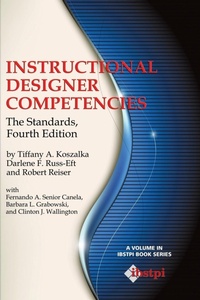
Instructional Designer Competencies
The Standards
4th Edition
Published on 20. August 2013
Book
Paperback/Softback
178 pages
978-1-62396-403-0 (ISBN)
Description
This book provides the most current and complete version of statements defining a competent instructional designer, for those who are or aspire to practice in virtually any context, anywhere in the world. The research conducted to update and validate these standards included obtaining feedback from over 1000 senior to novice practitioners and scholars working in the North, South, and Central Americas, Europe, Asia, Australia and New Zealand, and African nations.
This book is intended for those who hire, train, and prepare instructional designers and those who work (or plan to work) as instructional designers. It provides an updated description of the profession. It lays out the most critical competencies (e.g., knowledge, skills, and attitudes) of the successful instructional designer, regardless of the context in which they work (e.g., K-12, higher education, business and industry, government and military, private consultancy, informal or formal), the location in which they practice (e.g., the Americas, Europe, Asia, Africa, Australia), and the type of delivery for which they design (e.g., face-to-face, paper-based, digital, blended).
There have always been questions about what instructional designers do... such questions led to the creation of ibstpi more than 30 years ago. Yet, this questioning is especially true today with the growing call for developers of e-learning and other technology-supported instruction. The term 'instructional designer' seems to have become a generic phrase that now lends itself to a broad range of meanings, and yet, it is a definitive profession with a specific scope and focus. The more widely the label 'instructional designer' is used, the more room there is for misunderstanding about what is called for in skills, behaviors, competencies, and outputs. What is called for in the midst of this learning boom is clarity, direction and uniform expectations. With a common understanding, we can help avert poor design, especially in e-learning and technology-supported instruction, which often fails learners or has high attrition rates.
Grounded on rigorous research, consulting hundreds of practitioners around the world, this book articulates and explains what is required to be a competent instructional designer. It includes the set of standards that clarifies the profession and provides a set of competencies for creating hiring schemes, professional development guidelines, performance assessments, work plans, and curriculum to prepare instructional designers.The instructional designer profession continues to grow in wake of emerging technologies, new pedagogies, and virtual learning environments.
However, many educators, instructors, and even training specialists often lack the competencies to design, develop, implement, and evaluate these newer types of instructional solutions. This book articulates and explains the competencies that are required to be a competent instructional designer.
This book is intended for those who hire, train, and prepare instructional designers and those who work (or plan to work) as instructional designers. It provides an updated description of the profession. It lays out the most critical competencies (e.g., knowledge, skills, and attitudes) of the successful instructional designer, regardless of the context in which they work (e.g., K-12, higher education, business and industry, government and military, private consultancy, informal or formal), the location in which they practice (e.g., the Americas, Europe, Asia, Africa, Australia), and the type of delivery for which they design (e.g., face-to-face, paper-based, digital, blended).
There have always been questions about what instructional designers do... such questions led to the creation of ibstpi more than 30 years ago. Yet, this questioning is especially true today with the growing call for developers of e-learning and other technology-supported instruction. The term 'instructional designer' seems to have become a generic phrase that now lends itself to a broad range of meanings, and yet, it is a definitive profession with a specific scope and focus. The more widely the label 'instructional designer' is used, the more room there is for misunderstanding about what is called for in skills, behaviors, competencies, and outputs. What is called for in the midst of this learning boom is clarity, direction and uniform expectations. With a common understanding, we can help avert poor design, especially in e-learning and technology-supported instruction, which often fails learners or has high attrition rates.
Grounded on rigorous research, consulting hundreds of practitioners around the world, this book articulates and explains what is required to be a competent instructional designer. It includes the set of standards that clarifies the profession and provides a set of competencies for creating hiring schemes, professional development guidelines, performance assessments, work plans, and curriculum to prepare instructional designers.The instructional designer profession continues to grow in wake of emerging technologies, new pedagogies, and virtual learning environments.
However, many educators, instructors, and even training specialists often lack the competencies to design, develop, implement, and evaluate these newer types of instructional solutions. This book articulates and explains the competencies that are required to be a competent instructional designer.
More details
Series
Edition
4th Revised edition
Language
English
Place of publication
Charlotte
United States
Publishing group
Emerald Publishing Inc
Target group
Professional and scholarly
Edition type
Revised edition
Dimensions
Height: 234 mm
Width: 156 mm
Thickness: 10 mm
Weight
281 gr
ISBN-13
978-1-62396-403-0 (9781623964030)
Copyright in bibliographic data and cover images is held by Nielsen Book Services Limited or by the publishers or by their respective licensors: all rights reserved.
Schweitzer Classification
Other editions
Additional editions
Tiffany A. Koszalka | Darlene F. Russ-Eft
Instructional Designer Competencies
The Standards (Fourth Edition)
E-Book
08/2013
1st Edition
Information Age Publishing
from
€62.33
Available for download
Persons
Tiffany A. Koszalka, Syracuse University, USA
Darlene F. Russ-Eft, Oregon State University, USA
Robert Reiser, Florida State University, USA
Darlene F. Russ-Eft, Oregon State University, USA
Robert Reiser, Florida State University, USA
Content
Foreword, Barbara L. Grabowski.
Preface, Clint J. Wallington.
Chapter 1. Instructional Designer Competence.
Chapter 2. Instructional Designer Competencies and Performance Statements.
Chapter 3. The Instructional Designer Competencies: Discussion and Analysis.
Chapter 4. Instructional Designer Competencies in Practice.
Chapter 5. The Competencies and ID Specializations.
Chapter 6. The Competency Validation Research.
Chapter 7. Epilogue.
Appendixes.
References.
About the Authors.
Preface, Clint J. Wallington.
Chapter 1. Instructional Designer Competence.
Chapter 2. Instructional Designer Competencies and Performance Statements.
Chapter 3. The Instructional Designer Competencies: Discussion and Analysis.
Chapter 4. Instructional Designer Competencies in Practice.
Chapter 5. The Competencies and ID Specializations.
Chapter 6. The Competency Validation Research.
Chapter 7. Epilogue.
Appendixes.
References.
About the Authors.