

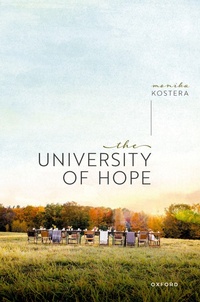
The University of Hope
Published on 13. August 2024
Book
Hardback
208 pages
978-0-19-889291-5 (ISBN)
Description
Is the University as we know it dead? Monika Kostera thinks not, but across the globe universities are under attack, be it by external forces or from within. Will they survive? Our civilisation requires that they must: planetary survival and sustainability depend on them. This book provides vital resources to give us all - professional academics, students, and university administrators - hope that universities will emerge renewed out of the current crisis. As this inspiring work shows, the practice of academic virtues can enable us to cultivate the awareness of the common good that academia serves: the preservation and development of humanity's potential of knowledge.
Drawing on a rich variety of ideas, theories, empirical cases, real and fictitious stories, as well as examples and images from art and literature, Monika Kostera demonstrates the splendid complexity of academic ecosystems. It is through looking for hope for the university that we find hope for society and the planet. In suggesting tangible steps for restoring a sense of meaning to academic work and the collegial community worldwide, The University of Hope shows us a path out of the darkness.
Drawing on a rich variety of ideas, theories, empirical cases, real and fictitious stories, as well as examples and images from art and literature, Monika Kostera demonstrates the splendid complexity of academic ecosystems. It is through looking for hope for the university that we find hope for society and the planet. In suggesting tangible steps for restoring a sense of meaning to academic work and the collegial community worldwide, The University of Hope shows us a path out of the darkness.
Reviews / Votes
Monika Kostera's book is a great source of knowledge for organization scholars and management students interested in how different forms of organizing can shape people's moral compasses and behaviours. This publication is also a valuable compendium for higher education policy makers and university managers - a warning signal on how the academic community could be easily destroyed by harmful organizational changes, and how to regain what has been already lost by recovering 'all the virtues connecting us with something greater than ourselves'.It is worth to mention, however, that there is no nostalgia for some better time in academia in this book-the author brilliantly diagnoses the pathologies of feudalism in the academy, and the harassing actions performed by feudal ladies and feudal lords, now reinforced by neoliberal reform. * Michal Zawadzki, Sage Journal * The feeling of picking up an academic book and not being able to put it down is rare, sadly. But Monika Kostera's book is compelling. The book reads like a crescendo of the current pressing discussions around the future-and present-of academia, accentuating the powerful voices already critiquing the current state. The book is dense, yet easy to read, thought-provoking but never didactic. It is deeply critical but never angry. It explores harsh and difficult realities, but with care and humility. It shares pain, and the wounds are visible- but these are transformed into courage, strength and hope. The book speaks to so many different levels at once; it is written on so many levels at once. * Alexia Panayiotou, Organization Studies * Readers with a predisposition towards intellectual curiosity and an enjoyment of jousting with ideas will find this book a treat. * Journal of the Commonwealth Lawyers' Association * Readers with a predisposition towards intellectual curiosity and an enjoyment of jousting with ideas will find this book a treat. * Journal of the Commonwealth Lawyers' Association *More details
Language
English
Place of publication
Oxford
United Kingdom
Target group
Professional and scholarly
Product notice
sewn/stitched
Cloth over boards
Dimensions
Height: 236 mm
Width: 158 mm
Thickness: 18 mm
Weight
468 gr
ISBN-13
978-0-19-889291-5 (9780198892915)
Copyright in bibliographic data and cover images is held by Nielsen Book Services Limited or by the publishers or by their respective licensors: all rights reserved.
Schweitzer Classification
Other editions
Additional editions
Person
Monika Kostera is a Professor in Sociology and Management at Warsaw University, as well as Professor in Management at Soedertoern University, Sweden, and is affiliated with LITEM, l'Universite Evry Val-d'Essonne, France. She has also been employed as professor and chair at UK universities. She writes and publishes texts on organization and management, as well as poetry. She is Associate Editor at Gender, Work and Organization and Culture & Organization, and has been co-editing several journals including British Journal of Management. Her current research interests include organizational imagination, disalienated work, and organizational ethnography.
Content
1: Kindness: Re-connecting with the foundation
2: Diligence: Beyond productivity
3: Patience: To see more clearly
4: Temperance: Against frantic emptiness
5: Chastity: Celebrating desire
6: Humility: Staying connected in a world of fierce competition
7: Collegiality: Against greed (which is not good)
8: Redemption and Renaissance
2: Diligence: Beyond productivity
3: Patience: To see more clearly
4: Temperance: Against frantic emptiness
5: Chastity: Celebrating desire
6: Humility: Staying connected in a world of fierce competition
7: Collegiality: Against greed (which is not good)
8: Redemption and Renaissance