

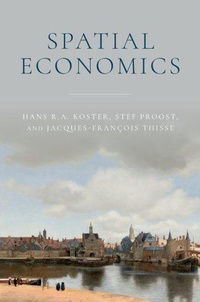
Spatial Economics
Published on 26. May 2026
Book
Hardback
530 pages
978-0-19-782469-6 (ISBN)
Description
An authoritative and cutting-edge exploration of how land, transportation, and economic forces shape cities, regions, and the distribution of economic activities from a local to a global scale.
Land, by its very nature, is immobile and unproduced, creating competition for prime locations that drives disparities in economic outcomes. Transportation, meanwhile, serves as the mechanism for overcoming spatial frictions but imposes costs that influence where firms and individuals choose to locate. Together, these factors explain the emergence and persistence of cities, regional disparities, and even global patterns of economic concentration. In Spatial Economics, Hans R.A. Koster, Stef Proost, and Jacques-Francois Thisse explore how cities, regions, and the global economy are shaped by the interplay between location, land use, and transportation. The authors examine why economic activities are clustered in large metropolitan areas and dispersed in vast areas, driven by the balance between the gains from concentration and various congestion and pollution costs. Blending classical theories with modern data and modeling approaches, the book addresses urbanization, spatial inequality, and the effects of policies like infrastructure investments and land regulations. Accessible yet rigorous, it offers valuable insights for understanding the geographic organization of economic activity in today's interconnected world.
Land, by its very nature, is immobile and unproduced, creating competition for prime locations that drives disparities in economic outcomes. Transportation, meanwhile, serves as the mechanism for overcoming spatial frictions but imposes costs that influence where firms and individuals choose to locate. Together, these factors explain the emergence and persistence of cities, regional disparities, and even global patterns of economic concentration. In Spatial Economics, Hans R.A. Koster, Stef Proost, and Jacques-Francois Thisse explore how cities, regions, and the global economy are shaped by the interplay between location, land use, and transportation. The authors examine why economic activities are clustered in large metropolitan areas and dispersed in vast areas, driven by the balance between the gains from concentration and various congestion and pollution costs. Blending classical theories with modern data and modeling approaches, the book addresses urbanization, spatial inequality, and the effects of policies like infrastructure investments and land regulations. Accessible yet rigorous, it offers valuable insights for understanding the geographic organization of economic activity in today's interconnected world.
More details
Language
English
Place of publication
New York
United States
Target group
College/higher education
Product notice
sewn/stitched
Cloth over boards
Illustrations
55 b/w figures; 41 tables
Dimensions
Height: 234 mm
Width: 156 mm
Thickness: 33 mm
Weight
916 gr
ISBN-13
978-0-19-782469-6 (9780197824696)
Copyright in bibliographic data and cover images is held by Nielsen Book Services Limited or by the publishers or by their respective licensors: all rights reserved.
Schweitzer Classification
Other editions
Additional editions
Hans R. A. Koster | Stef Proost | Jacques-Francois Thisse
Spatial Economics
Book
approx. 08/2026
Oxford University Press Inc
€57.50
Not yet published
Persons
Hans R.A. Koster is Professor of Urban Economics and Real Estate at Vrije Universiteit Amsterdam and an urban economist focusing on housing markets, urban spatial structure, spatial inequality, and regional policies. He teaches courses on applied econometrics, spatial and urban economics and serves as associate editor at Regional Science and Urban Economics. His work has appeared in leading journals and has earned several awards.
Stef Proost is Professor Emeritus at KULeuven, where he taught Environmental, Energy and Transport economics to engineers and economists. His research focuses on tax reform, climate change, and political economics of transport pricing and investment. He was visiting professor at several universities in the US, France, Germany, and Sweden.
Jacques-Francois Thisse is Professor Emeritus at UC Louvain. A Fellow of the Econometric Society and the Regional Science Association International, he has published over 200 articles in scientific journals and in
different fields such as industrial organization, spatial and urban economics, trade and management science. He was awarded in 2024 the Founder's Medal of the Regional Science Association International.
Stef Proost is Professor Emeritus at KULeuven, where he taught Environmental, Energy and Transport economics to engineers and economists. His research focuses on tax reform, climate change, and political economics of transport pricing and investment. He was visiting professor at several universities in the US, France, Germany, and Sweden.
Jacques-Francois Thisse is Professor Emeritus at UC Louvain. A Fellow of the Econometric Society and the Regional Science Association International, he has published over 200 articles in scientific journals and in
different fields such as industrial organization, spatial and urban economics, trade and management science. He was awarded in 2024 the Founder's Medal of the Regional Science Association International.
Content
Acknowledgments Chapter 1: What is Spatial Economics About? Part I: Land and Transportation Chapter 2: The Agricultural Land Rent Chapter 3: Land is Back: The Urban Land Rent Chapter 4: Transportation and Trade Chapter 5: Urban Transportation Part II: Cities Chapter 6: The Producer City Chapter 7: The Consumer City: Retailing Chapter 8: The Consumer City: Local Public Goods Part III: Regions and Urban Systems Chapter 9: Regional Disparities: The Mobility of Firms Chapter 10: Regional disparities: The mobility of workers Chapter 11: Urban Systems Chapter 12: Skill Sorting Across Cities Chapter 13: Quantitative Spatial Economics Part IV: Spatial Policy Chapter 14: Cities and the Environment Chapter 15: Place-Based Policies Chapter 16: Land Use Regulation Bibliography Index