

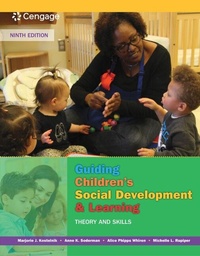
Guiding Children's Social Development and Learning
Theory and Skills
9th Edition
Published on 1. January 2017
Book
Paperback/Softback
576 pages
978-1-305-96075-6 (ISBN)
Description
Updated throughout and featuring an emphasis on NAEYC and other standards, GUIDING CHILDREN'S SOCIAL DEVELOPMENT AND LEARNING: THEORY AND SKILLS, Ninth Edition, focuses on ways professionals can help children develop both positive feelings about themselves and social competence. You'll find practical, developmentally appropriate strategies for how to work with children and families from many different backgrounds and circumstances, and in a variety of group settings. With the help of this text, you'll avoid much of the guesswork and frustration that can hinder practitioners' efforts to influence children's social development and behavior. And, you'll obtain a unified framework for decision-making and professional practice that incorporates sound principles of children's development, relationship enhancement, and behavior management. This is a book you'll want to keep and refer to long after you leave the course.
More details
Edition
9th edition
Language
English
Place of publication
Belmont, CA
United States
Publishing group
Cengage Learning, Inc
Target group
College/higher education
Product notice
Paperback (trade)
Unsewn / adhesive bound
Dimensions
Height: 274 mm
Width: 216 mm
Thickness: 23 mm
Weight
1157 gr
ISBN-13
978-1-305-96075-6 (9781305960756)
Copyright in bibliographic data and cover images is held by Nielsen Book Services Limited or by the publishers or by their respective licensors: all rights reserved.
Schweitzer Classification
Persons
Marjorie Kostelnik is dean of the College of Education and Human Sciences at the University of Nebraska, Lincoln. She entered the field of early childhood as a Head Start teacher before receiving her doctorate from the Pennsylvania State University. She was on the faculty at Michigan State University for 22 years, serving as director of the Child Development Laboratories, then as chair of the Department of Family and Child Ecology. Dr. Kostelnik has served as vice president of NAEYC, and was recently appointed to the National Academies of Science Institute of Medicine Committee to Study the Science of Children Birth to Age 8. Currently, she serves on the Dimensions Board (nature education for children), the Educare Board of Lincoln (infants, toddler, and preschool child care), and the City of Lincoln Prosper Committee for Early Education. Anne K. Soderman works internationally with schools in the area of early literacy and mathematics, assessment, and second language acquisition. Her research has been centered on gender differences as they relate to emerging literacy, particularly in children coming from diverse populations. Other recently co-authored publications include CREATING LITERACY-RICH PRESCHOOLS AND KINDERGARTENS and SCAFFOLDING EMERGENT LITERACY. Alice Whiren has taught kindergarten and preschool children, directed a center for children that serves a culturally and economically diverse population, and worked with families and children having special needs. Dr. Whiren has been a consultant to public schools and Head Start, and has taught at Michigan State University in child development and early education. Her publications are about social development and early childhood education, particularly in the area of play. Michelle Rupiper is an Associate Professor of Practice at the University of Nebraska-Lincoln. She has served as a classroom teacher for infants through school-aged children as well as directed community-based programs during her career. She frequently provides professional development and consults with early childhood programs on a variety of topics. She has been active in the state and regional affiliates of the National Association for the Education of Young Children (NAEYC) and has served on the NAEYC Affiliate Council and the National Coalition for Campus Children's Centers (NCCCC).
Content
1. Making a Difference in Children's Lives.
2. Good Beginnings: Establishing Positive Relationships with Infants and Toddlers.
3. Building Positive Relationships through Nonverbal Communication.
4. Promoting Children's Positive Sense of Self through Verbal Communication.
5. Supporting Children's Emotional Development and Learning.
6. Building Resilience in Children.
7. Play as a Context for Social Development and Learning.
8. Supporting Children's Peer Relationships and Friendships.
9. Influencing Children's Social Development by Structuring the Physical Environment.
10. Fostering Self-Regulation in Children: Communicating Expectations and Rules.
11. Fostering Self-Regulation in Children: and the Role of Consequences.
12. Handling Children's Aggressive Behavior.
13. Promoting Prosocial Behavior.
14. Fostering Healthy Attitudes about Sexuality and Diversity.
15. Making Ethical Judgments and Decisions.
2. Good Beginnings: Establishing Positive Relationships with Infants and Toddlers.
3. Building Positive Relationships through Nonverbal Communication.
4. Promoting Children's Positive Sense of Self through Verbal Communication.
5. Supporting Children's Emotional Development and Learning.
6. Building Resilience in Children.
7. Play as a Context for Social Development and Learning.
8. Supporting Children's Peer Relationships and Friendships.
9. Influencing Children's Social Development by Structuring the Physical Environment.
10. Fostering Self-Regulation in Children: Communicating Expectations and Rules.
11. Fostering Self-Regulation in Children: and the Role of Consequences.
12. Handling Children's Aggressive Behavior.
13. Promoting Prosocial Behavior.
14. Fostering Healthy Attitudes about Sexuality and Diversity.
15. Making Ethical Judgments and Decisions.