

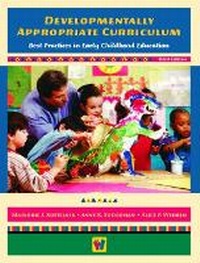
Developmentally Appropriate Curriculum
Best Practices in Early Childhood Education
3rd Edition
Published on 19. November 2003
Book
Paperback/Softback
528 pages
978-0-13-049658-4 (ISBN)
Description
For Curriculum in Early Childhood Education Courses.
This text brings together the best information available on developing an integrated, holistic approach to curriculum and instruction for children age three to eight in such formal group settings as childcare, pre-school, and the early elementary grades. Concentrating as much on the "how" of curriculum development as on the "what and why," the authors present numerous examples and practical, research-based guidelines-organized by developmental domain-for translating theory into best practice that accommodates age-appropriateness, individual differences, and social and cultural diversity. A unique field-tested observation tool in the Instructor's Manual supplies critical feedback during students' classroom sessions.
This text brings together the best information available on developing an integrated, holistic approach to curriculum and instruction for children age three to eight in such formal group settings as childcare, pre-school, and the early elementary grades. Concentrating as much on the "how" of curriculum development as on the "what and why," the authors present numerous examples and practical, research-based guidelines-organized by developmental domain-for translating theory into best practice that accommodates age-appropriateness, individual differences, and social and cultural diversity. A unique field-tested observation tool in the Instructor's Manual supplies critical feedback during students' classroom sessions.
More details
Edition
3rd edition
Language
English
Place of publication
United States
Publishing group
Pearson Education (US)
Target group
Professional and scholarly
Weight
1084 gr
ISBN-13
978-0-13-049658-4 (9780130496584)
Copyright in bibliographic data and cover images is held by Nielsen Book Services Limited or by the publishers or by their respective licensors: all rights reserved.
Schweitzer Classification
Other editions
New editions
Marjorie J. Kostelnik | Anne K. Soderman | Alice P. Whiren
Developmentally Appropriate Curriculum
Best Practices in Early Childhood Education
Book
10/2006
4th Edition
Pearson
€71.79
Article exhausted; check for reprint
Previous edition

Marjorie J. Kostelnik | Anne K. Soderman | Alice P. Whiren
Developmentally Appropriate Curriculum
Best Practices in Early Childhood Education
Book
11/1998
2nd Edition
Pearson
€38.37
Article exhausted; check for reprint
Content
Introduction.
I. FOUNDATIONS OF EARLY CHILDHOOD EDUCATION.
1. Developmentally Appropriate Practice: An Evolving Framework for Teaching Young Children.
2. Principles of Development and Learning: Implications for Effective Teaching.
II. SETTING THE STAGE FOR LEARNING.
3. Planning and Implementing Effective Small-Group Activities.
4. Planning and Implementing Effective Whole-Group Activities.
5. Organizing Space, Materials, Time, and Children's Groups.
6. Promoting Self-Discipline in Children.
7. Evaluating and Guiding Children's Progress by Using Authentic Assessment.
8. Strengthening Developmentally Appropriate Programs Through Family Involvement.
III. THE CURRICULUM.
9. The Aesthetic Domain.
10. The Affective Domain.
11. The Cognitive Domain.
12. The Language Domain.
13. The Physical Domain.
14. The Social Domain.
IV. INTEGRATING CURRICULUM.
15. Integrating Curriculum Through Pretend and Construction Play.
16. Integrating Curriculum by Using Themes and Projects.
Appendix: Sample Lesson Plans.
References.
Author Index.
Subject Index.
I. FOUNDATIONS OF EARLY CHILDHOOD EDUCATION.
1. Developmentally Appropriate Practice: An Evolving Framework for Teaching Young Children.
2. Principles of Development and Learning: Implications for Effective Teaching.
II. SETTING THE STAGE FOR LEARNING.
3. Planning and Implementing Effective Small-Group Activities.
4. Planning and Implementing Effective Whole-Group Activities.
5. Organizing Space, Materials, Time, and Children's Groups.
6. Promoting Self-Discipline in Children.
7. Evaluating and Guiding Children's Progress by Using Authentic Assessment.
8. Strengthening Developmentally Appropriate Programs Through Family Involvement.
III. THE CURRICULUM.
9. The Aesthetic Domain.
10. The Affective Domain.
11. The Cognitive Domain.
12. The Language Domain.
13. The Physical Domain.
14. The Social Domain.
IV. INTEGRATING CURRICULUM.
15. Integrating Curriculum Through Pretend and Construction Play.
16. Integrating Curriculum by Using Themes and Projects.
Appendix: Sample Lesson Plans.
References.
Author Index.
Subject Index.