

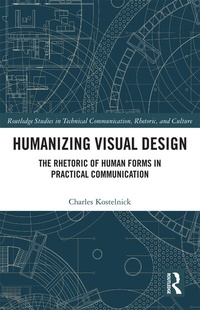
Humanizing Visual Design
The Rhetoric of Human Forms in Practical Communication
1st Edition
Published on 18. December 2020
Book
Paperback/Softback
280 pages
978-0-367-73096-3 (ISBN)
Description
This book analyzes the role that human forms play in visualizing practical information and in making that information understandable, accessible, inviting, and meaningful to readers-in short, "humanizing" it.
Although human figures have long been deployed in practical communication, their uses in this context have received little systematic analysis. Drawing on rhetorical theory, art history, design studies, and historical and contemporary examples, the book explores the many rhetorical purposes that human forms play in functional pictures, including empowering readers, narrating processes, invoking social and cultural identities, fostering pathos appeals, and visualizing data.
The book is aimed at scholars, teachers, and practitioners in business, technical, and professional communication as well as an interdisciplinary audience in rhetoric, art and design, journalism, engineering, marketing, science, and history.
Although human figures have long been deployed in practical communication, their uses in this context have received little systematic analysis. Drawing on rhetorical theory, art history, design studies, and historical and contemporary examples, the book explores the many rhetorical purposes that human forms play in functional pictures, including empowering readers, narrating processes, invoking social and cultural identities, fostering pathos appeals, and visualizing data.
The book is aimed at scholars, teachers, and practitioners in business, technical, and professional communication as well as an interdisciplinary audience in rhetoric, art and design, journalism, engineering, marketing, science, and history.
Reviews / Votes
"The Visual Rhetoric of Human Forms in Practical Communication is destined to become an essential book for anyone serious about the study of the human figure in functional communication. Drawing on a wide range of historical and contemporary images, Charles Kostelnick argues persuasively that human figures in design are essential to understanding processes and stories." -Marguerite Helmers, Defining Visual RhetoricsMore details
Series
Language
English
Place of publication
London
United Kingdom
Publishing group
Taylor & Francis Ltd
Target group
College/higher education
Postgraduate and Undergraduate
Dimensions
Height: 229 mm
Width: 152 mm
Weight
550 gr
ISBN-13
978-0-367-73096-3 (9780367730963)
Copyright in bibliographic data and cover images is held by Nielsen Book Services Limited or by the publishers or by their respective licensors: all rights reserved.
Schweitzer Classification
Other editions
Additional editions
Book
04/2019
1st Edition
Routledge
€208.10
Shipment within 10-20 days
E-Book
03/2019
1st Edition
Routledge
€60.49
Available for download
E-Book
03/2019
1st Edition
Routledge
€60.49
Available for download
Person
Charles Kostelnick is Professor of English at Iowa State University, USA
Content
Introduction
1. Foundations for Picturing Human Forms: Conventions, Historical Context, and the Confluence of the Fine and Applied Arts
2. Human Forms in Action: Agency and Empowerment, both Individual and Collective
3. Animating Visual Narratives with Agency: Temporality, Pictures, and Human Forms
4. Figures in Cultural Context: Envisioning Identity with Human Forms
5. Emotional Appeals in Picturing People: The Rhetoric of Equanimity and Distress
6. Humanizing Data Visualization: The Rhetorical Dynamics of Designing Data with Human Forms
Conclusion/Epilogue
1. Foundations for Picturing Human Forms: Conventions, Historical Context, and the Confluence of the Fine and Applied Arts
2. Human Forms in Action: Agency and Empowerment, both Individual and Collective
3. Animating Visual Narratives with Agency: Temporality, Pictures, and Human Forms
4. Figures in Cultural Context: Envisioning Identity with Human Forms
5. Emotional Appeals in Picturing People: The Rhetoric of Equanimity and Distress
6. Humanizing Data Visualization: The Rhetorical Dynamics of Designing Data with Human Forms
Conclusion/Epilogue