

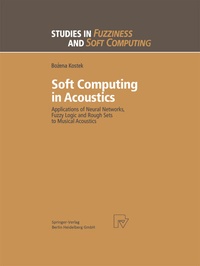
Soft Computing in Acoustics
Applications of Neural Networks, Fuzzy Logic and Rough Sets to Musical Acoustics
Published on 18. April 2014
Book
Paperback/Softback
XV, 244 pages
978-3-662-13005-6 (ISBN)
Description
Applications of some selected soft computing methods to acoustics and sound engineering are presented in this book. The aim of this research study is the implementation of soft computing methods to musical signal analysis and to the recognition of musical sounds and phrases. Accordingly, some methods based on such learning algorithms as neural networks, rough sets and fuzzy-logic were conceived, implemented and tested. Additionally, the above-mentioned methods were applied to the analysis and verification of subjective testing results. The last problem discussed within the framework of this book was the problem of fuzzy control of the classical pipe organ instrument.
The obtained results show that computational intelligence and soft computing may be used for solving some vital problems in both musical and architectural acoustics.
The obtained results show that computational intelligence and soft computing may be used for solving some vital problems in both musical and architectural acoustics.
More details
Series
Language
English
Place of publication
Heidelberg
Germany
Target group
Professional and scholarly
Research
Illustrations
XV, 244 p.
Dimensions
Height: 279 mm
Width: 210 mm
Thickness: 15 mm
Weight
652 gr
ISBN-13
978-3-662-13005-6 (9783662130056)
DOI
10.1007/978-3-7908-1875-8
Schweitzer Classification
Other editions
Additional editions
Bozena Kostek
Soft Computing in Acoustics
Applications of Neural Networks, Fuzzy Logic and Rough Sets to Musical Acoustics
Book
03/1999
Physica
€106.99
Shipment within 10-15 days
Content
1. Introduction.- 2. Some Selected Soft Computing Tools and Techniques.- 3. Preprocessing of Acoustical Data.- 4. Automatic Classification of Musical Instrument Sounds.- 5. Automatic Recognition of Musical Phrases.- 6. Intelligent Processing of Test Results.- 7. Control Applications.- 8. Conclusions.- 9. References.