

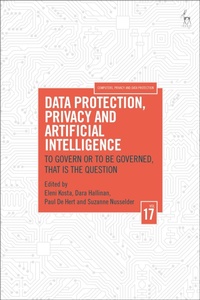
Data Protection, Privacy and Artificial Intelligence, Volume 17
To Govern or To Be Governed, That Is the Question
Published on 1. May 2025
Book
Hardback
328 pages
978-1-5099-8401-5 (ISBN)
Description
This book examines the discourse and developments surrounding privacy and data protection in the digital realm, featuring papers and discussions from the 2024 CPDP.ai international conference.
The question of governance-whether to lead or be led-has never been more relevant. Thus, the book not only addresses privacy and data protection, but also highlights issues related to the governance of artificial intelligence and the regulatory changes introduced by the EU AI Act.
The book features comprehensive discussions on the adequacy and effectiveness of the governance mechanisms established by the EU AI Act, particularly emphasising standardisation, co-regulation, and human oversight, while also identifying existing gaps in protection. Additionally, it pays special attention to the risks to fundamental rights associated with AI usage by law enforcement agencies, examining whether the current legal framework sufficiently safeguards against these risks. Finally, the book provides an in-depth exploration of deepnude and deepfake technology that generates nude images, as well as the role of AI in the EU's migration management systems.
The chapters in this book provide readers with an opportunity to explore the challenges and developments related to privacy, data protection, and artificial intelligence. By presenting academic insights alongside contributions from practitioners, civil society, and the European Data Protection Supervisor, this interdisciplinary volume encapsulates the essence of the CPDP.ai 2024 conference.
The question of governance-whether to lead or be led-has never been more relevant. Thus, the book not only addresses privacy and data protection, but also highlights issues related to the governance of artificial intelligence and the regulatory changes introduced by the EU AI Act.
The book features comprehensive discussions on the adequacy and effectiveness of the governance mechanisms established by the EU AI Act, particularly emphasising standardisation, co-regulation, and human oversight, while also identifying existing gaps in protection. Additionally, it pays special attention to the risks to fundamental rights associated with AI usage by law enforcement agencies, examining whether the current legal framework sufficiently safeguards against these risks. Finally, the book provides an in-depth exploration of deepnude and deepfake technology that generates nude images, as well as the role of AI in the EU's migration management systems.
The chapters in this book provide readers with an opportunity to explore the challenges and developments related to privacy, data protection, and artificial intelligence. By presenting academic insights alongside contributions from practitioners, civil society, and the European Data Protection Supervisor, this interdisciplinary volume encapsulates the essence of the CPDP.ai 2024 conference.
More details
Series
Language
English
Place of publication
Oxford
United Kingdom
Publishing group
Bloomsbury Publishing PLC
Target group
Professional and scholarly
College/higher education
Product notice
sewn/stitched
Cloth over boards
With dust jacket
Dimensions
Height: 238 mm
Width: 158 mm
Thickness: 29 mm
Weight
650 gr
ISBN-13
978-1-5099-8401-5 (9781509984015)
Copyright in bibliographic data and cover images is held by Nielsen Book Services Limited or by the publishers or by their respective licensors: all rights reserved.
Schweitzer Classification
Persons
Eleni Kosta is Professor of Technology Law and Human Rights at Tilburg University's Institute for Law, Technology and Society (TILT), the Netherlands.
Dara Hallinan is a Legal Academic at FIZ Karlsruhe, Germany.
Paul De Hert is Professor of Law at Vrije Universiteit Brussel, Belgium.
Suzanne Nusselder is a PhD Researcher at Tilburg University's Institute for Law, Technology and Society (TILT), the Netherlands.
Dara Hallinan is a Legal Academic at FIZ Karlsruhe, Germany.
Paul De Hert is Professor of Law at Vrije Universiteit Brussel, Belgium.
Suzanne Nusselder is a PhD Researcher at Tilburg University's Institute for Law, Technology and Society (TILT), the Netherlands.
Content
Part 1: Visual identity of CPDP.ai 2024
1. Behind the Visual Identity of CPDP.ai 2024, Vladan Joler (University of Novi Sad, Serbia)
Part 2: Academic Papers
2. The Scourge of Deepnude Applications: A Fundamental Rights Perspective, Aurelie Gilen (University of Antwerp, Belgium), Catherine Van de Heyning (University of Antwerp, Belgium) and Michel Walrave (University of Antwerp, Belgium)
3. AI Risk Assessments in EU Large-Scale IT Systems for Third-country Nationals and Access to Remedies: A Bumpy Road Ahead, Alexandra Karaiskou (European University Institute, Greece) and Niovi Vavoula (University of Luxembourg)
4. Complex Normativity: Understanding the Relationship between Human Oversight by Design and Standardization in the Context of AI Development and Deployment, Liane Colonna (Stockholm University, Sweden)
5. The Semi-perfect AI Act - A Missed Opportunity for Human Rights Centred Approach to AI and the Case of Facial Recognition, Anze Erbeznik (European Faculty of Law, Slovenia)
6. Artificial Intelligence and Employment Law: Through a Canadian Lens, Fife Ogunde (Government of Saskatchewan, Canada)
7. From Human Agency to Meaningful Human Oversight? Mapping the Opportunities and Pitfalls in the Decision-Making Process of Place-Based Big Data Policing, Naomi Theinert (BIGDATPOL, Belgium), Robin Khalfa (BIGDATPOL, Belgium) and Wim Hardyns (Ghent University, Belgium)
8. The AI Act as a Safeguard for Equality of Arms in Data-driven Criminal Investigations, Johan van Banning (Vrije Universiteit Amsterdam, the Netherlands)
9. Assessing the Risks of Emotion Recognition Technology in Domestic Security Settings: What Safeguards against the Rise of "Emotional Dominance"? Francesco Paolo Levantino (Sant'Anna School of Advanced Studies, Italy)
Part 3: Practitioners' Corner
10. Legislative Lag vs Technological Leap: Privacy and Data Protection Challenges when Using AI-Driven Workplace Solutions, S Ezgi Ercan (Timelex, Belgium) and Geert Somers (Timelex, Belgium)
11. Brick by Brick: What Will it Take to Centre People, the Planet and Democracy in our Digital Futures? Shubham Kaushik (EDRi, Belgium)
Part 4: EDPS Closing Remarks
12. Devising a Trajectory towards a Just and Fair Future: The Identity of Data Protection in Times of AI, Wojciech Wiewiorowski (European Data Protection Supervisor, Poland)
1. Behind the Visual Identity of CPDP.ai 2024, Vladan Joler (University of Novi Sad, Serbia)
Part 2: Academic Papers
2. The Scourge of Deepnude Applications: A Fundamental Rights Perspective, Aurelie Gilen (University of Antwerp, Belgium), Catherine Van de Heyning (University of Antwerp, Belgium) and Michel Walrave (University of Antwerp, Belgium)
3. AI Risk Assessments in EU Large-Scale IT Systems for Third-country Nationals and Access to Remedies: A Bumpy Road Ahead, Alexandra Karaiskou (European University Institute, Greece) and Niovi Vavoula (University of Luxembourg)
4. Complex Normativity: Understanding the Relationship between Human Oversight by Design and Standardization in the Context of AI Development and Deployment, Liane Colonna (Stockholm University, Sweden)
5. The Semi-perfect AI Act - A Missed Opportunity for Human Rights Centred Approach to AI and the Case of Facial Recognition, Anze Erbeznik (European Faculty of Law, Slovenia)
6. Artificial Intelligence and Employment Law: Through a Canadian Lens, Fife Ogunde (Government of Saskatchewan, Canada)
7. From Human Agency to Meaningful Human Oversight? Mapping the Opportunities and Pitfalls in the Decision-Making Process of Place-Based Big Data Policing, Naomi Theinert (BIGDATPOL, Belgium), Robin Khalfa (BIGDATPOL, Belgium) and Wim Hardyns (Ghent University, Belgium)
8. The AI Act as a Safeguard for Equality of Arms in Data-driven Criminal Investigations, Johan van Banning (Vrije Universiteit Amsterdam, the Netherlands)
9. Assessing the Risks of Emotion Recognition Technology in Domestic Security Settings: What Safeguards against the Rise of "Emotional Dominance"? Francesco Paolo Levantino (Sant'Anna School of Advanced Studies, Italy)
Part 3: Practitioners' Corner
10. Legislative Lag vs Technological Leap: Privacy and Data Protection Challenges when Using AI-Driven Workplace Solutions, S Ezgi Ercan (Timelex, Belgium) and Geert Somers (Timelex, Belgium)
11. Brick by Brick: What Will it Take to Centre People, the Planet and Democracy in our Digital Futures? Shubham Kaushik (EDRi, Belgium)
Part 4: EDPS Closing Remarks
12. Devising a Trajectory towards a Just and Fair Future: The Identity of Data Protection in Times of AI, Wojciech Wiewiorowski (European Data Protection Supervisor, Poland)