

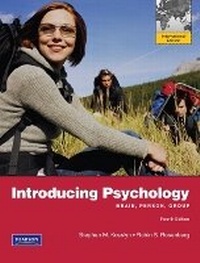
Introducing Psychology
Brain, Person, Group: International Edition
4th Edition
Published on 6. January 2011
Book
Paperback/Softback
640 pages
978-0-205-00568-0 (ISBN)
Description
This innovative, 13-chapter text examines psychological issues from the levels of the brain, person, and social world to help students actively apply psychology to their lives. Offered in digital format or on-demand custom format.
Through their own research, clinical work, and experiences as teachers, Stephen Kosslyn and Robin Rosenberg have found that exploring psychology from multiple perspectives further enhances learning. Examining psychological concepts from the levels of the brain (biological factors), the person (beliefs, desires, and feelings), and the world (social, cultural, and environmental factors) and their interactions helps students organize and integrate topics within and across chapters and actively apply psychology to their lives.
Through their own research, clinical work, and experiences as teachers, Stephen Kosslyn and Robin Rosenberg have found that exploring psychology from multiple perspectives further enhances learning. Examining psychological concepts from the levels of the brain (biological factors), the person (beliefs, desires, and feelings), and the world (social, cultural, and environmental factors) and their interactions helps students organize and integrate topics within and across chapters and actively apply psychology to their lives.
More details
Edition
4th edition
Language
English
Place of publication
United States
Publishing group
Pearson Education (US)
Target group
College/higher education
Dimensions
Height: 279 mm
Width: 215 mm
Thickness: 20 mm
Weight
1140 gr
ISBN-13
978-0-205-00568-0 (9780205005680)
Copyright in bibliographic data is held by Nielsen Book Services Limited or its licensors: all rights reserved.
Schweitzer Classification
Other editions
New editions
Book
11/2013
Pearson Education Limited
€96.74
Shipment within 10-20 days
Previous edition
Book
01/2011
Pearson
€147.06
Article exhausted; check for reprint
Persons
Stephen M. Kosslyn is formerly Chair of the Department of Psychology, Dean of Social Science, and John Lindsley Professor of Psychology in Memory of William James at Harvard University, as well as Associate Psychologist in the Department of Neurology at Massachusetts General Hospital. He is now professor of psychology and Director of the Center for Advanced Study in the Behavioral Sciences at Stanford University. He received his B.A. from UCLA and his Ph.D. from Stanford University, both in psychology. His research has focused primarily on the nature of visual mental imagery and visual communication, and he has published 9 books and over 300 papers on these topics. For ten years he was "head tutor" at Harvard, supervising graduate students who were teaching year-long introductory psychology courses using the levels-of-analysis approach. While actively engaged with writing and academic pursuits, Dr. Kosslyn is currently on the editorial boards of many professional journals. In his ample spare time, he takes French lessons and plays bass guitar.
Robin S. Rosenberg is a clinical psychologist in private practice and has taught psychology courses at Lesley University and Harvard University. She is board certified in clinical psychology by the American Board of Professional Psychology and has been certified in hypnosis. She is a fellow of the American Academy of Clinical Psychology and is a member of the Academy for Eating Disorders. She received her B.A. in psychology from New York University and her M.A. and Ph.D. in clinical psychology from the University of Maryland, College Park. Dr. Rosenberg did her clinical internship at Massachusetts Mental Health Center, had a postdoctoral fellowship at Harvard Community Health Plan, and was on the staff at Newton-Wellesley Hospital's Outpatient Services. Dr. Rosenberg specializes in treating people with eating disorders, anxiety, and depression. Dr. Rosenberg also writes and speaks about how superhero stories reveal psychological phenomena (she is series editor of the Oxford Superhero Series) and she can sometimes be found at comic book conventions. And when the opportunity arises, she also sings and plays guitar.
Robin S. Rosenberg is a clinical psychologist in private practice and has taught psychology courses at Lesley University and Harvard University. She is board certified in clinical psychology by the American Board of Professional Psychology and has been certified in hypnosis. She is a fellow of the American Academy of Clinical Psychology and is a member of the Academy for Eating Disorders. She received her B.A. in psychology from New York University and her M.A. and Ph.D. in clinical psychology from the University of Maryland, College Park. Dr. Rosenberg did her clinical internship at Massachusetts Mental Health Center, had a postdoctoral fellowship at Harvard Community Health Plan, and was on the staff at Newton-Wellesley Hospital's Outpatient Services. Dr. Rosenberg specializes in treating people with eating disorders, anxiety, and depression. Dr. Rosenberg also writes and speaks about how superhero stories reveal psychological phenomena (she is series editor of the Oxford Superhero Series) and she can sometimes be found at comic book conventions. And when the opportunity arises, she also sings and plays guitar.
Content
BRIEF TOC:
Chapter 1: Introduction to the Science of Psychology: History and Research Methods
Chapter 2: The Biology of Mind and Behavior: The Brain in Action
Chapter 3: Sensation and Perception: How the World Enters the Mind
Chapter 4: Learning: How Experience Changes Us
Chapter 5: Memory: Living With Yesterday
Chapter 6: Language, Thinking, and Intelligence: What Humans Do Best
Chapter 7: Emotion and Motivation: Feeling and Striving
Chapter 8: Personality: Vive La Difference!
Chapter 9: Psychology Over the Life Span: Growing Up, Growing Older, Growing Wiser
Chapter 10: Stress, Health, and Coping: Dealing With Life
Chapter 11: Psychological Disorders: More Than Everyday Problems
Chapter 12: Treatment: Healing Actions, Healing Words
Chapter 13: Social Psychology: Meeting of the Minds
Appendices: Statistics/How to Think about Research Studies
Chapter 1: Introduction to the Science of Psychology: History and Research Methods
Chapter 2: The Biology of Mind and Behavior: The Brain in Action
Chapter 3: Sensation and Perception: How the World Enters the Mind
Chapter 4: Learning: How Experience Changes Us
Chapter 5: Memory: Living With Yesterday
Chapter 6: Language, Thinking, and Intelligence: What Humans Do Best
Chapter 7: Emotion and Motivation: Feeling and Striving
Chapter 8: Personality: Vive La Difference!
Chapter 9: Psychology Over the Life Span: Growing Up, Growing Older, Growing Wiser
Chapter 10: Stress, Health, and Coping: Dealing With Life
Chapter 11: Psychological Disorders: More Than Everyday Problems
Chapter 12: Treatment: Healing Actions, Healing Words
Chapter 13: Social Psychology: Meeting of the Minds
Appendices: Statistics/How to Think about Research Studies