

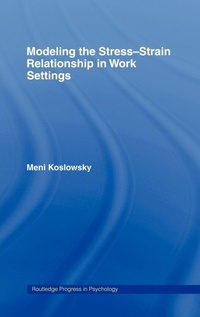
Modelling the Stress-Strain Relationship in Work Settings
1st Edition
Published on 4. June 1998
Book
Hardback
240 pages
978-0-415-15320-1 (ISBN)
Description
Meni Koslowsky presents here for the first time a way of modelling stress-strain that will enable researchers to both assess examples from the literature and correctly define and use the model in their own investigations. All stages from construction of the model to data analysis are covered, along with possible pitfalls.
This book enables investigators to develop and test models for describing stress phenomena in their own settings. It provides an essential research tool for all those who assess stress and strain in their working lives.
This book enables investigators to develop and test models for describing stress phenomena in their own settings. It provides an essential research tool for all those who assess stress and strain in their working lives.
More details
Series
Language
English
Place of publication
London
United Kingdom
Publishing group
Taylor & Francis Ltd
Target group
College/higher education
Illustrations
10 s/w Tabellen
10 Tables, black and white
Dimensions
Height: 240 mm
Width: 161 mm
Thickness: 17 mm
Weight
517 gr
ISBN-13
978-0-415-15320-1 (9780415153201)
Copyright in bibliographic data and cover images is held by Nielsen Book Services Limited or by the publishers or by their respective licensors: all rights reserved.
Schweitzer Classification
Other editions
Additional editions
Meni Koslowsky
Modelling the Stress-Strain Relationship in Work Settings
E-Book
02/2008
Routledge
€60.49
Available for download
Meni Koslowsky
Modelling the Stress-Strain Relationship in Work Settings
E-Book
02/2008
1st Edition
Routledge
€60.99
Available for download
Person
Meni Koslowsky is Associate Professor of Psychology at Bar-Ilan University, Israel. His previous publications include Commuting Stress: Causes, Effects and Methods of Coping (with A. N. Kluger and M. Reich) (1995)
Content
1 Introduction 2 Theories of organizational stress 3 Stressors 4 Extra-organizational stressors 5 Stress assessment instruments 6 Psychological and physiological reactions 7 Behavioral consequences of stress 8 Mediators and moderators 9 Modeling the stress-strain process 10 General methodological issues