

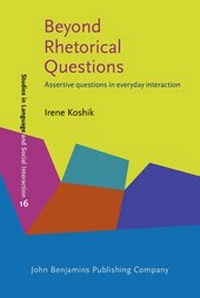
Beyond Rhetorical Questions
Assertive questions in everyday interaction
Published on 26. May 2005
Book
Hardback
183 pages
978-90-272-2626-6 (ISBN)
Description
This book uses Conversation Analysis methodology to analyze rhetorical and other questions that are designed to convey assertions, rather than seek new information. It shows how these question sequences unfold interactionally in naturally-occurring talk in a variety of settings, e.g., friends arguing over the phone, parents disciplining children, news interviews, and second language writing conferences. The questions are used across these widely different contexts to perform a number of related social actions such as accusations, challenges to prior turns, and complaints. Those used in institution settings, such as teacher-student conferences, orient to institutional norms and roles and can help accomplish institutional goals, e.g., eliciting student error correction. Both the interactional context in which these questions are embedded and the known epistemic authority of the questioner play a role in our understanding of these questions, i.e., what social actions the question is accomplishing in a particular interaction.
More details
Series
Language
English
Place of publication
Amsterdam
Netherlands
Target group
Professional and scholarly
Dimensions
Height: 245 mm
Width: 164 mm
Weight
520 gr
ISBN-13
978-90-272-2626-6 (9789027226266)
Copyright in bibliographic data and cover images is held by Nielsen Book Services Limited or by the publishers or by their respective licensors: all rights reserved.
Schweitzer Classification
Other editions
Additional editions
E-Book
05/2005
1st Edition
John Benjamins Publishing Company
€130.99
Available for download
Person
Content
1. Acknowledgments; 2. 1. Introduction; 3. 2. Yes/No Reversed Polarity Questions; 4. 3. Wh- Reversed Polarity Questions; 5. 4. Yes/No Reversed Polarity Questions Used in Pedagogically Specific Practices; 6. 5. Alternative Question Error Correction Sequences; 7. 6. Conclusion; 8. Appendix: Transcription Symbols; 9. Notes; 10. References; 11. Name index; 12. Subject index