

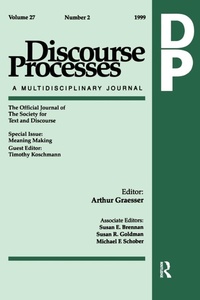
Meaning Making
A Special Issue of Discourse Processes
Published on 1. September 1999
Book
Paperback/Softback
142 pages
978-0-8058-9805-7 (ISBN)
Description
This special issue focuses on the difficult problem of how observers and researchers can make sense of how collaborating participants develop a shared understanding both of their task and their own participation in it. Or stated in another way, how can we derive meaning from their emergent and situated meaning making? Meaning making has been studied under a variety of names, and can be conceptualized on different levels of abstraction and from a variety of perspectives. The goal is to attempt to tease apart some of these views, while at the same time seeking means to bring them together in order to provide a more fully elaborated picture. This issue comes with downloadable resources containing the brief video segment which all authors analyzed in the preparation of their contributions.
More details
Language
English
Place of publication
New York
United States
Publishing group
Taylor & Francis Inc
Target group
College/higher education
Professional and scholarly
Dimensions
Height: 229 mm
Width: 152 mm
Thickness: 8 mm
Weight
217 gr
ISBN-13
978-0-8058-9805-7 (9780805898057)
Copyright in bibliographic data and cover images is held by Nielsen Book Services Limited or by the publishers or by their respective licensors: all rights reserved.
Schweitzer Classification
Other editions
Additional editions
E-Book
12/2018
1st Edition
Routledge
€39.49
Available for download
E-Book
12/2018
1st Edition
Routledge
€39.49
Available for download
Person
Timothy Koschmann
Content
Volume 27, Number 2, 1999. Contents: T. Koschmann, Editor's Introduction:The Edge of Many Circles: Making Meaning of Meaning Making. Analyses: P.J. Glenn, T. Koschmann, M. Conlee, Theory Presentation and Assessment in a Problem-Based Learning Group. C.H. Frederiksen, Learning to Reason Through Discourse in a Problem-Based Learning Group. A.S. Palincsar, Applying a Sociocultural Lens to the Work of a Transition Community. J.L. Lemke, Typological and Topological Meaning in Diagnostic Discourse. R. Hall, The Organization and Development of Discursive Practices for "Having a Theory." Commentaries: J.L. Green, M. McClelland, What Difference Does the Difference Make? Understanding Difference Across Perspectives. J. Roschelle, Transitioning to Professional Practice: A Deweyan View of Five Analyses of Problem-Based Learning.