

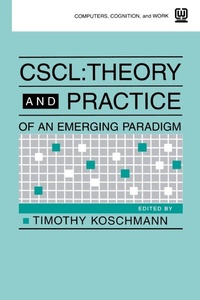
Cscl
Theory and Practice of An Emerging Paradigm
Published on 1. September 1996
Book
Paperback/Softback
368 pages
978-0-8058-1346-3 (ISBN)
Description
This book, about a newly emerging area of research in instructional technology, has as its title the acronym "CSCL." Initially, CSCL was chosen as an acronym for Computer-Supported Collaborative Learning. However, some would argue that "collaborative" is often not a descriptive term for what learners do in instructional settings; further, as the field develops, the technology used to support collaboration may not always involve computers, at least not in the direct ways they have been used to support instruction in the past. To avoid getting bogged down in this terminological debate, this book uses CSCL as a designation in its own right, leaving open to interpretation precisely what words it stands for.
The authors talk a great deal about the theory underlying their work. In part, this is because that is what they were asked to do, but it is also an indication of the state of the field. In an established paradigm in which the theories and methods are well agreed upon, such discussion is less central. CSCL, however, has not yet reached the stage of "normal" science. There is much to be worked out yet. This book is offered with the hope that it will help to define a direction for future work in this field.
The chapters appear in alphabetical order (except for the introductory chapter and the afterword) -- not for lack of a better way to organize the chapters, but rather because the organizational possibilities are too numerous and this order does not privilege one over another. By not imposing a topical organizing structure on this collection, it is hoped that readers will feel freer to explore the chapters in a way that best suits their needs.
COPY FOR BIND-CARD CD-ROM info ................................. There is an accompanying CD-Rom for this proceedings that will become available September 1998. Purchasers of the proceedings may obtain a copy of this CD-ROM at no cost by contacting Lawrence Erlbaum Associates, Inc. phone: (201) 236-9500 toll-free: 1-800-9-BOOKS-9 (1-800-926-6579) 9am-5pm EST fax: (201) 236-0072 e-mail: orders@erlbaum.com Web site: www.erlbaum.com address: 10 Industrial Avenue, Mahwah, NJ 07430-2262
The CD-ROM was funded through a grant from the National Science Foundation.
The authors talk a great deal about the theory underlying their work. In part, this is because that is what they were asked to do, but it is also an indication of the state of the field. In an established paradigm in which the theories and methods are well agreed upon, such discussion is less central. CSCL, however, has not yet reached the stage of "normal" science. There is much to be worked out yet. This book is offered with the hope that it will help to define a direction for future work in this field.
The chapters appear in alphabetical order (except for the introductory chapter and the afterword) -- not for lack of a better way to organize the chapters, but rather because the organizational possibilities are too numerous and this order does not privilege one over another. By not imposing a topical organizing structure on this collection, it is hoped that readers will feel freer to explore the chapters in a way that best suits their needs.
COPY FOR BIND-CARD CD-ROM info ................................. There is an accompanying CD-Rom for this proceedings that will become available September 1998. Purchasers of the proceedings may obtain a copy of this CD-ROM at no cost by contacting Lawrence Erlbaum Associates, Inc. phone: (201) 236-9500 toll-free: 1-800-9-BOOKS-9 (1-800-926-6579) 9am-5pm EST fax: (201) 236-0072 e-mail: orders@erlbaum.com Web site: www.erlbaum.com address: 10 Industrial Avenue, Mahwah, NJ 07430-2262
The CD-ROM was funded through a grant from the National Science Foundation.
Reviews / Votes
"...a strong presentation of a theoretical point of view and a good argument for the importance of theory in designing effective uses of technology."-Contemporary Psychology
More details
Language
English
Place of publication
New York
United States
Publishing group
Taylor & Francis Inc
Target group
College/higher education
Professional and scholarly
Dimensions
Height: 229 mm
Width: 152 mm
Thickness: 20 mm
Weight
533 gr
ISBN-13
978-0-8058-1346-3 (9780805813463)
Copyright in bibliographic data and cover images is held by Nielsen Book Services Limited or by the publishers or by their respective licensors: all rights reserved.
Schweitzer Classification
Other editions
Additional editions
E-Book
10/2012
1st Edition
Routledge
€81.99
Available for download
E-Book
10/2012
Routledge
€81.99
Available for download
Book
09/1996
Routledge
€230.45
Shipment within 10-20 days
Person
Timothy Koschmann
Content
Contents: Preface. T. Koschmann, Paradigm Shifts and Instructional Technology: An Introduction. P.J. Feltovich, R.J. Spiro, R.L. Coulson, J. Feltovich, Collaboration Within and Among Minds: Mastering Complexity, Individually and in Groups. S.V. Goldman, Mediating Microworlds: Collaboration on High School Science Activities. T. Koschmann, A.C. Kelson, P.J. Feltovich, H.S. Barrows, Computer-Supported Problem-Based Learning: A Principled Approach to the Use of Computers in Collaborative Learning. D. Morrison, B. Goldberg, New Actors, New Connections: The Role of Local Information Infrastructures in School Reform. C.M. Neuwirth, P.G. Wojahn, Learning to Write: Computer Support for a Cooperative Process. R.D. Pea, Seeing What We Build Together: Distributed Multimedia Learning Environments for Transformative Communications. M. Riel, Cross-Classroom Collaboration: Communication and Education. J. Roschelle, Learning by Collaborating: Convergent Conceptual Change. M. Scardamalia, C. Bereiter, Computer Support for Knowledge-Building Communities. E. Soloway, J.S. Krajcik, P. Blumenfeld, R. Marx, Technological Support for Teachers Transitioning to Project-Based Science Practices. J. Kolodner, M. Guzdial, Effects with and of CSCL: Tracking Learning in a New Paradigm.