

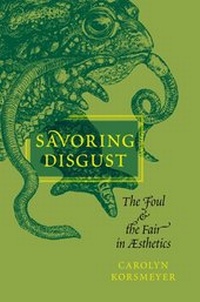
Savoring Disgust
The Foul and the Fair in Aesthetics
1st Edition
Published on 24. March 2011
Book
Hardback
208 pages
978-0-19-975694-0 (ISBN)
Description
Disgust is among the strongest of aversions, characterized by involuntary physical recoil and even nausea. Yet paradoxically, disgusting objects can sometimes exert a grisly allure, and this emotion can constitute a positive, appreciative aesthetic response when exploited by works of art -- a phenomenon labelled here "aesthetic disgust." While the reactive, visceral quality of disgust contributes to its misleading reputation as a relatively "primitive" response mechanism, it is this feature that also gives it a particular aesthetic power when manifest in art.
Most treatments of disgust mistakenly interpret it as only an extreme response, thereby neglecting the many subtle ways that it operates aesthetically. This study calls attention to the diversity and depth of its uses, analyzing the emotion in detail and considering the enormous variety of aesthetic forms it can assume in works of art and --unexpectedly-- even in foods.
In the process of articulating a positive role for disgust, this book examines the nature of aesthetic apprehension and argues for the distinctive mode of cognition that disgust affords -- an intimate apprehension of physical mortality. Despite some commonalities attached to the meaning of disgust, this emotion assumes many aesthetic forms: it can be funny, profound, witty, ironic, unsettling, sorrowful, or gross. To demonstrate this diversity, several chapters review examples of disgust as it is aroused by art. The book ends by investigating to what extent disgust can be discovered in art that is also considered beautiful.
Most treatments of disgust mistakenly interpret it as only an extreme response, thereby neglecting the many subtle ways that it operates aesthetically. This study calls attention to the diversity and depth of its uses, analyzing the emotion in detail and considering the enormous variety of aesthetic forms it can assume in works of art and --unexpectedly-- even in foods.
In the process of articulating a positive role for disgust, this book examines the nature of aesthetic apprehension and argues for the distinctive mode of cognition that disgust affords -- an intimate apprehension of physical mortality. Despite some commonalities attached to the meaning of disgust, this emotion assumes many aesthetic forms: it can be funny, profound, witty, ironic, unsettling, sorrowful, or gross. To demonstrate this diversity, several chapters review examples of disgust as it is aroused by art. The book ends by investigating to what extent disgust can be discovered in art that is also considered beautiful.
More details
Language
English
Place of publication
New York
United States
Target group
Professional and advanced students of philosophy, english, and cultural studies, as well as upper division and graduate philosophy courses in aesthetics and philosophy of art.
Dimensions
Height: 237 mm
Width: 236 mm
Thickness: 20 mm
Weight
454 gr
ISBN-13
978-0-19-975694-0 (9780199756940)
Copyright in bibliographic data and cover images is held by Nielsen Book Services Limited or by the publishers or by their respective licensors: all rights reserved.
Schweitzer Classification
Other editions
Additional editions
Book
03/2011
1st Edition
Oxford University Press Inc
€63.70
Shipment within 15-20 days
E-Book
03/2011
1st Edition
OUP eBook
€30.49
Available for download
E-Book
03/2011
1st Edition
OUP eBook
€30.49
Available for download
Person
Carolyn Korsmeyer is Professor of Philosophy at the University at Buffalo. She is the author of numerous works in philosophy, especially aesthetics and philosophy of art, including Making Sense of Taste: Food and Philosophy (1999) and Gender and Aesthetics: An Introduction (2004). She is a past president of the American Society for Aesthetics.
Content
Chapter 1 What Is Disgust? ; Chapter 2 Attractive Aversions ; Chapter 3 Delightful, Delicious, Disgusting ; Chapter 4 Varieties of Aesthetic Disgust ; Chapter 5 The Magnetism of Disgust ; Chapter 6 Hearts ; Chapter 7 The Foul and the Fair ; Bibliography