

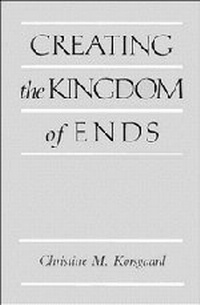
Creating the Kingdom of Ends
Published on 28. July 1996
Book
Hardback
462 pages
978-0-521-49644-5 (ISBN)
Description
Christine Korsgaard has become one of the leading interpreters of Kant's moral philosophy. She is identified with a small group of philosophers who are intent on producing a version of Kant's moral philosophy that is at once sensitive to its historical roots while revealing its particular relevance to contemporary problems. She rejects the traditional picture of Kant's ethics as a cold vision of the moral life which emphasises duty at the expense of love and value. Rather, Kant's work is seen as providing a resource for addressing not only the metaphysics of morals, but also for tackling practical questions about personal relations, politics, and everyday human interaction. This collection contains some of the finest current work on Kant's ethics and will command the attention of all those involved in teaching and studying moral theory.
Reviews / Votes
"This collection is essential for any student or teacher of Kantian ethics....She is excellent at conveying 'the big picture', at showing what makes Kant's approach distinctive and compelling." Lara Denis, Philosophy in Review "...this richly suggestive and ingeniously argued group of essays is a welcome addition to algrowing body literature that means to take Kant seriously without checking at the door common notions of decency and prudence." Susan Meld Shell, Review of Metaphysics "She writes with painstaking care, great intelligence and a powerful philosophical imagination. Her sights are often fruitfully turned against utilitarianism and what she sees as much modern ethics' `misguided emulation of science'.(pxii) Those who agree, as I do, with her rejection of these things can find in Kant's ethical writings an inexhaustible resource that her reading of them does much to illuminate. Those who do not would be foolish to ignore this impressive collection." James Lenman, Ethical Theory and Moral Practice "The papers in this book contain...the heart of Korsgaard's work: a variety of fresh and illuminating insights into Kant's moral theory and its relation to contemporary ethical theory which have helped to reshape the image of Kant's ethics and to refocus the issues dealt with in current moral philosophy." Allen W. Wood, The Philosophical Review "Clearly worth reprinting, Korsgaard's writing sparkles with original explanations and interpretations of Kant." International Studies in Philosophy, Sidney AxinnMore details
Language
English
Place of publication
Cambridge
United Kingdom
Target group
Professional and scholarly
Dimensions
Height: 236 mm
Width: 159 mm
Thickness: 29 mm
Weight
788 gr
ISBN-13
978-0-521-49644-5 (9780521496445)
Copyright in bibliographic data and cover images is held by Nielsen Book Services Limited or by the publishers or by their respective licensors: all rights reserved.
Schweitzer Classification
Other editions
New editions
Christine M. Korsgaard
Creating the Kingdom of Ends
Book
07/1996
Cambridge University Press
€48.30
Shipment within 15-20 days
Additional editions
Christine M. Korsgaard
Creating the Kingdom of Ends
Book
07/1996
Cambridge University Press
€48.30
Shipment within 15-20 days
Christine M. Korsgaard
Creating the Kingdom of Ends
E-Book
07/1996
1st Edition
Cambridge University Press
€35.49
Available for download
Person
Content
Part I. Kant's Moral Philosophy: 1. An introduction to the ethical, political, and religious thought of Kant; 2. Kant's analysis of obligation: the argument of Groundwork I; 3. Kant's formula of universal law; 4. Kant's formula of humanity; 5. The right to lie: Kant on dealing with evil; 6. Morality as freedom; 7. Creating the kingdom of ends: reciprocity and responsibility in personal relations; Part II. Comparative Essays: 8. Aristotle and Kant on the source of value; 9. Two distinctions in goodness; 10. The reasons we can share: an attack on the distinction between agent-relative and agent-neutral values; 11. Skepticism about practical reason; 12. Two arguments against lying; 13. Personal identity and the unity of agency: a Kantian response to Parfit.