

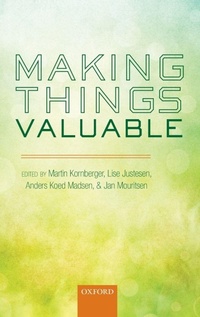
Making Things Valuable
Published on 13. August 2015
Book
Hardback
306 pages
978-0-19-871228-2 (ISBN)
Description
What if value is neither an intrinsic quality of an object, nor a reflection of a subjects preferencesbut rather something that is organized and brought into existence through mechanisms, technologies and practices of valuation?
This edited book addresses the question of valuation theoretically and through empirical analyses of diverse objects of valuations, such as university ranking lists, ice skating scoring, wind power, insurances, gold and big data. The theoretical inspiration is interdisciplinary and the volume brings together scholars from economic sociology, accounting, organization studies, and science and technology studies with the aim of understanding through which practices and processes things are made valuable.
Valuing is understood as a plural activity where pricing things is just one way of signifying value. Socio-economic reality is constituted through different orders of worth that are grounded in the way people praise and prize things. The book is arranged around five concerns that underpin the debate about making things valuable. These concerns are: calculating/economizing; commensurating/switching; visualizing/hiding; modelling/tracing; and knowing/disciplining.
This edited book addresses the question of valuation theoretically and through empirical analyses of diverse objects of valuations, such as university ranking lists, ice skating scoring, wind power, insurances, gold and big data. The theoretical inspiration is interdisciplinary and the volume brings together scholars from economic sociology, accounting, organization studies, and science and technology studies with the aim of understanding through which practices and processes things are made valuable.
Valuing is understood as a plural activity where pricing things is just one way of signifying value. Socio-economic reality is constituted through different orders of worth that are grounded in the way people praise and prize things. The book is arranged around five concerns that underpin the debate about making things valuable. These concerns are: calculating/economizing; commensurating/switching; visualizing/hiding; modelling/tracing; and knowing/disciplining.
More details
Other editions
Additional editions
Martin Kornberger | Lise Justesen | Anders Koed Madsen
Making Things Valuable
E-Book
08/2015
1st Edition
OUP eBook
€89.99
Available for download
Persons
Martin Kornberger is professor of Strategy and Organisation at Copenhagen Business School and visiting professor at the WU Wien. He received his PhD in philosophy from the University of Vienna, followed by a decade at the University of Technology, Sydney where he worked last as associate professor for design and management and research director of the Australian government's Creative Industry Innovation Centre. Next to articles in scholarly journals such as Organization Studies, Accounting, Organization and Society, Strategic Organization and others he is author of Brand Society. How Brands Transform Management and Lifestyle (Cambridge University Press, 2010) and has co-authored two textbooks, one on strategy and one on organization behavior.
Lise Justesen is Associate Professor at the department of Organization at Copenhagen Business School She has an MA in philosophy from Copenhagen University and a PhD from the Doctoral School of Managing Technologies, Copenhagen Business School. She is particularly interested in the intersections between organizing, management technologies and non-financial accounting practices. Her work is inspired by actor-network theory.
Anders Koed Madsen is Assistant Professor at Aalborg University Copenhagen, where he is part of the Techno Anthropoligy Reseach Group. Drawing on his background in philosophy, new media studies and organizational theory, Anders does research on the way new forms of digital data and analytical software set new conditions for the production of knowledge in public and private organizations as well as in academia. In order to explore this question, he is simultaneously engaged in experimenting with digital methods and anlyzing organizations working with similar techniques. Theoretically Anders is inspired by various strands of Science and Technology Studies as well as different versions of pragmatic theory.
Jan Mouritsen is professor at Copenhagen Business School. His research is oriented towards understanding the role of Management Technologies and Management Control in various organisational and social contexts. He focuses on empirical research and attempts to develop new ways of understanding the role and effects of controls and financial information in organisations and society. He is interested in translations and interpretations made of (numerical) representations (e.g. as in budgets, financial reports, non-financial indicators and profitability analysis) throughout the contexts they help to illuminate. His interests include Intellectual Capital and Knowledge Management, Technology Management, Operations Management, New Accounting and Management Control. Jan Mouritsen is currently editorial board member of 22 academic journals in the various areas of management and business research including accounting, operations management, IT and knowledge management.
Lise Justesen is Associate Professor at the department of Organization at Copenhagen Business School She has an MA in philosophy from Copenhagen University and a PhD from the Doctoral School of Managing Technologies, Copenhagen Business School. She is particularly interested in the intersections between organizing, management technologies and non-financial accounting practices. Her work is inspired by actor-network theory.
Anders Koed Madsen is Assistant Professor at Aalborg University Copenhagen, where he is part of the Techno Anthropoligy Reseach Group. Drawing on his background in philosophy, new media studies and organizational theory, Anders does research on the way new forms of digital data and analytical software set new conditions for the production of knowledge in public and private organizations as well as in academia. In order to explore this question, he is simultaneously engaged in experimenting with digital methods and anlyzing organizations working with similar techniques. Theoretically Anders is inspired by various strands of Science and Technology Studies as well as different versions of pragmatic theory.
Jan Mouritsen is professor at Copenhagen Business School. His research is oriented towards understanding the role of Management Technologies and Management Control in various organisational and social contexts. He focuses on empirical research and attempts to develop new ways of understanding the role and effects of controls and financial information in organisations and society. He is interested in translations and interpretations made of (numerical) representations (e.g. as in budgets, financial reports, non-financial indicators and profitability analysis) throughout the contexts they help to illuminate. His interests include Intellectual Capital and Knowledge Management, Technology Management, Operations Management, New Accounting and Management Control. Jan Mouritsen is currently editorial board member of 22 academic journals in the various areas of management and business research including accounting, operations management, IT and knowledge management.
Editor
Professor, Department of OrganizationProfessor, Department of Organization, Copenhagen Business School
Associate Professor, Department of OrganizationAssociate Professor, Department of Organization, Copenhagen Business School
Assistant Professor, Techno Anthropology Research Group, Dept. of Education, Learning and PhilosophyAssistant Professor, Techno Anthropology Research Group, Dept. of Education, Learning and Philosophy, Aalborg University Copenhagen
Professor, Department of Operations ManagementProfessor, Department of Operations Management, Copenhagen Business School
Content
Introduction: Making Things Valuable ; 1. Noticing Numbers: How Quantification Changes What We See and What We Dont ; 2. Value in the Age of Doubt: Accounting as a Maieutic Machine ; 3. Rating Reports as Figuring Documents: How CRAs Build Scenarios of the Future ; 4. Subitizing Practices and Market Decisions: The Role of Simple Graphs In Business Valuations ; 5. Capitalization devices: business models and the renewal of markets ; 6. Valuable assemblages or assembling values ; 7. Valuation devices orientation to each other: Imitation and differentiation among devices valuing companies social and environmental performance ; 8. What is a catastrophe model worth? The (e)valuative practices of cat analysts in insurance companies ; 9. The enactment of Economic Things: The Objects of Insurance ; 10. The politics of values: A case study of conflict-free gold ; 11. Notes on Objectual Valuation ; 12. Tracing Data Paying Attention: Interpreting digital methods through valuation studies and Gibsons theory of perception