

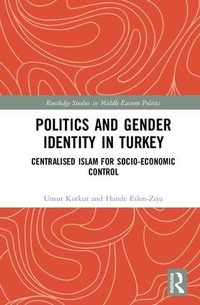
Politics and Gender Identity in Turkey
Centralised Islam for Socio-Economic Control
1st Edition
Published on 30. October 2017
Book
Hardback
140 pages
978-1-138-22323-3 (ISBN)
Description
The creation of Turkish nationhood, citizenship, economic transformation, the forceful removal of minorities and national homogenisation, gender rights, the position of armed forces in politics, and the political and economic integration of Kurdish minority in Turkish polity have all received major interest in academic and policy debates. The relationship between politics and religion in Turkey, originating from the early years of the Republicanism, has been central to many - if not all - of these issues.
This book looks at how centralized religion has turned into a means of controlling and organizing the Turkish polity under the AKP (Justice and Development Party) governments by presenting the results from a study on Turkish hutbes (mosque sermons), analysing how their content relates to gender roles and identities. The book argues that the political domination of a secular state as an agency over religion has not suppressed, but transformed, religion into a political tool for the same agency to organise the polity and the society along its own ideological tenets. It looks at how this domination organises gender roles and identities to engender human capital to serve for a neoliberal economic developmentalism. The book then discusses the limits of this domination, reflecting on how its subjects position themselves between the politico-religious authority and their secular lives.
Written in an accessible format, this book provides a fresh perspective on the relationship between religion and politics in the Middle East. More broadly, it also sheds light on global moral politics and illiberalism and why it relates to gender, religion and economics.
This book looks at how centralized religion has turned into a means of controlling and organizing the Turkish polity under the AKP (Justice and Development Party) governments by presenting the results from a study on Turkish hutbes (mosque sermons), analysing how their content relates to gender roles and identities. The book argues that the political domination of a secular state as an agency over religion has not suppressed, but transformed, religion into a political tool for the same agency to organise the polity and the society along its own ideological tenets. It looks at how this domination organises gender roles and identities to engender human capital to serve for a neoliberal economic developmentalism. The book then discusses the limits of this domination, reflecting on how its subjects position themselves between the politico-religious authority and their secular lives.
Written in an accessible format, this book provides a fresh perspective on the relationship between religion and politics in the Middle East. More broadly, it also sheds light on global moral politics and illiberalism and why it relates to gender, religion and economics.
More details
Series
Language
English
Place of publication
London
United Kingdom
Publishing group
Taylor & Francis Ltd
Target group
College/higher education
Illustrations
13 s/w Tabellen
13 Tables, black and white
Dimensions
Height: 234 mm
Width: 156 mm
Weight
440 gr
ISBN-13
978-1-138-22323-3 (9781138223233)
Copyright in bibliographic data and cover images is held by Nielsen Book Services Limited or by the publishers or by their respective licensors: all rights reserved.
Schweitzer Classification
Other editions
Additional editions
Umut Korkut | Hande Eslen-Ziya
Politics and Gender Identity in Turkey
Centralised Islam for Socio-Economic Control
Book
12/2019
1st Edition
Routledge
€64.60
Shipment within 15-20 days
Umut Korkut | Hande Eslen-Ziya
Politics and Gender Identity in Turkey
Centralised Islam for Socio-Economic Control
E-Book
10/2017
Routledge
€59.49
Available for download
Umut Korkut | Hande Eslen-Ziya
Politics and Gender Identity in Turkey
Centralised Islam for Socio-Economic Control
E-Book
10/2017
Routledge
€59.49
Available for download
Persons
Umut Korkut is Reader at Glasgow School for Business and Society at Glasgow Caledonian University. Previously, he was Research Fellow in the School for Politics and International Relations at the University College Dublin (2007-2010).
Hande Eslen-Ziya is research fellow at the University of Brighton, School of Applied Social Sciences. She holds a PhD in Sociology from Polish Academy of Sciences, Warsaw, Poland. In 2015, she was awarded Associate Professorship in Sociology by the Turkish Higher Education Council.
Hande Eslen-Ziya is research fellow at the University of Brighton, School of Applied Social Sciences. She holds a PhD in Sociology from Polish Academy of Sciences, Warsaw, Poland. In 2015, she was awarded Associate Professorship in Sociology by the Turkish Higher Education Council.
Content
Introduction 1. Moral politics, neoliberal governmentality, and gender 2. Discourse to Emotion Framework: How to read hutbes as data sources? 3. How do public narratives serve for neoliberal governmentality? 4. Manipulation, Discipline and Regulation: The Discursive Construction of Expertise and Social Policy 5. Deliberation, Contestation, and the boundaries of neoliberal governmentality Conclusion Appendix