

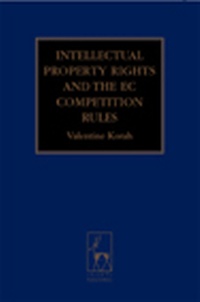
Intellectual Property Rights & the EC Competition Rules
Published in 2006
Book
Hardback
336 pages
978-1-84113-614-1 (ISBN)
Description
This latest monograph by Professor Korah on the recent group exemption consists of a detailed and critical commentary on the technology transfer block exemption of 2004 with annotated copies of the regulation and guidelines, together with a substantial chapter on refusal to supply or license in the light of the recent case law under Article 82. In doing so it embraces all the competition issues that may affect intellectual property rights.
After a brief introduction, the work starts with short chapters on the free movement of goods and services, the status of the Commission's guidelines and the historically hostile attitude of the Commission under Article 81 towards licensing. It then launches into a detailed analysis of the regulation and the probable treatment of licences that do not fall within it.
Throughout the book the author provides extensive analysis of policy and economics as well as comparison with US practice. Contents:
Chapter 1 Introduction ? Tension Between Intellectual Property Rights (iprs) and Competition Rules and the Principle of Free Movement
1.1 BIBLIOGRAPHY
Chapter 2 Free Movement of Goods
2.1 JUDGMENTS ON EXHAUSTION OF PATENTS
2.1.1 'Specific Subject Matter'
2.1.2 Merck v Stephar
2.2 EXHAUSTION OF TRADEMARKS
2.3 EXHAUSTION OF COPYRIGHT
2.4 NO INTERNATIONAL EXHAUSTION
2.5 SALE WITHIN THE COMMON MARKET WITH THE HOLDER?S CONSENT
2.6 CONCLUSION
2.7 BIBLIOGRAPHY
Chapter 3 Status of Various Sources of Law
3.1 JUDGMENTS
3.2 DECISIONS OF THE COMMISSION
3.3 RECITALS TO AN ACT
3.4 GUIDELINES
3.5 COMFORT LETTERS
Chapter 4 Article 81
4.1 HISTORICAL ATTITUDE OF COMMISSION AND COURTS TOWARDS LICENSING
4.1.1 Exclusive Licences with and without Export Bans
4.1.1.1 Exclusive Patent and Know-How Licences
4.1.1.2 Exclusive Licences of Plant Breeders' Rights
4.1.1.3 Exclusive Licences of Performing Rights
4.1.1.4 Copyright Collecting Societies
4.1.1.5 The Software Directive
4.1.1.6 Software Licensing
4.1.2 No Challenge Provisions
4.1.3 Feed and Grantback Provisions
4.1.4 Royalties to Continue After the Last Intellectual Property Right Expires
4.1.5 Single Branding Obligations
4.2 COMMISSION'S MORE RECENT VIEWS
4.3 BIBLIOGRAPHY
Chapter 5 The New Group Exemption for Technology Transfer ? Regulation 772/04 (TTBER)
5.1 OUTLINE OF THE REGULATION
5.2 COVERAGE OF THE TECHNOLOGY TRANSFER GROUP EXEMPTION (ARTICLE 2)
5.2.1 Definitions
5.2.2 Relationship with other Group Exemptions (Gs 56?64)
5.2.2.1 Specialisation and R & D (Gs 57?60)
5.2.2.2 Vertical Agreements (Gs 61?64)
5.3 CEILING OF MARKET SHARES (ARTICLE 3)
5.3.1 Competing Undertakings (Article 1(1)(j))
5.3.2 Conclusion on Market Shares
5.4 HARDCORE RESTRAINTS (ARTICLE 4, R 13 AND GS 74?76)
5.4.1 As between Competitors (Article 4(1) and Gs 77?95)
5.4.1.1 Price Fixing (Article 4(1)(a), Gs 79?81)
5.4.1.2 Limitation of Output (Gs 82?83)
5.4.1.3 Allocation of Markets or Customers
5.4.1.4 Sole Licences (Article 4(1)(c)(iii), G 88)
5.4.1.5 Field of Use Restrictions and Exclusive Licences (Article 4(1)(c)(i) and (ii), G 86)
5.4.1.6 No Poaching Provisions in Non-Reciprocal Licences (Article 4(1)(c) (iv) & (v), Gs 87 and 89)
5.4.1.7 Captive Use and Second Source (Article 4(1)(c)(vi) and (vii), Gs 92?93)
5.4.1.8 Restriction on Licensee Using its Own Technology (Article 4(1)(d), Gs 81, 94, 95 and157)
5.4.2 Hardcore List as between Non Competitors (Article 4(2),Gs 96?106) 5.4.2.1 Price Restrictions (Article 4(2)(a) and G 97)
5.4.2.2 Territorial Restrictions on Licensee (Article 4(2)(b), Gs 98, 99, 174 and 180)
5.4.2.2.1 Protection of exclusive territory or customer group of licensor or another licensee (Article 4(2)(b)(i) and (ii) and Gs 100 and 101)
5.4.2.2.2 Captive sales and second source (Article 4(2)(iii) and (iv), Gs 102 and 103)
5.4.2.3 Separation of Wholesale and Retail Functions (Article 4(2)(b)(v), G 104)
5.4.2.4 Selective Distribution (Article 4(2)(b)(vi), G 104)
5.4.3 Where the Parties Become Competitors (Article 4(3)
5.5 EXCLUDED RESTRICTIONS (ARTICLE 5, R14, GS 107?116)
5.5.1 Grantback (Article 5(1)(a) and (b), and Gs 109 and 110)
5.5.2 No Challenge (Article 5(1)(c), Gs 112 and 113)
5.5.3 Restriction on Licensee Using its Own Technology (Article 5(2), Gs 114?116)
5.6 WITHDRAWAL OF BLOCK EXEMPTION (ARTICLE 6, RS 16 AND 17 AND GS 117?122)
5.7 WITHDRAWAL OF BLOCK EXEMPTION BY REGULATION (ARTICLE 7, R 18 AND GS 34, 123?129)
5.8 TRANSITIONAL PROVISIONS
5.9 CONCLUSION
Chapter 6 Recitals and Guidelines Not Limited to Agreements Exempted by the TTBER
6.1 STATUS OF RECITALS, GUIDELINES AND OTHER KINDS OF 'SOFT LAW'
6.2 COMMISSION'S CURRENT GENERAL APPROACH TO TECHNOLOGY TRANSFER
6.2.1 More Economic Approach
6.2.2 Possible Pro-competitive Effects of Technology Transfer ? Consumer Welfare
6.2.3 Possible Anti-competitive Effects of Licensing ? Restrictions by Object or Effect
6.2.4 Balancing Pro- and Anti-competitive Effects Under Article 81(3)
6.2.5 Attitude to Horizontal Relationships Stricter than to Vertical
6.2.5.1 Relationship Vertical if Unlikely to Compete in the Absence of a Licence
6.2.5.2 If Licensee has Alternative Technology it is not Licensing, the Parties are not Competitors in the Technology Market for the Purpose of Article 3
6.2.6 Commission Concerned about Dividing Market Power Between Licensor and its Licensees
6.3 GUIDELINES DEALING MAINLY WITH AGREEMENTS OUTSIDE THE REGULATION
6.3.1 No Presumption that Agreements Outside the TTBER Infringe Article 81
6.3.2 Market Power
6.3.2.1 Market Shares of Parties and their Cost Advantages
6.3.2.2 Barriers to Entry
6.3.2.3 Maturity of the Market
6.3.2.4 Cumulative Effects
6.3.2.5 Market Power of Competitors
6.3.2.6 Buyer Power
6.3.3 Possible Negative Effects of Restrictive Licence Agreements
6.3.4 Balance Benefits and Detriments in their Actual Context Under Article 81(3)
6.3.5 Analysis of the Four Conditions of Article 81(3) 6.4 APPLICATION OF ARTICLE 81 TO VARIOUS TYPES OF LICENSING RESTRAINTS (GS 153?235)
6.4.1 Agreements that Do Not Restrict Competition Within Article 81(1)
6.4.1.1 Royalties
6.4.1.2 Restrictions on Production within a Specified Territory (Gs 161?167)
6.4.1.3 Sales Restrictions in Agreements between Competitors (Gs 169?171)
6.4.1.4 Sales Restrictions in Agreements between Non-Competitors (Gs 172?173)
6.4.1.5 Criticism of Distinctions between Production and Sales Exclusivity and between Protection from Active and Passive Sales
6.4.1.6 Output Restrictions between Competitors (Gs 82 and 175)
6.4.1.7 Output Restrictions between Non-Competitors (Gs 176?178)
6.4.1.8 Field of Use Restrictions between Actual or Potential Competitors (Gs 179?183)
6.4.1.9 Field of Use Restrictions between Non-Competitors (Gs 184?185)
6.4.1.10 Captive Use Restrictions (Gs 186?190)
6.4.1.11 Tying and Bundling (Gs 191?195)
6.4.1.12 Non-Compete Obligations (Gs 196?203)
6.4.2 Settlement and Non-assertion Agreements (Gs 204?209)
6.4.3 Technology Pools (Gs 210?235) Chapter 7 Other Kinds of Commercial and Industrial Property Rights
7.1 TRADEMARK LICENCES
7.1.1 Trademark Licences are Block Exempted only if Ancillary
7.1.2 A Trademark Licence May, However, Not Infringe Article 81(1)
7.1.3 Exclusive Licence With Restriction On Challenging Validity of Mark
7.1.4 Obligations to Use the Licensor's Trademark On the Licensed Product Not Generally Restrictive of Competition
7.1.5 Trademark Delimitation Agreements
7.2 TRADITIONAL COPYRIGHT LICENCES
7.3 LICENCES OF PERFORMING AND RENTAL RIGHTS
7.4 CONCLUSION
7.5 SUBCONTRACTING NOTICE (G 44)
Chapter 8 Article 82
8.1 REFUSALS TO LICENSE
8.1.1 Commercial Solvents
8.1.2 Volvo
8.1.3 Magill
8.1.4 Tiercé Ladbroke
8.1.5 Oscar Bronner
8.1.6 IMS Appeal to CFI
8.1.7 Preliminary Ruling in IMS 8.1.7.1 Are the Special Circumstances in Magill Exhaustive?
8.1.7.2 Access must be Essential to Prevent all Competition being Eliminated
8.1.7.3 Secondary Market may be Potential or Hypothetical
8.1.7.4 No Justification
8.1.8 Syfait
8.1.9 The Commission?s Decision in Microsoft
8.1.9.1 Dominant Position Over Operating Sytems for Client Personal Computers (PCs)
8.1.9.1.1 Entry barriers ? network effects and switching costs ? middleware
8.1.9.1.2 Overwhelmingly dominant position
8.1.9.2 Refusal to Supply Interface Information to Competitors Selling Servers
8.1.9.2.1 Circumstances that were special
8.1.9.2.2 Microsoft's justification
8.1.9.3 Tying the Operating System for Windows Media Player (WMP) to the Operating System for PCs also Constitutes Abuse of a Dominant Position
8.1.9.3.1 Products distinct
8.1.9.3.2 Overwhelming dominant position
8.1.9.3.3 Consumers deprived of choice
8.1.9.3.4 Foreclosure of competitors
8.1.9.3.5 Justification
8.1.9.4 Remedies for the Infringements
8.1.9.4.1 Fine
8.1.9.4.2 Obligation to supply interface information for servers
8.1.9.4.3 The remedy for tying
8.1.9.4.4 Remedy not suspended by CFI
8.1.9.4.5 Comment
8.2 BIBLIOGRAPHY
Chapter 9 General comment on iprs and competition
9.1 WAYS IN WHICH EC LAW DIFFERS FROM THE US AND IS LESS STRICT THAN PREVIOUSLY
9.2 MORE ECONOMIC APPROACH WELCOME
Chapter 10 General conclusion
BIBLIOGRAPHY
Appendix 1 Excerpts from the Treaty establishing the European Community
Appendix 2 Regulation 19/65
Appendix 3 Regulation 772/2004
Appendix 4 Commission's guidelines on technology transfer
Appendix 5 Commission?s guidelines on Article 81(3)
Index
After a brief introduction, the work starts with short chapters on the free movement of goods and services, the status of the Commission's guidelines and the historically hostile attitude of the Commission under Article 81 towards licensing. It then launches into a detailed analysis of the regulation and the probable treatment of licences that do not fall within it.
Throughout the book the author provides extensive analysis of policy and economics as well as comparison with US practice. Contents:
Chapter 1 Introduction ? Tension Between Intellectual Property Rights (iprs) and Competition Rules and the Principle of Free Movement
1.1 BIBLIOGRAPHY
Chapter 2 Free Movement of Goods
2.1 JUDGMENTS ON EXHAUSTION OF PATENTS
2.1.1 'Specific Subject Matter'
2.1.2 Merck v Stephar
2.2 EXHAUSTION OF TRADEMARKS
2.3 EXHAUSTION OF COPYRIGHT
2.4 NO INTERNATIONAL EXHAUSTION
2.5 SALE WITHIN THE COMMON MARKET WITH THE HOLDER?S CONSENT
2.6 CONCLUSION
2.7 BIBLIOGRAPHY
Chapter 3 Status of Various Sources of Law
3.1 JUDGMENTS
3.2 DECISIONS OF THE COMMISSION
3.3 RECITALS TO AN ACT
3.4 GUIDELINES
3.5 COMFORT LETTERS
Chapter 4 Article 81
4.1 HISTORICAL ATTITUDE OF COMMISSION AND COURTS TOWARDS LICENSING
4.1.1 Exclusive Licences with and without Export Bans
4.1.1.1 Exclusive Patent and Know-How Licences
4.1.1.2 Exclusive Licences of Plant Breeders' Rights
4.1.1.3 Exclusive Licences of Performing Rights
4.1.1.4 Copyright Collecting Societies
4.1.1.5 The Software Directive
4.1.1.6 Software Licensing
4.1.2 No Challenge Provisions
4.1.3 Feed and Grantback Provisions
4.1.4 Royalties to Continue After the Last Intellectual Property Right Expires
4.1.5 Single Branding Obligations
4.2 COMMISSION'S MORE RECENT VIEWS
4.3 BIBLIOGRAPHY
Chapter 5 The New Group Exemption for Technology Transfer ? Regulation 772/04 (TTBER)
5.1 OUTLINE OF THE REGULATION
5.2 COVERAGE OF THE TECHNOLOGY TRANSFER GROUP EXEMPTION (ARTICLE 2)
5.2.1 Definitions
5.2.2 Relationship with other Group Exemptions (Gs 56?64)
5.2.2.1 Specialisation and R & D (Gs 57?60)
5.2.2.2 Vertical Agreements (Gs 61?64)
5.3 CEILING OF MARKET SHARES (ARTICLE 3)
5.3.1 Competing Undertakings (Article 1(1)(j))
5.3.2 Conclusion on Market Shares
5.4 HARDCORE RESTRAINTS (ARTICLE 4, R 13 AND GS 74?76)
5.4.1 As between Competitors (Article 4(1) and Gs 77?95)
5.4.1.1 Price Fixing (Article 4(1)(a), Gs 79?81)
5.4.1.2 Limitation of Output (Gs 82?83)
5.4.1.3 Allocation of Markets or Customers
5.4.1.4 Sole Licences (Article 4(1)(c)(iii), G 88)
5.4.1.5 Field of Use Restrictions and Exclusive Licences (Article 4(1)(c)(i) and (ii), G 86)
5.4.1.6 No Poaching Provisions in Non-Reciprocal Licences (Article 4(1)(c) (iv) & (v), Gs 87 and 89)
5.4.1.7 Captive Use and Second Source (Article 4(1)(c)(vi) and (vii), Gs 92?93)
5.4.1.8 Restriction on Licensee Using its Own Technology (Article 4(1)(d), Gs 81, 94, 95 and157)
5.4.2 Hardcore List as between Non Competitors (Article 4(2),Gs 96?106) 5.4.2.1 Price Restrictions (Article 4(2)(a) and G 97)
5.4.2.2 Territorial Restrictions on Licensee (Article 4(2)(b), Gs 98, 99, 174 and 180)
5.4.2.2.1 Protection of exclusive territory or customer group of licensor or another licensee (Article 4(2)(b)(i) and (ii) and Gs 100 and 101)
5.4.2.2.2 Captive sales and second source (Article 4(2)(iii) and (iv), Gs 102 and 103)
5.4.2.3 Separation of Wholesale and Retail Functions (Article 4(2)(b)(v), G 104)
5.4.2.4 Selective Distribution (Article 4(2)(b)(vi), G 104)
5.4.3 Where the Parties Become Competitors (Article 4(3)
5.5 EXCLUDED RESTRICTIONS (ARTICLE 5, R14, GS 107?116)
5.5.1 Grantback (Article 5(1)(a) and (b), and Gs 109 and 110)
5.5.2 No Challenge (Article 5(1)(c), Gs 112 and 113)
5.5.3 Restriction on Licensee Using its Own Technology (Article 5(2), Gs 114?116)
5.6 WITHDRAWAL OF BLOCK EXEMPTION (ARTICLE 6, RS 16 AND 17 AND GS 117?122)
5.7 WITHDRAWAL OF BLOCK EXEMPTION BY REGULATION (ARTICLE 7, R 18 AND GS 34, 123?129)
5.8 TRANSITIONAL PROVISIONS
5.9 CONCLUSION
Chapter 6 Recitals and Guidelines Not Limited to Agreements Exempted by the TTBER
6.1 STATUS OF RECITALS, GUIDELINES AND OTHER KINDS OF 'SOFT LAW'
6.2 COMMISSION'S CURRENT GENERAL APPROACH TO TECHNOLOGY TRANSFER
6.2.1 More Economic Approach
6.2.2 Possible Pro-competitive Effects of Technology Transfer ? Consumer Welfare
6.2.3 Possible Anti-competitive Effects of Licensing ? Restrictions by Object or Effect
6.2.4 Balancing Pro- and Anti-competitive Effects Under Article 81(3)
6.2.5 Attitude to Horizontal Relationships Stricter than to Vertical
6.2.5.1 Relationship Vertical if Unlikely to Compete in the Absence of a Licence
6.2.5.2 If Licensee has Alternative Technology it is not Licensing, the Parties are not Competitors in the Technology Market for the Purpose of Article 3
6.2.6 Commission Concerned about Dividing Market Power Between Licensor and its Licensees
6.3 GUIDELINES DEALING MAINLY WITH AGREEMENTS OUTSIDE THE REGULATION
6.3.1 No Presumption that Agreements Outside the TTBER Infringe Article 81
6.3.2 Market Power
6.3.2.1 Market Shares of Parties and their Cost Advantages
6.3.2.2 Barriers to Entry
6.3.2.3 Maturity of the Market
6.3.2.4 Cumulative Effects
6.3.2.5 Market Power of Competitors
6.3.2.6 Buyer Power
6.3.3 Possible Negative Effects of Restrictive Licence Agreements
6.3.4 Balance Benefits and Detriments in their Actual Context Under Article 81(3)
6.3.5 Analysis of the Four Conditions of Article 81(3) 6.4 APPLICATION OF ARTICLE 81 TO VARIOUS TYPES OF LICENSING RESTRAINTS (GS 153?235)
6.4.1 Agreements that Do Not Restrict Competition Within Article 81(1)
6.4.1.1 Royalties
6.4.1.2 Restrictions on Production within a Specified Territory (Gs 161?167)
6.4.1.3 Sales Restrictions in Agreements between Competitors (Gs 169?171)
6.4.1.4 Sales Restrictions in Agreements between Non-Competitors (Gs 172?173)
6.4.1.5 Criticism of Distinctions between Production and Sales Exclusivity and between Protection from Active and Passive Sales
6.4.1.6 Output Restrictions between Competitors (Gs 82 and 175)
6.4.1.7 Output Restrictions between Non-Competitors (Gs 176?178)
6.4.1.8 Field of Use Restrictions between Actual or Potential Competitors (Gs 179?183)
6.4.1.9 Field of Use Restrictions between Non-Competitors (Gs 184?185)
6.4.1.10 Captive Use Restrictions (Gs 186?190)
6.4.1.11 Tying and Bundling (Gs 191?195)
6.4.1.12 Non-Compete Obligations (Gs 196?203)
6.4.2 Settlement and Non-assertion Agreements (Gs 204?209)
6.4.3 Technology Pools (Gs 210?235) Chapter 7 Other Kinds of Commercial and Industrial Property Rights
7.1 TRADEMARK LICENCES
7.1.1 Trademark Licences are Block Exempted only if Ancillary
7.1.2 A Trademark Licence May, However, Not Infringe Article 81(1)
7.1.3 Exclusive Licence With Restriction On Challenging Validity of Mark
7.1.4 Obligations to Use the Licensor's Trademark On the Licensed Product Not Generally Restrictive of Competition
7.1.5 Trademark Delimitation Agreements
7.2 TRADITIONAL COPYRIGHT LICENCES
7.3 LICENCES OF PERFORMING AND RENTAL RIGHTS
7.4 CONCLUSION
7.5 SUBCONTRACTING NOTICE (G 44)
Chapter 8 Article 82
8.1 REFUSALS TO LICENSE
8.1.1 Commercial Solvents
8.1.2 Volvo
8.1.3 Magill
8.1.4 Tiercé Ladbroke
8.1.5 Oscar Bronner
8.1.6 IMS Appeal to CFI
8.1.7 Preliminary Ruling in IMS 8.1.7.1 Are the Special Circumstances in Magill Exhaustive?
8.1.7.2 Access must be Essential to Prevent all Competition being Eliminated
8.1.7.3 Secondary Market may be Potential or Hypothetical
8.1.7.4 No Justification
8.1.8 Syfait
8.1.9 The Commission?s Decision in Microsoft
8.1.9.1 Dominant Position Over Operating Sytems for Client Personal Computers (PCs)
8.1.9.1.1 Entry barriers ? network effects and switching costs ? middleware
8.1.9.1.2 Overwhelmingly dominant position
8.1.9.2 Refusal to Supply Interface Information to Competitors Selling Servers
8.1.9.2.1 Circumstances that were special
8.1.9.2.2 Microsoft's justification
8.1.9.3 Tying the Operating System for Windows Media Player (WMP) to the Operating System for PCs also Constitutes Abuse of a Dominant Position
8.1.9.3.1 Products distinct
8.1.9.3.2 Overwhelming dominant position
8.1.9.3.3 Consumers deprived of choice
8.1.9.3.4 Foreclosure of competitors
8.1.9.3.5 Justification
8.1.9.4 Remedies for the Infringements
8.1.9.4.1 Fine
8.1.9.4.2 Obligation to supply interface information for servers
8.1.9.4.3 The remedy for tying
8.1.9.4.4 Remedy not suspended by CFI
8.1.9.4.5 Comment
8.2 BIBLIOGRAPHY
Chapter 9 General comment on iprs and competition
9.1 WAYS IN WHICH EC LAW DIFFERS FROM THE US AND IS LESS STRICT THAN PREVIOUSLY
9.2 MORE ECONOMIC APPROACH WELCOME
Chapter 10 General conclusion
BIBLIOGRAPHY
Appendix 1 Excerpts from the Treaty establishing the European Community
Appendix 2 Regulation 19/65
Appendix 3 Regulation 772/2004
Appendix 4 Commission's guidelines on technology transfer
Appendix 5 Commission?s guidelines on Article 81(3)
Index
Reviews / Votes
This book provides a clear framework for the beginner but at the same time provides plenty of food for thought for those who might consider themselves rather more expert in the field. Importantly, Professor Korah manages to set her thoughts on some of the less explored issues in a highly structured framework which means that the book will be of genuine use to the practitioner.It would be equally important for those seeking a broad understanding of intellectual property law and the context within which it operates in Europe. It is a very useful book for academics and practitioners alike. Christopher Stothers World Competition Law and Economics Review June 2007 .a sharp, provocative and exhaustive analysis, likely to be of considerable interest to academics and practitioners working in the field of competition law. Arianna Andreangeli European Law Review April 2007 Korah's book is a welcome addition to the market.Those who are familiar with the author's insightful, concise and always rigorous style will recognize it once again here.The book is interesting beyond the topic of IP rights and competition law.this book offers an insightful overview of the legal principles, the leading cases, and the Commission technology transfer regulation and guidelines. It is a useful, concise and readable text that will prove invaluable for competition and IP law students and practitioners alike. Renato Nazzini Common Market Law Review, Vol 44, Issue 1, 2007 .one of the strengths of the book is Korah's ability to illustrate the current legal position as the result of a lengthy and not always straightforward development. Another strength is the analysis of the complete body of case law of the ECJ, the CFI and the Commission..She has, once more, succeeded in contributing an individual, and at times idiosyncratic, view on an important subject matter. Nobody who is interested in intellectual property rights and competition law, especially in the BER technology transfer, can ignore this contribution. Stefan Enchelmaier GRUR International 2006 This book is very useful for both practitioners and students, and according to Sir Robin Jacob's foreword, to judges.this book offers a very compact and stimulating account of what is an important and developing area of the law. Readers will find it both useful and accessible. David Rogers European Intellectual Property Review Vol 28, Issue 12, Dec. 2006 . a detailed and critical commentary.The author provides a detailed analysis of the Regulation and the likely treatment of licences that are not covered by it. Throughout the book, the author provides extensive analysis of politics and economics and includes a comparison of competition law in Europe and the United States.The level of analysis of the case law of the European Court of Justice, the European Court of First Instance and the Commission makes this an invaluable reference for people with a sophisticated interest in intellectual property rights and competition law as they currently operate in Europe. Shehana Wijesena Copyright Reporter Vol 25 No 1 February 2007 This book. provides plenty of food for thought World CompetitionMore details
Other editions
Additional editions
Valentine Korah
Intellectual Property Rights and the EC Competition Rules
E-Book
02/2006
1st Edition
Hart Publishing
€278.99
Available for download
Persons
Valentine Korah is Professor Emeritus of Competition Law at University College, London, and a Barrister.
Content
Chapter 1 Introduction - tension between intellectual property rights (iprs) on the one hand and the competition rules and principle of free movement on the other
Chapter 2 Free movement of Goods
Chapter 3 Status of Various Sources of Law
Chapter 4 Article 81
Chapter 5 The New Group Exemption for Technology Transfer - Regulation 772/04 (TTBER)
Chapter 6 Recitals and Guidelines Not Limited to Agreements Exempted by the TTBER
Chapter 7 Other Kinds of Commercial and Industrial
Property Rights
Chapter 8 Article 82
Chapter 9 General Comment on iprs and competition
Chapter 10 General conclusion
Chapter 2 Free movement of Goods
Chapter 3 Status of Various Sources of Law
Chapter 4 Article 81
Chapter 5 The New Group Exemption for Technology Transfer - Regulation 772/04 (TTBER)
Chapter 6 Recitals and Guidelines Not Limited to Agreements Exempted by the TTBER
Chapter 7 Other Kinds of Commercial and Industrial
Property Rights
Chapter 8 Article 82
Chapter 9 General Comment on iprs and competition
Chapter 10 General conclusion