

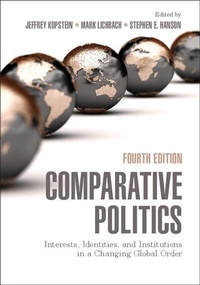
Comparative Politics
Interests, Identities, and Institutions in a Changing Global Order
4th Edition
Published on 21. July 2014
Book
Paperback/Softback
630 pages
978-0-521-13574-0 (ISBN)
Description
Twelve in-depth case studies of the EU and countries across the globe, written by the leading country specialists and combining insights of cutting-edge institutional analysis and deep study of national histories, explore how the concepts of interests, identities and institutions shape the politics of nations and regions. The country studies trace the global and historical contexts of political development and examine the diverse pathways that countries have taken in their quest to adapt to the competitive pressures of twenty-first-century globalization. These country studies constitute the overarching framework of the text, addressing the larger question, 'why are countries ruled and governed so differently?' Free of heavy-handed jargon, Comparative Politics inspires thought-provoking debate among introductory students and specialists alike, and encourages students to engage in real comparative analysis. In this new edition, all twelve country studies have been rewritten, and the first two theory chapters have been updated to reflect the latest research in the field.
More details
Edition
4th Revised edition
Language
English
Place of publication
Cambridge
United Kingdom
Target group
College/higher education
Edition type
Revised edition
Product notice
Paperback (trade)
Illustrations
18 Tables, unspecified; 10 Maps
Dimensions
Height: 254 mm
Width: 178 mm
Thickness: 33 mm
Weight
1138 gr
ISBN-13
978-0-521-13574-0 (9780521135740)
Copyright in bibliographic data and cover images is held by Nielsen Book Services Limited or by the publishers or by their respective licensors: all rights reserved.
Schweitzer Classification
Other editions
Additional editions
Jeffrey Kopstein
Comparative Politics
Interests, Identities, and Institutions in a Changing Global Order
E-Book
07/2014
Cambridge University Press
€56.49
Available for download
Jeffrey Kopstein | Mark Lichbach | Stephen E. Hanson
Comparative Politics
Interests, Identities, and Institutions in a Changing Global Order
E-Book
07/2014
4th Edition
Cambridge University Press
€67.99
Available for download
Jeffrey Kopstein | Mark Lichbach
Comparative Politics
Interests, Identities, and Institutions in a Changing Global Order
Book
09/2005
2nd Edition
Cambridge University Press
€80.47
Article exhausted; check for reprint
Jeffrey Kopstein | Mark Lichbach
Comparative Politics
Interests, Identities, and Institutions in a Changing Global Order
Book
08/2000
Cambridge University Press
€92.85
Article exhausted; check for reprint
Previous edition
Jeffrey Kopstein | Mark Lichbach
Comparative Politics
Interests, Identities, and Institutions in a Changing Global Order
Book
07/2008
3rd Edition
Cambridge University Press
€61.89
Article exhausted; check for reprint
Persons
Jeffrey Kopstein is Professor of Political Science at the University of Toronto. Mark Lichbach is Professor of Political Science at the University of Maryland, College Park. Stephen Hanson is Professor of Government at the College of William and Mary, Virginia.
Content
1. What is comparative politics? Jeffrey Kopstein, Mark Lichbach and Stephen Hanson; 2. The framework of analysis Stephen Hanson, Jeffrey Kopstein and Mark Lichbach; Part I. Early Developers: 3. Britain Peter Rutland; 4. France Laurence McFalls; Stop and compare: early developers: Britain and France; Part II. Middle Developers: 5. Germany Andrew C. Gould; 6. Japan Miranda A. Schreurs; Stop and compare: early developers and middle developers; Part III. Late Developers: 7. Russia Stephen Hanson; 8. China Yu-Shan Wu; Stop and compare: early developers, middle developers, and late developers; Part IV. Experimental Developers: 9. Mexico Anthony Gill; 10. India Rudra Sil; 11. Iran Vali Nasr; 12. South Africa Antoinette Handley; 13. The European Union Paulette Kurzer; 14. Nigeria Okechukwu C. Iheduru; Stop and compare: early developers, middle developers, late developers, and experimental developers; Index.