

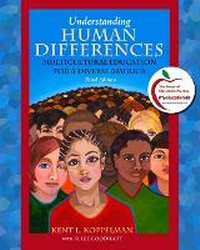
Understanding Human Differences
Multicultural Education for a Diverse America
3rd Edition
Published on 27. August 2010
Book
Paperback/Softback
408 pages
978-0-13-610301-1 (ISBN)
Description
For Multicultural Education/Diversity as well as General Education courses Understanding Human Differences is the best single text for introducing students to the study of diversity in Twenty-First Century America and provides a clear conceptual framework for teaching about diversity.The author uses clear examples, lucid language, and engaging activities to involve students in thinking through fundamental ideas that ground their understanding of diversity.
The author investigates three converging elements in his examination of human differences: individual attitudes and behaviors, cultural expectations, and institutional policies and practices. This examination provides the basis for the conceptual organization of the text.
The author investigates three converging elements in his examination of human differences: individual attitudes and behaviors, cultural expectations, and institutional policies and practices. This examination provides the basis for the conceptual organization of the text.
More details
Edition
3rd edition
Language
English
Place of publication
United States
Publishing group
Pearson Education (US)
Target group
Professional and scholarly
Dimensions
Height: 187 mm
Width: 233 mm
Thickness: 20 mm
Weight
544 gr
ISBN-13
978-0-13-610301-1 (9780136103011)
Copyright in bibliographic data is held by Nielsen Book Services Limited or its licensors: all rights reserved.
Schweitzer Classification
Other editions
New editions
Book
03/2013
4th Edition
Pearson
€111.41
Article is exhausted; no reprint
Previous edition
Kent L. Koppelman | R. Lee Goodhart
Understanding Human Differences
Multicultural Education for a Diverse America
Book
03/2007
2nd Edition
Pearson
€78.17
Article exhausted; check for reprint
Persons
In 2000, Dr. Koppelman published Values in the Key of Life, a book of essays on diversity and moral issues. Understanding Human Differences was first published in 2005. He is currently working on an anthology for Pearson addressing diversity issues. Dr. Koppelman is a professor emeritus at UW-La Crosse.
Content
Preface
Section I: Individual Attitudes and Interpersonal Relations
1. Understanding Ourselves and Others: Clarifying Values and Language
2. Understanding Prejudice and Its Causes
3. Communication, Conflict, and Conflict Resolution
Section II: Cultural Foundations of Oppression in the United States
4. Immigrants and Oppressions: The Assault on Cultural and Language Diversity
5. Race and Oppression: The Experiences of People of Color in America
6. Religion and Oppression: The Struggle for Religious Freedom
7. rejecting Oppressive Relationships: The Logic of Cultural Pluralism for a Diverse Society
Section III: Contemporary Dilemmas for Intergroup Relations
8. Racism: Confronting a Legacy of White Domination of America
9. Sexism: Where the Personal Becomes Political
10. Heterosexism: Transforming Homosexuality from Deviant to Different
11. Classism: Misperceptions and Myths about Income, Wealth, and Poverty
12. Ableism: Disability Does Not Mean Inability
Section IV: The Challenge of Diversity to American Institutions
13. Pluralism in Schools: The Promise of Multicultural Education
14. Pluralism in Society: Creating Unity in a Diverse America
Index
Section I: Individual Attitudes and Interpersonal Relations
1. Understanding Ourselves and Others: Clarifying Values and Language
2. Understanding Prejudice and Its Causes
3. Communication, Conflict, and Conflict Resolution
Section II: Cultural Foundations of Oppression in the United States
4. Immigrants and Oppressions: The Assault on Cultural and Language Diversity
5. Race and Oppression: The Experiences of People of Color in America
6. Religion and Oppression: The Struggle for Religious Freedom
7. rejecting Oppressive Relationships: The Logic of Cultural Pluralism for a Diverse Society
Section III: Contemporary Dilemmas for Intergroup Relations
8. Racism: Confronting a Legacy of White Domination of America
9. Sexism: Where the Personal Becomes Political
10. Heterosexism: Transforming Homosexuality from Deviant to Different
11. Classism: Misperceptions and Myths about Income, Wealth, and Poverty
12. Ableism: Disability Does Not Mean Inability
Section IV: The Challenge of Diversity to American Institutions
13. Pluralism in Schools: The Promise of Multicultural Education
14. Pluralism in Society: Creating Unity in a Diverse America
Index