

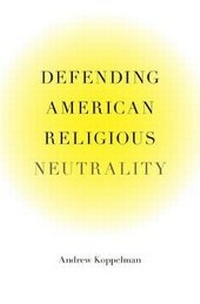
Defending American Religious Neutrality
Published on 1. January 2013
Book
Hardback
256 pages
978-0-674-06646-5 (ISBN)
Description
Although it is often charged with hostility toward religion, First Amendment doctrine in fact treats religion as a distinctive human good. It insists, however, that this good be understood abstractly, without the state taking sides on any theological question. Here, a leading scholar of constitutional law explains the logic of this uniquely American form of neutrality-more religion-centered than liberal theorists propose, and less overtly theistic than conservatives advocate.
The First Amendment's guarantee of freedom of religion is under threat. Growing numbers of critics, including a near-majority of the Supreme Court, seem ready to cast aside the ideal of American religious neutrality. Andrew Koppelman defends that ideal and explains why protecting religion from political manipulation is imperative in an America of growing religious diversity.
Understanding American religious neutrality, Koppelman shows, can explain some familiar puzzles. How can Bible reading in public schools be impermissible while legislative sessions begin with prayers, Christmas is an official holiday, and the words "under God" appear in the Pledge of Allegiance? Are faith-based social services, public financing of religious schools, or the teaching of intelligent design constitutional? Combining legal, historical, and philosophical analysis, Koppelman shows how law coherently navigates these conundrums. He explains why laws must have a secular legislative purpose, why old, but not new, ceremonial acknowledgments of religion are permitted, and why it is fair to give religion special treatment.
The First Amendment's guarantee of freedom of religion is under threat. Growing numbers of critics, including a near-majority of the Supreme Court, seem ready to cast aside the ideal of American religious neutrality. Andrew Koppelman defends that ideal and explains why protecting religion from political manipulation is imperative in an America of growing religious diversity.
Understanding American religious neutrality, Koppelman shows, can explain some familiar puzzles. How can Bible reading in public schools be impermissible while legislative sessions begin with prayers, Christmas is an official holiday, and the words "under God" appear in the Pledge of Allegiance? Are faith-based social services, public financing of religious schools, or the teaching of intelligent design constitutional? Combining legal, historical, and philosophical analysis, Koppelman shows how law coherently navigates these conundrums. He explains why laws must have a secular legislative purpose, why old, but not new, ceremonial acknowledgments of religion are permitted, and why it is fair to give religion special treatment.
Reviews / Votes
Neutrality has been the central but embattled ideal in the modern jurisprudence of religious freedom. Andrew Koppelman offers the most serious and sophisticated defense of that ideal now available. For anyone interested in these important debates, this book is not recommended reading: it is required. -- Steven D. Smith, University of San Diego This is an exceptionally valuable work. Koppelman persuasively argues why viewing neutrality as an ideal can have more significant practical consequences than arguing for a specific sort of legal neutrality. All law and religion scholars will have to address Koppelman's arguments. -- Frank Ravitch, Michigan State University Andrew Koppelman is one of the most thoughtful law-and-religion scholars in America, and this book is an impressive accomplishment. Koppelman shows how a secular political community can and must respect the consciences of persons of all faiths and none, while seeing the search for religious truth as a special, and especially important, human good. -- Richard Garnett, University of Notre DameMore details
Language
English
Place of publication
Cambridge, Mass
United States
Target group
Professional and scholarly
US School Grade: College Graduate Student
Dimensions
Height: 235 mm
Width: 156 mm
ISBN-13
978-0-674-06646-5 (9780674066465)
Copyright in bibliographic data and cover images is held by Nielsen Book Services Limited or by the publishers or by their respective licensors: all rights reserved.
Schweitzer Classification
Other editions
Additional editions
Andrew Koppelman
Defending American Religious Neutrality
E-Book
01/2013
1st Edition
Harvard University Press
€90.99
Available for download
Andrew Koppelman
Defending American Religious Neutrality
E-Book
01/2013
1st Edition
Harvard University Press
€60.09
Available for download
Person
Andrew Koppelman is John Paul Stevens Professor of Law at Northwestern University.