

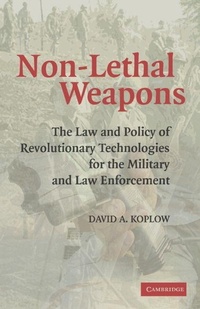
Non-Lethal Weapons
The Law and Policy of Revolutionary Technologies for the Military and Law Enforcement
Published on 3. April 2006
Book
Paperback/Softback
204 pages
978-0-521-67435-5 (ISBN)
Description
Too often, military and law enforcement authorities have found themselves constrained by inadequate weaponry. An emerging category of 'non-lethal weapons' carries promise for resolving this dilemma, proffering new capabilities for disabling opponents without inflicting death or permanent injury. This array of much more sophisticated technologies is being developed, and could emerge for use by soldiers and police in the near future. These augmented capabilities carry both immense promise and grave risks: they expand the power of law enforcement and military units, enabling them to accomplish assigned missions with greater finesse and reduced casualties. But they may also be misused - increasing maligned applications and inspiring leaders to over-rely upon a myth of 'bloodless combat'. This book explores the emerging world of non-lethal weapons by examining a series of case studies - recent real-world scenarios from five confrontations around the world where the availability of a modern arsenal might have made a difference.
Reviews / Votes
'This book gives a clear and structured overview of the issues concerning the emergence of non-lethal weapons. The analysis of the five cases gives the reader an insight in the possible future use of these 'less than lethal' weapons in conflict situations. The citations in the footnotes give useful supplemental information. ... this book is certainly a great introduction for whoever wants to acquire an insight in the subject of non-lethal weapons.' Military Law and the Law of War ReviewMore details
Language
English
Place of publication
Cambridge
United Kingdom
Target group
Professional and scholarly
Product notice
Paperback (trade)
Illustrations
Worked examples or Exercises
Dimensions
Height: 216 mm
Width: 140 mm
Thickness: 11 mm
Weight
266 gr
ISBN-13
978-0-521-67435-5 (9780521674355)
Copyright in bibliographic data and cover images is held by Nielsen Book Services Limited or by the publishers or by their respective licensors: all rights reserved.
Schweitzer Classification
Other editions
Additional editions
David A. Koplow
Non-Lethal Weapons
The Law and Policy of Revolutionary Technologies for the Military and Law Enforcement
E-Book
08/2006
1st Edition
Cambridge University Press
€36.99
Available for download
David A. Koplow
Non-Lethal Weapons
The Law and Policy of Revolutionary Technologies for the Military and Law Enforcement
Book
04/2006
Cambridge University Press
€124.00
Article exhausted; check different version
Person
David A. Koplow is a Professor of Law at Georgetown University Law Center and Director of the Center for Applied Legal Studies, in which students represent refugees who seek political asylum in the United States due to persecution on account of race, religion and political opinion in their homelands. After graduating from Yale Law School in 1978, he served the U.S. government in the Arms Control and Disarmament Agency (1978-81, as Attorney-Adviser and as Special Assistant to the Director) and in the Department of Defense (1997-99, as Deputy General Counsel for International Affairs). He also was the senior legal specialist for top Pentagon leadership on the full array of international legal issues, including the use of military force in the Persian Gulf and in Kosovo, the negotiation and implementation of treaties, the law of the sea, the programs of military cooperation and assistance, and the law of outer space. He has published many articles in law journals dealing with treaties and U.S. constitutional law and published books on national security and arms control policy.
Content
1. Introduction; 2. The world of non-lethal weapons; 3. The law of non-lethal weapons; 4. The FBI and the Davidians at Waco in 1993; 5. The United Nations and the Rwandan genocide in 1994; 6. The Peruvians and Tupac Amaru in Lima in 1996-97; 7. The Russians and the Chechens in Moscow in 2002; 8. The British and the Iraqis in Basra in 2003; 9. Cautionary considerations; 10. Recommendations and conclusions.