

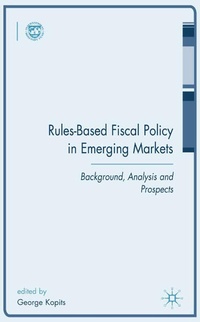
Rules-Based Fiscal Policy in Emerging Markets
Background, Analysis and Prospects
Published on 21. September 2004
Book
Hardback
XIII, 286 pages
978-1-4039-2085-0 (ISBN)
Description
Inspired by the experience of some advanced economies, a number of emerging market economies have recently adopted rules limiting the budget deficit, expenditure level, or indebtedness of the public sector, while others consider them for eventual adoption. This volume brings together policy analysts to discuss the rationale, suitability, and usefulness of fiscal policy rules in emerging market economies. Grouped under three main parts (political economy and macroeconomic setting; design issues at the national level; design issues at the subnational level), the chapters have a practical orientation, based on conceptual grounding.
More details
Series
Edition
2004 edition
Language
English
Place of publication
London
United Kingdom
Publishing group
Palgrave USA
Target group
Professional and scholarly
Product notice
sewn/stitched
Cloth over boards
With dust jacket
Illustrations
XIII, 286 p.
Dimensions
Height: 223 mm
Width: 164 mm
Thickness: 21 mm
Weight
494 gr
ISBN-13
978-1-4039-2085-0 (9781403920850)
DOI
10.1057/9781137001573
Schweitzer Classification
Other editions
Additional editions
E-Book
09/2004
Palgrave Macmillan
€96.29
Available for download
Person
FABRIZIO BALASSONE Bank of Italy, Italy
OLAV BJERKHOLT University of Oslo, Norway
MIGUEL BRAUN University of San Andres, Colombia
MARCO BUTI European Commission, International
ANDRÉS CONESA Secretariat of Finance, Mexico
FABRIZIO CORICELLI University of Siena, Italy
ALLAN DRAZEN Tel Aviv University, Israel
VALERIO ERCOLANI University of Siena, Italy
DANIELE FRANCO Bank of Italy, Italy
GABRIELE GIUDICE European Commission, Italy
ILAN GOLDFAJN Central Bank of Brazil, Brazil
CHRISTIAN Y. GONZALEZ Georgetown University, USA
EDUARDO R. GUARDIA State of Sao Paulo, Brazil
RICARDO HAUSMANN Harvard University, USA
KALPANA KOCHHAR International Monetary Fund, USA
IRENE NICULESCU Central University of Venezuela and Ministry of Finance, Venezuela
GUILLERMO PERRY The World Bank, USA
CATRIONA PURFIELD International Monetary Fund, USA
DAVID ROSENBLATT The World Bank, USA
ALLEN SCHICK Brookings Institution and University of Maryland, USA
MOISÉS J. SCHWARTZ Secretariat of Finance, Mexico
ALEJANDRO SOMUANO Secretariat of Finance, Mexico
J. ALFREDO TIJERINA Secretariat of Finance, Mexico
MARIANO TOMMASI University of San Andres, Colombia
STEVEN B. WEBB The World Bank, USA
STEFANIA ZOTTERI Bank of Italy, Italy
Content
Overview of Fiscal Policy Rules in Emerging Markets; G.Kopits PART I: POLITICAL ECONOMY AND MACROECONOMIC SETTING Fiscal Rules from a Political Economy Perspective; A.Drazen Good Debt Ratios, Bad Credit Ratings: The Role of Debt Structure; R.Hausmann Can Fiscal Rules Help Reduce Macroeconomic Volatility?; G.Perry Fiscal Policy and High Capital Mobility; G.Kopits Fiscal Institutions Versus Political Will; A.Schick PART II: DESIGN ISSUES AT THE NATIONAL LEVEL EMU Fiscal Rules: What Can and Cannot Be Exported; M.Buti & G.Giudice Fiscal Rules and Debt Sustainability in Brazil; I.Goldfajn & E.R.Guardia Fiscal Rules in Mexico: Evolution and Prospects; A.Conesa , M.J.Schwartz , A.Somuano & J.A.Tijerina Fiscal Rules on the Road to an Enlarged European Union; F.Coricelli & V.Ercolani Fiscal Rules for Economies with Nonrenewable Resources: Norway and Venezuela; O.Bjerkholt & I.Niculescu PART III: DESIGN ISSUES AT THE SUBNATIONAL LEVEL Subnational Fiscal Rules: A Game Theoretic Approach; M.Braun & M.Tommasi Rules-Based Adjustment in a Highly Decentralized Context: The Case of India; K.Kochhar & C.Purfield Fiscal Rules for Subnational Governments: Lessons from the EMU; F.Balassone, D.Franco & S.Zotteri Rules for Stabilizing Intergovernmental Transfers in Latin America; C.Y.Gonzalez, D.Rosenblat t & S.B.Webb