

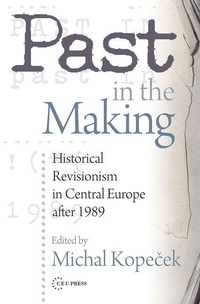
Past in the Making
Historical Revisionism in Central Europe After 1989
Published on 1. January 2008
Book
Hardback
274 pages
978-963-9776-02-9 (ISBN)
Description
Historical revisionism, far from being restricted to small groups of 'negationists,' has galvanized debates in the realm of recent history. The studies in this book range from general accounts of the background of recent historical revisionism to focused analyses of particular debates or social-cultural phenomena in individual Central European countries, from Germany to Ukraine and Estonia. Where is the borderline between legitimate re-examination of historical interpretations and attempts to rewrite history in a politically motivated way that downgrades or denies essential historical facts? How do the traditional 'national historical narratives' react to the 'spill-over' of international and political controversies into their 'sphere of influence'? Technological progress, along with the overall social and cultural decentralization shatters the old hierarchies of academic historical knowledge under the banner of culture of memory, and breeds an unequalled democratization in historical representation. This book offers a unique approach based on the provocative and instigating intersection of scholarly research, its political appropriations, and social reflection from a representative sample of Central and East European countries.
Reviews / Votes
"Historical revisionism has a number of different meanings. In this context the term provides a peg for discussing a variety of reinterpretations of tha past among professional historians and politicians, and in a more general collective memory. A major merit of the book is its demonstration of the extent to which re-evaluations of history are bound up with changes in politics and society" * Europe-Asia Studies * "'Far from being restricted to a small group of 'deniers', historical revisionism seems to feature strongly in the public historical discourses of many countries and regions nowadays': states the editor of this publication Michal Kopecek. Especially central and eastern Europe has a long-time experience with this concept and its changes. The various tendencies appearing (or enduring) after the 1989, are only giving new meanings to this notion. The publication is based on the conviction that the problem of revisionism in post-communist countries is a research subject that deserves a proper analysis. Although written mainly as case studies, most of the articles are proving the striking resemblances in the historiographic developments in post-communist European countries." * H-Soz-u-Kult *More details
Language
English
Place of publication
Budapest
Hungary
Target group
Academic
Product notice
sewn/stitched
Cloth over boards
With dust jacket
Dimensions
Height: 229 mm
Width: 164 mm
Thickness: 21 mm
Weight
522 gr
ISBN-13
978-963-9776-02-9 (9789639776029)
Copyright in bibliographic data and cover images is held by Nielsen Book Services Limited or by the publishers or by their respective licensors: all rights reserved.
Schweitzer Classification
Other editions
Additional editions
Book
01/2008
Central European University Press
€58.50
Available (delivery time upon request)
E-Book
01/2008
Central European University Press
€23.49
Available for download
Person
Michal Kopecek is Research Fellow at the Institute of Contemporary History, Prague.
Content
Preface Tucker: Historiographic Revision and Revisionism: The Evidential Difference; Petrovic: From Revisionism to "Revisionism": Legal Limits to Historical Interpretation; Hahn : The Holocaustizing of the Transfer-Discourse: Historical Revisionism or Old Wine in New Bottles?; Loose : The Anti-Fascist Myth of the German Democratic Republic and Its Decline after 1989; Kopecek: In Search of "National Memory": Politics of History, Nostalgia and the Historiography of Communism in the Czech Republic and East Central Europe; Kocourek: White Spaces are also Grey Spaces in Historical Revisionism: The Czech Right, 1939-1948 and the Battle against the Benes Doctrine in Czech Historiography; Johnson: Begetting & Remembering: Creating a Slovak Collective Memory in the Post-Communist World; Laczo: The Many Moralists and the Few Communists. Approaching Morality and Politics in post-Communist Hungary; Mink: The Revisions of the 1956 Hungarian revolution; Stobiecki: Historians Facing Politics of History. The Case of Poland; Kasianov: Revisiting the Great Famine of 1932-1933: Politics of Memory and Public Consciousness (Ukraine after 1991); Wulf: The Struggle for Official Recognition of 'Displaced' Group Memories in Post-Soviet Estonia, About the Authors Index