

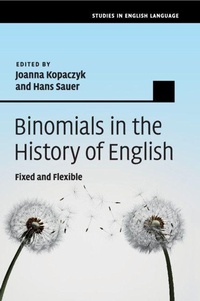
Binomials in the History of English
Fixed and Flexible
Published on 2. April 2020
Book
Paperback/Softback
396 pages
978-1-107-54426-0 (ISBN)
Description
Binomials, such as for and against, dead or alive, to have and to hold, can be broadly defined as two words belonging to the same grammatical category and linked by a semantic relationship. They are an important phraseological phenomenon present throughout the history of the English language. This volume offers a range of studies on binomials, their types and functions from Old English through to the present day. Searching for motivations and characteristic features of binomials in a particular genre or writer, the chapters engage with many linguistic levels of analysis, such as phonology or semantics, and explore the important role of translation. Drawing on philological and corpus-linguistic approaches, the authors employ qualitative and quantitative methods, setting the discussion firmly in the extra-linguistic context. Binomials and their extended forms - multinomials - emerge from these discussions as an important phraseological tool, with rich applications and complex motivations.
Reviews / Votes
'Binomials in the History of English contains chapters providing detailed, interesting, and highly informative historical descriptions of binomials in English: fixed structures such as to and fro or knife and fork that are joined by a coordinator. Individual chapters contain descriptions of the form and function of these structures in texts taken from all the major periods of English, ranging from the roles that they played in Old English poetry and law to their stylistic uses in modern English novels.' Charles Meyer, University of Massachusetts, BostonMore details
Series
Language
English
Place of publication
Cambridge
United Kingdom
Target group
Professional and scholarly
Product notice
Paperback (trade)
Illustrations
73 Tables, black and white; 2 Halftones, black and white; 30 Line drawings, black and white
Dimensions
Height: 229 mm
Width: 152 mm
Thickness: 21 mm
Weight
529 gr
ISBN-13
978-1-107-54426-0 (9781107544260)
Copyright in bibliographic data and cover images is held by Nielsen Book Services Limited or by the publishers or by their respective licensors: all rights reserved.
Schweitzer Classification
Other editions
Additional editions
Book
07/2017
Cambridge University Press
€137.50
Shipment within 15-20 days
Persons
Content
1. Defining and exploring binomials Joanna Kopaczyk and Hans Sauer; Part I. Old English: 2. Pragmatic and stylistic functions of binomials in Old English R. D. Fulk; 3. Fixity and flexibility in Wulfstan's binomials Don Chapman; 4. Binomials, word pairs and variation as a feature of style in Old English poetry Michiko Ogura; 5. Binomials or not? Double glosses in Farman's gloss to the Rushworth Gospels Tadashi Kotake; 6. Lexical pairs and their function in the Eadwine Psalter manuscript Paulina Zagorska; Part II. Middle English: 7. Binomials in Middle English poetry: Havelok, Ywain and Gawain, The Canterbury Tales Ulrike Schenk; 8. Binomials in Caxton's Ovid (Book I) Elisabeth Kubaschewski; 9. Binomial glosses in translation: the case of the Wycliffite Bible Marcin Krygier; Part III. Early Modern English: 10. Binomials in several editions of the Kalender of Shepherdes, an Early Modern English almanac Hanna Rutkowska; 11. Binomials and multinomials in Sir Thomas Elyot's The Boke Named The Gouernour Melanie Sprau; 12. 'I do make and ordayne this my last wyll and testament in maner and forme Folowing': functions of binomials in Early Modern English Protestant wills Ulrich Bach; 13. 'Shee gave Selfe both Soule and body to the Devill': the use of binomials in the Salem witchcraft trials of 1692 Kathleen L. Doty and Mark Wicklund; 14. Binomials and multinomials in early modern English parliamentary acts Anu Lehto; Part IV. To the Present: 15. Developments in the frequency of English binomials, 1600-2000 Sandra Mollin; 16. Binomials in English novels of the late modern period: fixedness, formulaicity and style Jukka Tyrkkoe; 17. On the linguistic and social development of a binomial: the example of to have and to hold Ursula Schaefer.