

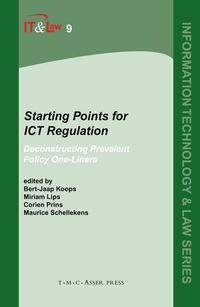
Starting Points for ICT Regulation
Deconstructing Prevalent Policy One-liners
Published on 27. April 2006
Book
Hardback
310 pages
978-90-6704-216-1 (ISBN)
Description
How does the 'on-line' world relate to the 'off-line' world? Is it different, separate, or even unique compared to the off-line world, or just a part thereof? And when do we need to regulate it, and how? These have become important, but complex questions for legislators, policy-makers, regulators, and politicians who design regulatory frameworks to address fast-moving technologies that change society in intricate ways.
Over the course of time, governments and international organizations have developed regulatory 'starting points', in order to consistently and effectively deal with ICT and Internet regulation. These offer policy one-liners such as 'what holds off-line, must hold on-line' and 'regulation should be technology-neutral'. This book questions these regulatory starting points in detail and systematically explores their application, meaning and value for international e-regulation. It digs deeper than existing literature in trying to find out in which cases the starting points merit attention, and how we should really use them.
This volume is the product of close collaboration and debate between scholars working at the Tilburg Institute for Law, Technology, and Society (TILT), to which international colleagues have added valuable reactions and reflections. The contributions in this volume have been written by TILT researchers Simone van der Hof, Bert-Jaap Koops, Miriam Lips, Sjaak Nouwt, Corien Prins, Maurice Schellekens. and Kees Stuurman , and by guest authors Dan Burk (University of Minnesota), Herbert Burkert (University of St. Gallen), and Yves Poullet (Facultés universitaires Notre-Dame de la Paix, Namur).
This is Volume 9 in the Information Technology and Law (IT&Law) Series
Over the course of time, governments and international organizations have developed regulatory 'starting points', in order to consistently and effectively deal with ICT and Internet regulation. These offer policy one-liners such as 'what holds off-line, must hold on-line' and 'regulation should be technology-neutral'. This book questions these regulatory starting points in detail and systematically explores their application, meaning and value for international e-regulation. It digs deeper than existing literature in trying to find out in which cases the starting points merit attention, and how we should really use them.
This volume is the product of close collaboration and debate between scholars working at the Tilburg Institute for Law, Technology, and Society (TILT), to which international colleagues have added valuable reactions and reflections. The contributions in this volume have been written by TILT researchers Simone van der Hof, Bert-Jaap Koops, Miriam Lips, Sjaak Nouwt, Corien Prins, Maurice Schellekens. and Kees Stuurman , and by guest authors Dan Burk (University of Minnesota), Herbert Burkert (University of St. Gallen), and Yves Poullet (Facultés universitaires Notre-Dame de la Paix, Namur).
This is Volume 9 in the Information Technology and Law (IT&Law) Series
More details
Series
Edition
1st Edition.
Language
English
Place of publication
The Hague
Germany
Target group
Professional and scholarly
Research
Illustrations
310 p.
Dimensions
Height: 241 mm
Width: 160 mm
Thickness: 23 mm
Weight
635 gr
ISBN-13
978-90-6704-216-1 (9789067042161)
DOI
10.1007/978-90-6704-665-7
Schweitzer Classification
Content
Inventory of General ICT Regulatory Starting Points.- What Holds Off-Line, Also Holds on-Line?.- Should ICT Regulation Be Technology-Neutral?.- Should Self-Regulation Be The Starting Point?.- Should ICT Regulation Be Undertaken at An International Level?.- CODE AS LAW?1.- Conclusion.- Selected Comments on Themes Developed in This Volume.- Selected Comments on Themes Developed in This Volume.- Selected Comments on Themes Developed in This Volume.