

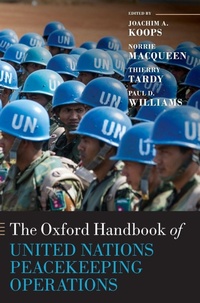
The Oxford Handbook of United Nations Peacekeeping Operations
Published on 9. July 2015
Book
Hardback
944 pages
978-0-19-968604-9 (ISBN)
Description
The Oxford Handbook of United Nations Peacekeeping Operations provides an innovative, authoritative, and accessible examination and critique of all 67 United Nations peacekeeping operations launched between 1948 and 2013. ^l Since the late 1940s, but particularly since the end of the cold war, peacekeeping has been the most visible and one of the most important activities of the United Nations and a significant part of global security governance and conflict management. The volume offers a chapter-by-chapter chronological analysis, designed to provide a comprehensive overview that highlights the evolution, changing nature and overall impact of UN peacekeeping. It also includes a collection of thematic chapters that examine key issues such as major trends of peace operations, the link between peacekeeping, humanitarian interventions and the responsibility to protect, peacekeeping and international law, the UN's inter-organizational partnerships and how to evaluate success or failure. ^l This handbook brings together leading scholars and senior practitioners in order to provide a comprehensive assessment of the successes, failures and lessons learned of UN peacekeeping since 1948. This is a unique reference book for scholars and practitioners working in the field of international relations, international security, peacekeeping and global governance.
Reviews / Votes
As with all Oxford Handbooks, this publication masters its enormous task with precision and elegance, providing readers with insightful summary chapters in Part I, followed by highly readable case studies in chronological order of the peacekeeping operations in Part II ... the editors and writers have made an important contribution to promote such an understanding among the UN member states. * Helmut Volger, PassBlue Blog * These chapters cover extensive ground and provide an up-to-date perspective on peacekeeping and international security. They also succeed in dispelling the conceptual confusion that prevails in some corners of the literature on peace missions....The book brings together an impressive group of academics and practitioners including leading scholars, senior diplomats and military officers with first-hand experience in UN peace operations. * Patrick A Mello, Political Studies Review *More details
Other editions
Additional editions
Joachim Koops | Norrie MacQueen | Thierry Tardy
The Oxford Handbook of United Nations Peacekeeping Operations
E-Book
07/2015
1st Edition
OUP eBook
€92.49
Available for download
Joachim Koops | Norrie MacQueen | Thierry Tardy
The Oxford Handbook of United Nations Peacekeeping Operations
E-Book
07/2015
1st Edition
OUP eBook
€92.49
Available for download
Persons
Joachim A. Koops is Associate Professor of Political Science at Vesalius College, Free University of Brussels (VUB) and Academic Director of the European Peace & Security Studies (EPSS) Programme and the Executive Course in Global Risk Analysis and Crisis Management (GRACM). He is also Research Professor at the VUB's Institute for European Studies and the founding Director of the Global Governance Institute (GGI), Brussels. His latest publications include SHIRBRIG and the Project of a UN Army: Successes, Failures, Lessons Learned (co-authored with C. Tatschl, Nomos, 2014), The Responsibility to Protect and the Third Pillar: A Critical Appraisal (co-edited with D. Fiott, PalgraveMacMillan, forthcoming), and The European Union as an Integrative Power? Assessing the EU's Effective Multilateralism towards the United Nations and NATO (Brussels University Press, 2011).
Norrie MacQueen is Honorary Research Fellow in the School in International Relations at the University of St Andrews. He worked for the Mozambican Ministry of Education in the years following the country's independence and taught for several years at the University of Papua New Guinea. More recently he served as an electoral officer with the United Nations peacekeeping mission in Timor-Leste. His latest books include: The United Nations, Peace Operations and the Cold War (2nd edition Longman, 2011), Humanitarian Intervention and the United Nations (Edinburgh UP, 2011), and The United Nations: a Beginner's Guide (Oneworld, 2010).
Thierry Tardy is Senior Analyst at the European Union Institute for Security Studies (EUISS) in Paris. Previously he was Senior Fellow at the Geneva Centre for Security Policy (GCSP). He has researched and published on conflict management with a particular focus on the United Nations and the European Union, inter-institutional cooperation in security governance, security regionalism, and the EU Common Security and Defence Policy. His books include Peacekeeping in Africa: The Evolving Security Architecture (Routledge, 2014, edited with M. Wyss), and European Security in a Global Context. Internal and External Dynamics (Routledge, 2009, edited).
Paul D. Williams is Associate Professor in the Elliott School of International Affairs at the George Washington University, USA. He also serves as a Non-resident Senior Adviser at the International Peace Institute (IPI) in New York City and a Visiting Professor at the Institute for Peace and Security Studies in Addis Ababa, Ethiopia. At IPI, he co-manages the Providing for Peacekeeping Project, which aims to generate and disseminate data and analysis to support efforts to improve the quality of troop and police contributions to UN peacekeeping and fill key capability gaps in those missions. His latest books include: Providing Peacekeepers: The Politics, Challenges and Future of UN Peacekeeping Contributions (Oxford University Press, 2013), Understanding Peacekeeping (Polity, 2nd ed. 2010), and The International Politics of Mass Atrocities: The Case of Darfur (Routledge, 2010).
Norrie MacQueen is Honorary Research Fellow in the School in International Relations at the University of St Andrews. He worked for the Mozambican Ministry of Education in the years following the country's independence and taught for several years at the University of Papua New Guinea. More recently he served as an electoral officer with the United Nations peacekeeping mission in Timor-Leste. His latest books include: The United Nations, Peace Operations and the Cold War (2nd edition Longman, 2011), Humanitarian Intervention and the United Nations (Edinburgh UP, 2011), and The United Nations: a Beginner's Guide (Oneworld, 2010).
Thierry Tardy is Senior Analyst at the European Union Institute for Security Studies (EUISS) in Paris. Previously he was Senior Fellow at the Geneva Centre for Security Policy (GCSP). He has researched and published on conflict management with a particular focus on the United Nations and the European Union, inter-institutional cooperation in security governance, security regionalism, and the EU Common Security and Defence Policy. His books include Peacekeeping in Africa: The Evolving Security Architecture (Routledge, 2014, edited with M. Wyss), and European Security in a Global Context. Internal and External Dynamics (Routledge, 2009, edited).
Paul D. Williams is Associate Professor in the Elliott School of International Affairs at the George Washington University, USA. He also serves as a Non-resident Senior Adviser at the International Peace Institute (IPI) in New York City and a Visiting Professor at the Institute for Peace and Security Studies in Addis Ababa, Ethiopia. At IPI, he co-manages the Providing for Peacekeeping Project, which aims to generate and disseminate data and analysis to support efforts to improve the quality of troop and police contributions to UN peacekeeping and fill key capability gaps in those missions. His latest books include: Providing Peacekeepers: The Politics, Challenges and Future of UN Peacekeeping Contributions (Oxford University Press, 2013), Understanding Peacekeeping (Polity, 2nd ed. 2010), and The International Politics of Mass Atrocities: The Case of Darfur (Routledge, 2010).
Editor
Dean of Vesalius College & Research Professor IES (VUB) and Director of the Global Governance Institute (GGI)Dean of Vesalius College & Research Professor IES (VUB) and Director of the Global Governance Institute (GGI)
Honorary Research Fellow, School in International RelationsHonorary Research Fellow, School in International Relations, University of St Andrews
Senior AnalystSenior Analyst, European Union Institute for Security Studies (EUISS), Paris
Associate Professor, Elliott School of International AffairsAssociate Professor, Elliott School of International Affairs, George Washington University
Content
PART I: CONCEPTS AND PERSPECTIVES; PART II: UN PEACEKEEPING OPERATIONS - 1948-2013; SECTION 1: EARLY EXPERIENCES - 1948-1963; SECTION 2: COLD WAR PEACEKEEPING - 1964-1987; SECTION 3: POST-COLD WAR PEACEKEEPING - 1988-1998; SECTION 4: PEACEKEEPING IN THE TWENTY-FIRST CENTURY - 1999-2013