

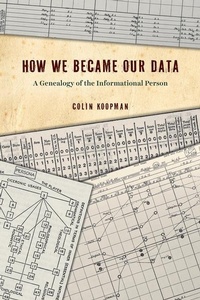
How We Became Our Data
A Genealogy of the Informational Person
Published on 31. May 2019
Book
Paperback/Softback
272 pages
978-0-226-62658-1 (ISBN)
Description
We are now acutely aware, as if all of the sudden, that data matters enormously to how we live. How did information come to be so integral to what we can do? How did we become people who effortlessly present our lives in social media profiles and who are meticulously recorded in state surveillance dossiers and online marketing databases? What is the story behind data coming to matter so much to who we are?
In How We Became Our Data, Colin Koopman excavates early moments of our rapidly accelerating data-tracking technologies and their consequences for how we think of and express our selfhood today. Koopman explores the emergence of mass-scale record keeping systems like birth certificates and social security numbers, as well as new data techniques for categorizing personality traits, measuring intelligence, and even racializing subjects. This all culminates in what Koopman calls the "informational person" and the "informational power" we are now subject to. The recent explosion of digital technologies that are turning us into a series of algorithmic data points is shown to have a deeper and more turbulent past than we commonly think. Blending philosophy, history, political theory, and media theory in conversation with thinkers like Michel Foucault, J rgen Habermas, and Friedrich Kittler, Koopman presents an illuminating perspective on how we have come to think of our personhood--and how we can resist its erosion.
In How We Became Our Data, Colin Koopman excavates early moments of our rapidly accelerating data-tracking technologies and their consequences for how we think of and express our selfhood today. Koopman explores the emergence of mass-scale record keeping systems like birth certificates and social security numbers, as well as new data techniques for categorizing personality traits, measuring intelligence, and even racializing subjects. This all culminates in what Koopman calls the "informational person" and the "informational power" we are now subject to. The recent explosion of digital technologies that are turning us into a series of algorithmic data points is shown to have a deeper and more turbulent past than we commonly think. Blending philosophy, history, political theory, and media theory in conversation with thinkers like Michel Foucault, J rgen Habermas, and Friedrich Kittler, Koopman presents an illuminating perspective on how we have come to think of our personhood--and how we can resist its erosion.
More details
Language
English
Place of publication
Chicago
United States
Publishing group
The University of Chicago Press
Product notice
Paperback (trade)
Unsewn / adhesive bound
Illustrations
19 halftones
Dimensions
Height: 226 mm
Width: 151 mm
Thickness: 20 mm
Weight
427 gr
ISBN-13
978-0-226-62658-1 (9780226626581)
Copyright in bibliographic data and cover images is held by Nielsen Book Services Limited or by the publishers or by their respective licensors: all rights reserved.
Schweitzer Classification
Other editions
Additional editions
E-Book
12/2022
1st Edition
University of Chicago Press
from
€27.60
Available for download
Person
Colin Koopman is associate professor of philosophy and director of the New Media & Culture Program at the University of Oregon.