

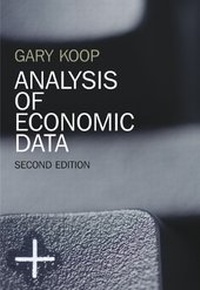
Analysis of Economic Data
2nd Edition
Published on 10. December 2004
Book
Paperback/Softback
256 pages
978-0-470-02468-3 (ISBN)
Description
Analysis of Economic Data teaches methods of data analysis to students whose primary interest is not in econometrics, statistics or mathematics. It shows students how to apply econometric techniques in the context of real-world empirical problems. It adopts a largely non-mathematical approach relying on verbal and graphical intuition and covers most of the tools used in modern econometrics research e.g. correlation, regression and extensions for time-series methods. It contains extensive use of real data examples and involves readers in hands-on computer work. The new edition includes new material on the mathematical background required by students and, for those readers unfamiliar with this background, a brief explanation of the relevant mathematics. Topics covered include: the equation of a straight line, the summation operator, and logarithms. The author also includes a much greater discussion of data transformations such as growth rates and index numbers. More material will also be added on data sources, largely focusing on internet data sources.
* Gary Koop has a very high international profile in the field of econometrics and is well known for his books and numerous journal publications.
* The second edition provides stronger coverage of the relevant introductory mathematics, including: the equation of a straight line, the summation operator, and logarithms. This will make the book more accessible for those students who have limited mathematical skills.
* Greater discussion is also provided of data transformations such as growth rate and index numbers. Index numbers are becoming increasingly important and are frequently used in economics courses.
* More material will also be provided on data sources, especially internet data sources which are becoming extremely important as a means of gathering data. Some students have difficulty with the collection of data and the inclusion of this material will help those students.
* Gary Koop has a very high international profile in the field of econometrics and is well known for his books and numerous journal publications.
* The second edition provides stronger coverage of the relevant introductory mathematics, including: the equation of a straight line, the summation operator, and logarithms. This will make the book more accessible for those students who have limited mathematical skills.
* Greater discussion is also provided of data transformations such as growth rate and index numbers. Index numbers are becoming increasingly important and are frequently used in economics courses.
* More material will also be provided on data sources, especially internet data sources which are becoming extremely important as a means of gathering data. Some students have difficulty with the collection of data and the inclusion of this material will help those students.
More details
Edition
2., Auflage
Language
English
Place of publication
Chichester
United Kingdom
Publishing group
John Wiley and Sons Ltd
Target group
Professional and scholarly
Edition type
Revised edition
Illustrations
Illustrations
Dimensions
Height: 24.4 cm
Width: 16.8 cm
Thickness: 20 mm
Weight
454 gr
ISBN-13
978-0-470-02468-3 (9780470024683)
Schweitzer Classification
Other editions
New editions

Gary Koop
Analysis of Economic Data
Book
02/2009
3rd Edition
Wiley
€46.90
Article exhausted; check for reprint
Previous edition

Gary Koop
Analysis of Economic Data
Book
02/2000
1st Edition
Wiley
€34.90
Article exhausted; check for reprint
Person
Gary Koop is Professor of Economics at the University of Leicester.
Content
Preface to the first edition.
Preface to the second edition.
Chapter 1: Introduction.
Chapter 2: Basic data handling.
Chapter 3: Correlation.
Chapter 4: An introduction to simple regression.
Chapter 5: Statistical aspects of regression.
Chapter 6: Multiple regression.
Chapter 7: Regression with dummy variables.
Chapter 8: Regression with time lags: distributed lag models.
Chapter 9: Univariate time series analysis.
Chapter 10: Regression with time series variables.
Chapter 11: Applications of time series methods in macroeconomics and finance.
Chapter 12: Limitations and extensions.
Appendix A: Writing an empirical project.
Appendix B: Data directory.
Index.
Preface to the second edition.
Chapter 1: Introduction.
Chapter 2: Basic data handling.
Chapter 3: Correlation.
Chapter 4: An introduction to simple regression.
Chapter 5: Statistical aspects of regression.
Chapter 6: Multiple regression.
Chapter 7: Regression with dummy variables.
Chapter 8: Regression with time lags: distributed lag models.
Chapter 9: Univariate time series analysis.
Chapter 10: Regression with time series variables.
Chapter 11: Applications of time series methods in macroeconomics and finance.
Chapter 12: Limitations and extensions.
Appendix A: Writing an empirical project.
Appendix B: Data directory.
Index.