

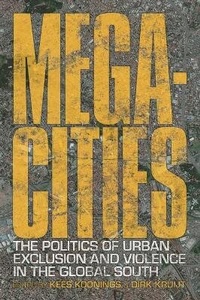
Megacities
The Politics of Urban Exclusion and Violence in the Global South
Published on 10. December 2009
Book
Hardback
208 pages
978-1-84813-295-5 (ISBN)
Description
For the first time in history, the majority of the world's population lives in cities, the result of a rapid process of urbanization that started in the second half of the twentieth century. 'Megacities' around the world are rapidly becoming the scene for deprivation, especially in the global South, and the urban excluded face the brunt of what in many cases seems like low-intensity warfare.
Featuring case studies from across the globe, including Latin America, the Middle East and Africa, Megacities examines recent worldwide trends in poverty and social exclusion, urban violence and politics, and links these to the challenges faced by policy-makers and practitioners.
Featuring case studies from across the globe, including Latin America, the Middle East and Africa, Megacities examines recent worldwide trends in poverty and social exclusion, urban violence and politics, and links these to the challenges faced by policy-makers and practitioners.
Reviews / Votes
'Trends in the social and political landscapes of today's cities will underpin significant aspects of our global future now that the world's population is mainly urban and are therefore ever more pressing arenas for social science research. This book provides a compelling, and at times devastating, appraisal of contemporary evidence about the social, political and economic exclusion of the poor urban majority in the global south. Of particular significance is the book's focus on the ways in which violence has become an increasing element in the exclusion of the urban poor from the potential benefits of an urban existence in certain megacities. Particularly in large Latin American cities, the everyday experience of the residents in low-income settlements is so affected by violence - from drug-related gangs, from private armed militias and from deeply corrupt and inadequate police forces that it has become the worst of the many problems they face. When Janice Perlman who, in the 1970s, championed the idea that the concept of urban marginality was a myth argues that violence in Rio de Janeiro has made marginalization a reality, we should take note and listen. Megacities also provides insightful analysis of developments in our understanding of urban politics in the global south, and the various explicit and covert ways the urban poor with varying degrees of success seek to improve their livelihoods in globalizing urban centres. There are crucial questions involved such as who has a right to the city, are there separate categories of citizens and pseudo-citizens, and can cities fulfil their potential as sites where democracy might be facilitated, rather than areas where people's options are closed down by the fear and violence that deepening inequality inevitably brings?'Dr Deborah Potts, King's College London.
'This edited volume is a useful academic insertion into discussions in the development community about poverty alleviation and good governance in the so-called megacities of the Global South. A fine roster of scholars articulates the ways in which poverty is intertwined with inequality, social and political exclusion as well as crime and increasing violence in cities in Latin America, the Middle East, and Southern Africa. Their work is quite valuable for its analysis of the contradictions embedded in the ways in which a rhetorical advance of participatory, democratic governance aimed at poverty reduction runs smack into the real wall of repression, insecurity, and injustice.'
Garth Myers, University of Kansas
More details
Language
English
Place of publication
United Kingdom
Publishing group
Bloomsbury Publishing PLC
Target group
College/higher education
Professional and scholarly
Dimensions
Height: 234 mm
Width: 156 mm
ISBN-13
978-1-84813-295-5 (9781848132955)
Copyright in bibliographic data and cover images is held by Nielsen Book Services Limited or by the publishers or by their respective licensors: all rights reserved.
Schweitzer Classification
Other editions
Additional editions
Kees Koonings | Dirk Kruijt
Megacities
The Politics of Urban Exclusion and Violence in the Global South
E-Book
12/2009
1st Edition
Zed Books Ltd
€35.49
Available for download
Persons
Kees Koonings is Associate Professor of Development Studies and Latin American Studies at the Faculty of Social Sciences of Utrecht University. He has published on development issues, ethnicity, the military, democracy and violence in Latin America. He has previously co-edited Societies of Fear (1999), Political Armies (2002), Armed Actors (2004) and Fractured Cities (2007). His current research interests include the armed conflict and peace processes in Colombia, and social mobilization and citizenship in Brazil.
Dirk Kruijt is Honorary Professor of Development Studies at the Faculty of Social and Behavioural Sciences of Utrecht University. He has published on social exclusion, poverty and Informalisation, military dictatorship, guerrilla movements, civil wars and ethnic conflicts, peace negotiations and post-war reconstruction. He has previously co-edited Societies of Fear (1999), Political Armies (2002), Armed Actors (2004) and Fractured Cities (2007) and published Guerrillas (2008) with Zed Books.
Dirk Kruijt is Honorary Professor of Development Studies at the Faculty of Social and Behavioural Sciences of Utrecht University. He has published on social exclusion, poverty and Informalisation, military dictatorship, guerrilla movements, civil wars and ethnic conflicts, peace negotiations and post-war reconstruction. He has previously co-edited Societies of Fear (1999), Political Armies (2002), Armed Actors (2004) and Fractured Cities (2007) and published Guerrillas (2008) with Zed Books.
Content
Acknowledgements
Introduction
1. The Rise of Megacities and the Urbanization of Informality, Exclusion and Violence - Dirk Kruijt & Kees Koonings
Part I: The Social Dynamics of Exclusion and Violence in Megacities
2. From Popular Movements to Drug Gangs to Militias: An Anatomy of Violence in Rio de Janeiro by Robert Gay
3. Megacity's Violence and its Consequences in Rio de Janeiro by Janice Perlman
4. Coping with Urban Violence: State and Community Responses to Crime and Insecurity in Guayaquil, Ecuador by Caroline Moser
5. Middle Eastern Megacities: Social Exclusion, Popular Movements and the Quiet Encroachment of the Urban Poor by Asef Bayat
Part II: Political and Policy Dimensions of Urban Exclusion and Violence
6. Urban Governance and the Paradox of Conflict by Jo Beall
7. Shoot the Citizen, Save the Customer: Participatory Budgeting and Bare Citizenship in Porto Alegre, Brazil by Sergio Gregorio Baierle
8. Crisis of the State, Violence in the City by Mariano Aguirre
9. Urban Exclusion and the (False) Assumptions of Spatial Policy Reform in South Africa by Susan Parnell and Owen Crankshaw
Conclusions: Governing Exclusion and Violence in Megacities by Kees Koonings & Dirk Kruijt
Introduction
1. The Rise of Megacities and the Urbanization of Informality, Exclusion and Violence - Dirk Kruijt & Kees Koonings
Part I: The Social Dynamics of Exclusion and Violence in Megacities
2. From Popular Movements to Drug Gangs to Militias: An Anatomy of Violence in Rio de Janeiro by Robert Gay
3. Megacity's Violence and its Consequences in Rio de Janeiro by Janice Perlman
4. Coping with Urban Violence: State and Community Responses to Crime and Insecurity in Guayaquil, Ecuador by Caroline Moser
5. Middle Eastern Megacities: Social Exclusion, Popular Movements and the Quiet Encroachment of the Urban Poor by Asef Bayat
Part II: Political and Policy Dimensions of Urban Exclusion and Violence
6. Urban Governance and the Paradox of Conflict by Jo Beall
7. Shoot the Citizen, Save the Customer: Participatory Budgeting and Bare Citizenship in Porto Alegre, Brazil by Sergio Gregorio Baierle
8. Crisis of the State, Violence in the City by Mariano Aguirre
9. Urban Exclusion and the (False) Assumptions of Spatial Policy Reform in South Africa by Susan Parnell and Owen Crankshaw
Conclusions: Governing Exclusion and Violence in Megacities by Kees Koonings & Dirk Kruijt