

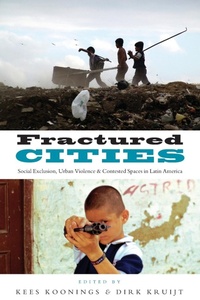
Fractured Cities
Social Exclusion, Urban Violence and Contested Spaces in Latin America
Published on 15. November 2006
Book
Paperback/Softback
176 pages
978-1-84277-731-2 (ISBN)
Description
As cities sprawl across Latin America, absorbing more and more of its people, crime and violence have become inescapable.
From the paramilitary invasion of Medell!n in Colombia, the booming wealth of crack dealers in Managua, Nicaragua and police corruption in Mexico City, to the glimmers of hope in Lima, this book provides a dynamic analysis of urban insecurity. Based on new empirical evidence, interviews with local people and historical contextualization, the authors attempts to shed light on the fault-lines which have appeared in Latin American society.
Neoliberal economic policy, it is argued, has intensified the gulf between elites, insulated in gated estates monitored by private security firms, and the poor, who are increasingly mistrustful of state-sponsored attempts to impose order on their slums. Rather than the current trend towards government withdrawal, the situation can only be improved by co-operation between communities and police to build new networks of trust. In the end, violence and insecurity are inseparable from social justice and democracy.
From the paramilitary invasion of Medell!n in Colombia, the booming wealth of crack dealers in Managua, Nicaragua and police corruption in Mexico City, to the glimmers of hope in Lima, this book provides a dynamic analysis of urban insecurity. Based on new empirical evidence, interviews with local people and historical contextualization, the authors attempts to shed light on the fault-lines which have appeared in Latin American society.
Neoliberal economic policy, it is argued, has intensified the gulf between elites, insulated in gated estates monitored by private security firms, and the poor, who are increasingly mistrustful of state-sponsored attempts to impose order on their slums. Rather than the current trend towards government withdrawal, the situation can only be improved by co-operation between communities and police to build new networks of trust. In the end, violence and insecurity are inseparable from social justice and democracy.
More details
Language
English
Place of publication
United Kingdom
Publishing group
Bloomsbury Publishing PLC
Target group
College/higher education
Professional and scholarly
Dimensions
Height: 234 mm
Width: 156 mm
Thickness: 10 mm
Weight
275 gr
ISBN-13
978-1-84277-731-2 (9781842777312)
Copyright in bibliographic data and cover images is held by Nielsen Book Services Limited or by the publishers or by their respective licensors: all rights reserved.
Schweitzer Classification
Other editions
Additional editions
Kees Koonings | Dirk Kruijt
Fractured Cities
Social Exclusion, Urban Violence and Contested Spaces in Latin America
E-Book
04/2013
1st Edition
Zed Books Ltd
€35.49
Available for download
Kees Koonings | Dirk Kruijt
Fractured Cities
Social Exclusion, Urban Violence and Contested Spaces in Latin America
E-Book
02/2008
1st Edition
Zed Books Ltd
€35.49
Available for download
Persons
Kees Koonings is Associate Professor of Development Studies in the Faculty of Social Sciences, Utrecht University.
Dirk Kruijt is Professor of Development Studies in the Faculty of Social Sciences, Utrecht University.
Dirk Kruijt is Professor of Development Studies in the Faculty of Social Sciences, Utrecht University.
Content
Introduction: The Duality of Latin American Cityscapes
Part I: Fractured Cities, Second-Class Citizenship, and Urban Violence
Urban poverty, desborde popular and the erosion of the formal social order
From desborde popular to desborde de la violencia : conceptualising exclusion, insecurity and violence
Armed actors and violence brokers
The politics of urban violence
Parallel power and perverse integration
Part II: Rio de Janeiro
Introduction
Favela-Related Violence
Impact on Education
Motives for involvement in drug-trading
Police and Community - Negative Dialogues
Political-Administrative Constraints
Police Oversight and the Lack of Political Will - Costs and Consequences
Conclusions
Part III: Mexico City
Violence as fact and phantom
Metropolitan structure and security governance
Patterns and actors of insecurity and violence
Governmental and societal responses and strategies
Conclusions
Part IV: Medelli.
History of urban violence in Medellin
Daily life under guerrillas and paramilitaries
A promising peace process with paramilitaries
Concluding remarks
Part V: Managua
Introduction
Barrio Luis Fanor Hern ndez: Past and Present
Drugs, material wealth, and conspicuous consumption
Consumption, cultural exclusion, and predation
Violence and primitive accumulation
Conclusion
Part VI: Caracas
Divided Caracas
The advent of violence in Caracas
Forms of violence
Fear as an urban sentiment
The loss of the city
Democracy and violence in the city
Part VII: Lima Metropolitana
City of informales
New social actors and new forms of popular organisation
Low-Intensity Violence
Conclusion
Part VII:
Living in Fear: How the Urban Poor Perceive Violence, Fear and Insecurity
Cathy McIlwaine and Caroline O.N. Moser
The Diversity and Complexity of Violence among the Urban Poor
Urban Poor Constructions of Fear: Social Fragmentation and Spatial Restrictions
The Legitimization of Violence among the Urban Poor I: The Emergence of Perverse Social Organizations
The Legitimization of Violence among the Urban Poor II: Inadequate State Security and Judicial Protection
Non-violent Coping: a Gendered Response
Conclusions
Epilogue: Latin America's Urban Duality Revisited
Bibliography
Index
Part I: Fractured Cities, Second-Class Citizenship, and Urban Violence
Urban poverty, desborde popular and the erosion of the formal social order
From desborde popular to desborde de la violencia : conceptualising exclusion, insecurity and violence
Armed actors and violence brokers
The politics of urban violence
Parallel power and perverse integration
Part II: Rio de Janeiro
Introduction
Favela-Related Violence
Impact on Education
Motives for involvement in drug-trading
Police and Community - Negative Dialogues
Political-Administrative Constraints
Police Oversight and the Lack of Political Will - Costs and Consequences
Conclusions
Part III: Mexico City
Violence as fact and phantom
Metropolitan structure and security governance
Patterns and actors of insecurity and violence
Governmental and societal responses and strategies
Conclusions
Part IV: Medelli.
History of urban violence in Medellin
Daily life under guerrillas and paramilitaries
A promising peace process with paramilitaries
Concluding remarks
Part V: Managua
Introduction
Barrio Luis Fanor Hern ndez: Past and Present
Drugs, material wealth, and conspicuous consumption
Consumption, cultural exclusion, and predation
Violence and primitive accumulation
Conclusion
Part VI: Caracas
Divided Caracas
The advent of violence in Caracas
Forms of violence
Fear as an urban sentiment
The loss of the city
Democracy and violence in the city
Part VII: Lima Metropolitana
City of informales
New social actors and new forms of popular organisation
Low-Intensity Violence
Conclusion
Part VII:
Living in Fear: How the Urban Poor Perceive Violence, Fear and Insecurity
Cathy McIlwaine and Caroline O.N. Moser
The Diversity and Complexity of Violence among the Urban Poor
Urban Poor Constructions of Fear: Social Fragmentation and Spatial Restrictions
The Legitimization of Violence among the Urban Poor I: The Emergence of Perverse Social Organizations
The Legitimization of Violence among the Urban Poor II: Inadequate State Security and Judicial Protection
Non-violent Coping: a Gendered Response
Conclusions
Epilogue: Latin America's Urban Duality Revisited
Bibliography
Index