

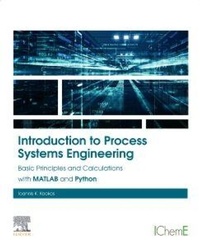
Introduction to Process Systems Engineering
Basic Principles and Calculations with MATLAB and Python
Will be published approx. on 21. August 2026
Book
Paperback/Softback
350 pages
978-0-443-45444-8 (ISBN)
Description
Introduction to Process Systems Engineering: Basic Principles and Calculations with MATLAB and Python comprehensively approaches how to master core chemical engineering concepts through computational methods. The book bridges the gap between theory and practice by integrating numerical computations from the outset, enabling students and professionals to develop practical skills alongside foundational knowledge. Covering essential topics such as mass and energy balances, property calculations, vapor-liquid equilibria, and process optimization, the book emphasizes realistic problem-solving using accessible MATLAB and Python programs. Each chapter features real-world examples, progressively increasing in complexity to build confidence and competence.
The material is tailored to current chemical engineering practice, making it an invaluable resource for students, researchers, and industry practitioners seeking to enhance their computational and analytical capabilities in process systems engineering. This book empowers readers to learn by doing, fostering a deeper understanding of both theoretical principles and their practical applications.
The material is tailored to current chemical engineering practice, making it an invaluable resource for students, researchers, and industry practitioners seeking to enhance their computational and analytical capabilities in process systems engineering. This book empowers readers to learn by doing, fostering a deeper understanding of both theoretical principles and their practical applications.
More details
Language
English
Place of publication
Philadelphia
United States
Target group
Professional and scholarly
Dimensions
Height: 235 mm
Width: 191 mm
Weight
450 gr
ISBN-13
978-0-443-45444-8 (9780443454448)
Copyright in bibliographic data and cover images is held by Nielsen Book Services Limited or by the publishers or by their respective licensors: all rights reserved.
Schweitzer Classification
Person
Ioannis K. Kookos is a Professor in the Department of Chemical Engineering at the University of Patras, with a Diploma from the National Technical University of Athens and advanced degrees from Imperial College, London. His research emphasizes the design, economic analysis, and optimization of renewable energy and platform chemical production systems. He has over 130 publications, authored five books in Greek, and two in English, with significant citation metrics. Kookos directs the "Design, Economic Analysis and Optimization? Laboratory and the Institute of Circular Economy, supervising numerous students and researchers. His teaching spans over 25 years, covering various chemical engineering courses.
Content
1. Introduction
2. Basic Definitions
3. Mass Balance Equations
4. Energy Balance In Macroscopic Systems
5. Material Balances At Steady State 5.1introduction
6. Simultaneous Material And Energy Balances At Steady State
7. Calculating Properties Of Pure Components
8. Vapour-Liquid Equilibria Calculations
9. Graphical Methods Of Design
10. Dimensional Analysis And Scale Up
11. Differential Balances
12. Solving Nonlinear Algebraic And Differential Equations
13. Optimization Of Chemical Processes
14. Batch Processes
15. Phycrometry, Refrigeration And Power Production Cycles 15.1 Introduction
16. Energy And Energy Production Systems
2. Basic Definitions
3. Mass Balance Equations
4. Energy Balance In Macroscopic Systems
5. Material Balances At Steady State 5.1introduction
6. Simultaneous Material And Energy Balances At Steady State
7. Calculating Properties Of Pure Components
8. Vapour-Liquid Equilibria Calculations
9. Graphical Methods Of Design
10. Dimensional Analysis And Scale Up
11. Differential Balances
12. Solving Nonlinear Algebraic And Differential Equations
13. Optimization Of Chemical Processes
14. Batch Processes
15. Phycrometry, Refrigeration And Power Production Cycles 15.1 Introduction
16. Energy And Energy Production Systems