

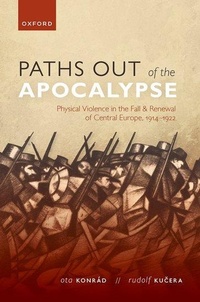
Paths out of the Apocalypse
Physical Violence in the Fall and Renewal of Central Europe, 1914-1922
Published on 24. May 2022
Book
Hardback
368 pages
978-0-19-289678-0 (ISBN)
Description
Paths out of the Apocalypse uses violence as a prism through which to investigate the profound social, cultural, and political changes experienced by (post-) Habsburg Central Europe during and immediately after the Great War. It compares attitudes toward, and experiences and practices of, physical violence in the mostly Czech-speaking territories of Bohemia and Moravia, the German-speaking territories that would constitute the Republic of Austria after 1918, and the mostly German-speaking region of South Tyrol. Based on research in national and local archives and copious secondary literature, the study argues that, in the context of total war, physical violence became a predominant means of conceptualizing and expressing social-political demands as well as a means of demarcating various notions of community and belonging. The authors apply an interdisciplinary understanding of violence informed by sociological and psychological theories as well as by rigorous empirical historiographical approach. First, they examine the most severe kind of physical violence - murder - against the backdrop of shifting scientific and media discourses during the war and its immediate aftermath. Second, the authors use numerous cases of collective violence, ranging from less serious everyday conflicts to massive hunger demonstrations and riots, to unravel its 'language', thus deciphering the attitudes and values shared among an ever-growing group of perpetrators. Paths out of the Apocalypse thus fundamentally rethinks some key topics currently debated in the scholarship on early twentieth-century Central Europe, the First World War, violence, nationalism, and modern European comparative social and cultural history.
Reviews / Votes
Methodically, the book stands out as an ambitious interlacing of perspectives...consult this volume as a material-rich and stimulating special research on the history of violence in three historical areas of the dual monarchy. * Markus Poehlmann, Journal of History *More details
Series
Language
English
Place of publication
Oxford
United Kingdom
Target group
College/higher education
Product notice
sewn/stitched
Cloth over boards
Illustrations
17 black and white figures/illustrations
Dimensions
Height: 241 mm
Width: 163 mm
Thickness: 30 mm
Weight
698 gr
ISBN-13
978-0-19-289678-0 (9780192896780)
Copyright in bibliographic data and cover images is held by Nielsen Book Services Limited or by the publishers or by their respective licensors: all rights reserved.
Schweitzer Classification
Other editions
Additional editions
Ota Konrád | Rudolf Kucera
Paths out of the Apocalypse
Physical Violence in the Fall and Renewal of Central Europe, 1914-1922
E-Book
05/2022
1st Edition
OUP eBook
€62.99
Available for download
Ota Konrád | Rudolf Kucera
Paths out of the Apocalypse
Physical Violence in the Fall and Renewal of Central Europe, 1914-1922
E-Book
05/2022
1st Edition
OUP eBook
€62.99
Available for download
Persons
Ota Konrad is an Associate Professor of Modern History and Director of Modern History PhD Program at Charles University in Prague. He has worked on topics dealing with the history of the humanities, history of the foreign policy, history of WWI in Central Europe, the cultural history of violence, and contemporary Austrian history. He is the author of Geisteswissenschaften im Umbruch: Die Faecher Geschichte, Germanistik und Slawistik an der Deutschen Universitaet in Prag 1918-1945 (2020). Currently, he is working on a project supported by the Humboldt foundation about collective violence as a tool for reshaping national identities at the end of WWII in Europe, mainly in Czechoslovakia.
Rudolf Kucera is Director of the Masaryk Institute and Archives of the Czech Academy of Sciences and Associate Professor of Modern History at the Faculty of Social Sciences of the Charles University in Prague. He was a visiting professor at the University of Vienna and is currently a permanent visiting professor at the University of Konstanz. He is the author of Rationed Life: Science, Everyday Life, and Working-Class Politics in the Bohemian Lands, 1914-1918 (2016).
Rudolf Kucera is Director of the Masaryk Institute and Archives of the Czech Academy of Sciences and Associate Professor of Modern History at the Faculty of Social Sciences of the Charles University in Prague. He was a visiting professor at the University of Vienna and is currently a permanent visiting professor at the University of Konstanz. He is the author of Rationed Life: Science, Everyday Life, and Working-Class Politics in the Bohemian Lands, 1914-1918 (2016).
Content
Introduction Part I 1: Uncle Rudolf 2: Degenerates 3: Seeking the truth 4: Mental illness in court 5: Poverty in court 6: Improvising in court 7: Jack the Ripper and Sherlock Holmes 8: Cannibals, poachers, and deserters 9: Crime or politics 10: That the president may long govern 11: Ominous eagles PART II 12: Youths outside the house 13: Prostitutes and workers 14: Appeasement in the public square 15: Fat ones, rich ones, Jews, and gendarmes 16: The Russian hunter 17: Disintegrating societies 18: The wild west or a new republic? 19: The victors and the vanquished 20: A slapped factory owner 21: Gallows and committess 22: The wild east 23: Blackshirts Conclusion