

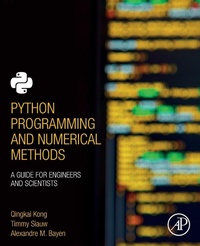
Python Programming and Numerical Methods
A Guide for Engineers and Scientists
Published on 2. December 2020
Book
Paperback/Softback
480 pages
978-0-12-819549-9 (ISBN)
Description
Python Programming and Numerical Methods: A Guide for Engineers and Scientists introduces programming tools and numerical methods to engineering and science students, with the goal of helping the students to develop good computational problem-solving techniques through the use of numerical methods and the Python programming language. Part One introduces fundamental programming concepts, using simple examples to put new concepts quickly into practice. Part Two covers the fundamentals of algorithms and numerical analysis at a level that allows students to quickly apply results in practical settings.
More details
Language
English
Place of publication
San Diego
United States
Publishing group
Elsevier Science Publishing Co Inc
Target group
College/higher education
Senior undergraduates or graduate students in engineering and science who are taking a numerical methods course using Python
Dimensions
Height: 233 mm
Width: 189 mm
Thickness: 30 mm
Weight
998 gr
ISBN-13
978-0-12-819549-9 (9780128195499)
Copyright in bibliographic data and cover images is held by Nielsen Book Services Limited or by the publishers or by their respective licensors: all rights reserved.
Schweitzer Classification
Other editions
Additional editions
Qingkai Kong | Timmy Siauw | Alexandre Bayen
Python Programming and Numerical Methods
A Guide for Engineers and Scientists
E-Book
11/2020
Academic Press
€69.95
Available for download
Persons
Qingkai Kong is currently a seismologist at Lawrence Livermore National Laboratory. He is actively working on using machine learning approaches for seismic simulations and explosion discrimination. Dr. Kong has a Master's degree in Structural Engineering and a PhD. in Earth Science. Before joining the lab, he worked at Berkeley Division of Data Sciences and Berkeley Seismology Lab as a researcher to develop the MyShake project. He also worked as a visiting researcher at Google's visiting Faculty program to help build the Android Earthquake Alerting system. In his spare time, he loves playing soccer and kayaking in SF bay. Play better, work better.
Alexandre Bayen is the Liao-Cho Professor of Engineering at UC Berkeley. He is a Professor of Electrical Engineering and Computer Science, and Civil and Environmental Engineering. He is currently the Director of the Institute of Transportation Studies (ITS). He is also a Faculty Scientist in Mechanical Engineering, at the Lawrence Berkeley National Laboratory (LBNL). He received the Engineering Degree in applied mathematics from the Ecole Polytechnique, France, in 1998, the M.S. and Ph.D. in aeronautics and astronautics from Stanford University in 1998 and 1999 respectively. He was a Visiting Researcher at NASA Ames Research Center from 2000 to 2003. Between January 2004 and December 2004, he worked as the Research Director of the Autonomous Navigation Laboratory at the Laboratoire de Recherches Balistiques et Aerodynamiques, (Ministere de la Defense, Vernon, France), where he holds the rank of Major. He has been on the faculty at UC Berkeley since 2005. Bayen has authored two books and over 200 articles in peer reviewed journals and conferences. He is the recipient of the Ballhaus Award from Stanford University, 2004, of the CAREER award from the National Science Foundation, 2009 and he is a NASA Top 10 Innovators on Water Sustainability, 2010. His projects Mobile Century and Mobile Millennium received the 2008 Best of ITS Award for 'Best Innovative Practice', at the ITS World Congress and a TRANNY Award from the California Transportation Foundation, 2009. Mobile Millennium has been featured more than 200 times in the media, including TV channels and radio stations (CBS, NBC, ABC, CNET, NPR, KGO, the BBC), and in the popular press (Wall Street Journal, Washington Post, LA Times). Bayen is the recipient of the Presidential Early Career Award for Scientists and Engineers (PECASE) award from the White House, 2010. He is also the recipient of the Okawa Research Grant Award, the Ruberti Prize from the IEEE, and the Huber Prize from the ASCE.
Alexandre Bayen is the Liao-Cho Professor of Engineering at UC Berkeley. He is a Professor of Electrical Engineering and Computer Science, and Civil and Environmental Engineering. He is currently the Director of the Institute of Transportation Studies (ITS). He is also a Faculty Scientist in Mechanical Engineering, at the Lawrence Berkeley National Laboratory (LBNL). He received the Engineering Degree in applied mathematics from the Ecole Polytechnique, France, in 1998, the M.S. and Ph.D. in aeronautics and astronautics from Stanford University in 1998 and 1999 respectively. He was a Visiting Researcher at NASA Ames Research Center from 2000 to 2003. Between January 2004 and December 2004, he worked as the Research Director of the Autonomous Navigation Laboratory at the Laboratoire de Recherches Balistiques et Aerodynamiques, (Ministere de la Defense, Vernon, France), where he holds the rank of Major. He has been on the faculty at UC Berkeley since 2005. Bayen has authored two books and over 200 articles in peer reviewed journals and conferences. He is the recipient of the Ballhaus Award from Stanford University, 2004, of the CAREER award from the National Science Foundation, 2009 and he is a NASA Top 10 Innovators on Water Sustainability, 2010. His projects Mobile Century and Mobile Millennium received the 2008 Best of ITS Award for 'Best Innovative Practice', at the ITS World Congress and a TRANNY Award from the California Transportation Foundation, 2009. Mobile Millennium has been featured more than 200 times in the media, including TV channels and radio stations (CBS, NBC, ABC, CNET, NPR, KGO, the BBC), and in the popular press (Wall Street Journal, Washington Post, LA Times). Bayen is the recipient of the Presidential Early Career Award for Scientists and Engineers (PECASE) award from the White House, 2010. He is also the recipient of the Okawa Research Grant Award, the Ruberti Prize from the IEEE, and the Huber Prize from the ASCE.
Content
PART 1 INTRODUCTION TO PYTHON PROGRAMMING
CHAPTER 1 Python Basics
CHAPTER 2 Variables and Basic Data Structures
CHAPTER 3 Functions
CHAPTER 4 Branching Statements
CHAPTER 5 Iteration
CHAPTER 7 Object-Oriented Programming
CHAPTER 8 Complexity
CHAPTER 9 Representation of Numbers
CHAPTER 10 Errors, Good Programming Practices, and Debugging
CHAPTER 11 Reading and Writing Data
CHAPTER 12 Visualization and Plotting
CHAPTER 13 Parallelize Your Python
PART 2 INTRODUCTION TO NUMERICAL METHODS
CHAPTER 14 Linear Algebra and Systems of Linear Equations
CHAPTER 15 Eigenvalues and Eigenvectors
CHAPTER 16 Least Squares Regression
CHAPTER 17 Interpolation
CHAPTER 18 Taylor Series
CHAPTER 19 Root Finding
CHAPTER 20 Numerical Differentiation
CHAPTER 21 Numerical Integration
CHAPTER 22 Ordinary Differential Equations (ODEs) Initial-Value Problems
CHAPTER 23 Boundary-Value Problems for Ordinary Differential Equations (ODEs)
CHAPTER 24 Fourier Transform
CHAPTER 1 Python Basics
CHAPTER 2 Variables and Basic Data Structures
CHAPTER 3 Functions
CHAPTER 4 Branching Statements
CHAPTER 5 Iteration
CHAPTER 7 Object-Oriented Programming
CHAPTER 8 Complexity
CHAPTER 9 Representation of Numbers
CHAPTER 10 Errors, Good Programming Practices, and Debugging
CHAPTER 11 Reading and Writing Data
CHAPTER 12 Visualization and Plotting
CHAPTER 13 Parallelize Your Python
PART 2 INTRODUCTION TO NUMERICAL METHODS
CHAPTER 14 Linear Algebra and Systems of Linear Equations
CHAPTER 15 Eigenvalues and Eigenvectors
CHAPTER 16 Least Squares Regression
CHAPTER 17 Interpolation
CHAPTER 18 Taylor Series
CHAPTER 19 Root Finding
CHAPTER 20 Numerical Differentiation
CHAPTER 21 Numerical Integration
CHAPTER 22 Ordinary Differential Equations (ODEs) Initial-Value Problems
CHAPTER 23 Boundary-Value Problems for Ordinary Differential Equations (ODEs)
CHAPTER 24 Fourier Transform