

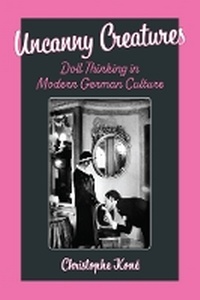
Uncanny Creatures
Doll Thinking in Modern German Culture
Published on 18. July 2024
Book
Paperback/Softback
184 pages
978-0-472-03973-9 (ISBN)
Description
Germany held a monopoly on the manufacture and export of bisque toy dolls in Europe before WWI. Yet, dolls' omnipresence in the material, visual, and literary culture of the modern German-speaking world has so far not been properly addressed. In demonstrating this cultural affinity for dolls, Christophe Kone draws upon a range of stories and seminal essays on dolls, as well as toys, sculptures, paintings, and photographs. He examines how E.T.A. Hoffmann's romantic tale The Sandman (1815) has been a major source of inspiration for German-speaking doll makers because of how it centers imagination and inventiveness. Using Hoffmann's tale as an early example of an amalgam between doll thinking and making in German culture, Kone shows how it initiated a genealogy of doll thinkers (Freud & Jentsch), writers (Rilke), painters (Kokoschka), photographers (Bellmer), and makers (Pritzel).
Uncanny Creatures then explores how this unusual interest in human-like figures continues a long tradition of thought devoted to conceptualizing "things," from Immanuel Kant's theory of the thing-in-itself to Martin Heidegger's lecture on the thing, and Eduard Moerike or Rainer Maria Rilke's thing-poems. Because dolls occupy a liminal space-not quite things and more than mere objects-they appear as uncanny creatures which have held a fascination for writers, thinkers, and artists alike. Uncanny Creatures moves past the Freudian discourse of fetishism to propose a new reading of doll artifacts in German culture centered on their ability to evoke a feeling of uncertainty and unsettlement in the viewer.
Uncanny Creatures then explores how this unusual interest in human-like figures continues a long tradition of thought devoted to conceptualizing "things," from Immanuel Kant's theory of the thing-in-itself to Martin Heidegger's lecture on the thing, and Eduard Moerike or Rainer Maria Rilke's thing-poems. Because dolls occupy a liminal space-not quite things and more than mere objects-they appear as uncanny creatures which have held a fascination for writers, thinkers, and artists alike. Uncanny Creatures moves past the Freudian discourse of fetishism to propose a new reading of doll artifacts in German culture centered on their ability to evoke a feeling of uncertainty and unsettlement in the viewer.
More details
Series
Language
English
Place of publication
Ann Arbor
United States
Target group
Professional and scholarly
Illustrations
58 photographs
Dimensions
Height: 229 mm
Width: 152 mm
ISBN-13
978-0-472-03973-9 (9780472039739)
Copyright in bibliographic data and cover images is held by Nielsen Book Services Limited or by the publishers or by their respective licensors: all rights reserved.
Schweitzer Classification
Person
Christophe Kone is Associate Professor of German at Williams College and Director of the Oakley Center for Humanities and Social Sciences.
Content
List of Illustrations
Acknowledgments
Introduction
Chapter I. Doll Thinking: A Hermeneutic Method. The Wooden Doll Olimpia in E.T.A. Hoffman's The Sandman (1816)
Chapter II. Doll Thinking: An Aesthetic Investigation. Oskar Kokoschka's Fluffy Alma-Doll by Hermine Moos
Chapter III. Doll Thinking: A Kinetic Approach. Lotte Pritzel's Wax Dolls
Chapter IV. Doll thinking: An Epistemological Method. Hans Bellmer's Papier Mache Dolls
Epilogue
Bibliography
Index
Acknowledgments
Introduction
Chapter I. Doll Thinking: A Hermeneutic Method. The Wooden Doll Olimpia in E.T.A. Hoffman's The Sandman (1816)
Chapter II. Doll Thinking: An Aesthetic Investigation. Oskar Kokoschka's Fluffy Alma-Doll by Hermine Moos
Chapter III. Doll Thinking: A Kinetic Approach. Lotte Pritzel's Wax Dolls
Chapter IV. Doll thinking: An Epistemological Method. Hans Bellmer's Papier Mache Dolls
Epilogue
Bibliography
Index