

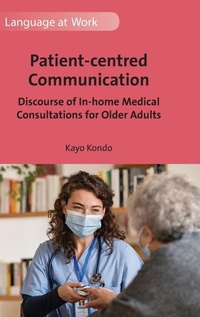
Patient-centred Communication
Discourse of In-home Medical Consultations for Older Adults
Published on 12. August 2022
Book
Hardback
221 pages
978-1-80041-588-1 (ISBN)
Description
This book presents a comprehensive analysis of the use of patient-/person-centred communication in providing healthcare for ageing populations through an ethnographic approach to physician in-home medical consultations in Tokyo, Japan, alongside interviews with physicians. It focuses on illustrating how linguistic dimensions of person-centred communication work by citing examples of case studies, as well as the sociocultural differences between the US, the UK, Japan and other societies in which person-centred communication models are employed. The author uses her own framework, which takes into account face and politeness theory, and makes recommendations for future training.
Reviews / Votes
In an era of increased digitalisation and performance targets, this book directs us back to the quintessential site of healthcare delivery, namely interpersonal contact between doctors, patients and family members. Through fine-grained analyses of clinical encounters involving older patients, Kondo beautifully illustrates the delicate interactional labour involved in compassionate, patient-centred communication and care. * Spencer Hazel, Newcastle University, UK * A fascinating study of the language of patient-centred communication in real settings, based on observation of real interactions between doctors and older patients in the home. This book sheds light on essential aspects such as politeness and empathy in medical consultations and has important implications for medical training. * Ruth Breeze, University of Navarra, Spain * Patient-centredness is crucial to good healthcare, but what does it actually mean when it comes to communication in different geographical contexts? This timely volume addresses this question with the nuance and insight that only a situated discourse-based approach can provide. Drawing on authentic healthcare interactions in Japan, this is a fascinating study that will be of interest to linguists and healthcare practitioners alike. * Zsofia Demjen, Institute of Education, UCL, UK * People who are interested in linguistics, especially in pragmatics (the study of language in use/contexts), may find this book fascinating in its quite novel perspective looking into face theory in PCC. The multiple qualitative methods of integrating the findings of literature review with empirical investigation in a culturally specific context shows both its practical and theoretical significance. * Yufei Ren, Tsinghua University, China, LINGUIST List 34.687 * By drawing attention to the local challenges in reconciling models of interaction and PCC, Kondo's innovative framework makes a practical contribution to the field, and this fascinating volume is likely to prove of great interest to those working in medical education. * Emma Brooks, UCL, IOE, Language in Society 53 (2024) *More details
Series
Language
English
Place of publication
Bristol
United Kingdom
Target group
College/higher education
Dimensions
Height: 240 mm
Width: 161 mm
Thickness: 18 mm
Weight
529 gr
ISBN-13
978-1-80041-588-1 (9781800415881)
DOI
10.21832/KONDO5881
Copyright in bibliographic data and cover images is held by Nielsen Book Services Limited or by the publishers or by their respective licensors: all rights reserved.
Schweitzer Classification
Other editions
Additional editions
E-Book
08/2022
Multilingual Matters
€24.49
Available for download
Person
Kayo Kondo is an Assistant Lecturer in Japanese Studies at the School of Modern Languages and Cultures, Durham University, UK. Her research interests include patient-health provider communication, clinical empathy, dementia communication, discourse studies in health and social care, pragmatics, face and politeness theories.
Content
Figures and Tables
Acknowledgments
Acronyms
Introduction
Scope of the Book
Chapter 1. Introduction to Patient-centred Communication
Chapter 2. Face and Linguistic Politeness
Chapter 3. Fieldwork and Data
Chapter 4. Listening to Patients and Identifying Issues
Chapter 5. Empathy and Acceptance
Chapter 6. Work Towards Shared Decision-making
Chapter 7. Leave Space for the Patient and Respecting the Patient's Freedom
Chapter 8. Transferring into Future Training
Chapter 9. Appendices
References
Index
Acknowledgments
Acronyms
Introduction
Scope of the Book
Chapter 1. Introduction to Patient-centred Communication
Chapter 2. Face and Linguistic Politeness
Chapter 3. Fieldwork and Data
Chapter 4. Listening to Patients and Identifying Issues
Chapter 5. Empathy and Acceptance
Chapter 6. Work Towards Shared Decision-making
Chapter 7. Leave Space for the Patient and Respecting the Patient's Freedom
Chapter 8. Transferring into Future Training
Chapter 9. Appendices
References
Index