

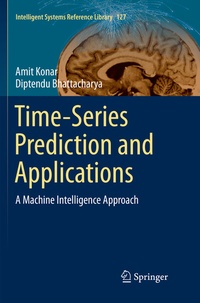
Time-Series Prediction and Applications
A Machine Intelligence Approach
Published on 21. July 2018
Book
Paperback/Softback
XVIII, 242 pages
978-3-319-85435-9 (ISBN)
Description
This book presents machine learning and type-2 fuzzy sets for the prediction of time-series with a particular focus on business forecasting applications. It also proposes new uncertainty management techniques in an economic time-series using type-2 fuzzy sets for prediction of the time-series at a given time point from its preceding value in fluctuating business environments. It employs machine learning to determine repetitively occurring similar structural patterns in the time-series and uses stochastic automaton to predict the most probabilistic structure at a given partition of the time-series. Such predictions help in determining probabilistic moves in a stock index time-series
Primarily written for graduate students and researchers in computer science, the book is equally useful for researchers/professionals in business intelligence and stock index prediction. A background of undergraduate level mathematics is presumed, although not mandatory, for most of the sections. Exercises with tips are provided at the end of each chapter to the readers' ability and understanding of the topics covered.More details
Series
Edition
Softcover reprint of the original 1st ed. 2017
Language
English
Place of publication
Cham
Switzerland
Publishing group
Springer International Publishing
Target group
Professional and scholarly
Illustrations
56 s/w Abbildungen, 13 farbige Abbildungen
XVIII, 242 p. 69 illus., 13 illus. in color.
Dimensions
Height: 235 mm
Width: 155 mm
Thickness: 15 mm
Weight
400 gr
ISBN-13
978-3-319-85435-9 (9783319854359)
DOI
10.1007/978-3-319-54597-4
Schweitzer Classification
Other editions
Additional editions
Amit Konar | Diptendu Bhattacharya
Time-Series Prediction and Applications
A Machine Intelligence Approach
Book
04/2017
Springer
€171.19
Shipment within 10-15 days
Persons
Dr. Pratyusha Rakshit received her B.Tech. degree in Electronics and Communication Engineering (ECE) from the Institute of Engineering and Management, Kolkata, India, and her M.E. degree in Control Engineering from the Department of Electronics and Telecommunication Engineering (ETCE), Jadavpur University, Kolkata, India in 2010 and 2012, respectively.
She was awarded her Ph.D. (Engineering) degree from Jadavpur University, India, in 2016 and is currently an Assistant Professor at its ETCE Department. She was awarded Gold Medals for securing the highest marks in B.Tech. in ECE and among all the courses of M.E. respectively in 2010 and 2012. She was the recipient of the CSIR Senior Research Fellowship, INSPIRE Fellowship and UGC UPE-II Junior Research Fellowship. Her principal research interests include artificial and computational intelligence, evolutionary computation, robotics, bioinformatics, pattern recognition, fuzzy logic, cognitive science and human-computer interaction. She is the author of over 50 papers published in top international journals and conference proceedings. She also serves as a reviewer for IEEE-TFS, IEEE-SMC: Systems, Neurocomputing, Information Sciences, and Applied Soft Computing.
Dr. Amit Konar is currently a Professor at the Department of Electronics and Telecommunication Engineering, Jadavpur University, Kolkata, India. Dr. Konar is the author of over 350 publications, including books/monographs, peer-reviewed book chapters and papers, all with leading international publishers. He is an Associate Editor of several prestigious journals, including IEEE Transactions, Elsevier, Springer and IOS Press, the Netherlands. He has undertaken several prestigious research projects, including UGC's departmental research support (DRS) scheme, DIT's national project on Perception Engineering and UGC's excellence program in Cognitive Science. Dr. Konar was a recipient of the AICTE-accredited 1997-2000 Career Award for young teachers. He has been nominated as a Fellow of the National Academy of Engineering, and his current research interests include human-computer interfacing, cognitive neuroscience, robotics and machine intelligence.
Content
An Introduction to Time-Series Prediction.- Prediction Using Self-Adaptive Interval Type-2 Fuzzy Sets.- Handling Multiple Factors in the Antecedent of Type-2 Fuzzy Rules.- Learning Structures in an Economic Time-Series for Forecasting Applications.- Grouping of First-Order Transition Rules for Time-Series Prediction by Fuzzy-induced Neural Regression.- Conclusions and Future Directions.