

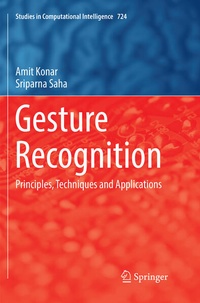
Gesture Recognition
Principles, Techniques and Applications
Published on 18. August 2018
Book
Paperback/Softback
XVIII, 276 pages
978-3-319-87259-9 (ISBN)
Description
This book presents a thorough analysis of gestural data extracted from raw images and/or range data with an aim to recognize the gestures conveyed by the data. It covers image morphological analysis, type-2 fuzzy logic, neural networks and evolutionary computation for classification of gestural data. The application areas include the recognition of primitive postures in ballet/classical Indian dances, detection of pathological disorders from gestural data of elderly people, controlling motion of cars in gesture-driven gaming and gesture-commanded robot control for people with neuro-motor disability.
The book is unique in terms of its content, originality and lucid writing style. Primarily intended for graduate students and researchers in the field of electrical/computer engineering, the book will prove equally useful to computer hobbyists and professionals engaged in building firmware for human-computer interfaces. A prerequisite of high school level mathematics issufficient to understand most of the chapters in the book. A basic background in image processing, although not mandatory, would be an added advantage for certain sections.
More details
Series
Edition
Softcover reprint of the original 1st ed. 2018
Language
English
Place of publication
Cham
Switzerland
Publishing group
Springer International Publishing
Target group
Professional and scholarly
Illustrations
26 s/w Abbildungen, 73 farbige Abbildungen
XVIII, 276 p. 99 illus., 73 illus. in color.
Dimensions
Height: 235 mm
Width: 155 mm
Thickness: 17 mm
Weight
452 gr
ISBN-13
978-3-319-87259-9 (9783319872599)
DOI
10.1007/978-3-319-62212-5
Schweitzer Classification
Other editions
Additional editions
Book
07/2017
Springer
€160.49
Shipment within 10-15 days
Content
Introduction.- Radon Transform based Automatic Posture Recognition in Ballet Dance.- Fuzzy Image Matching Based Posture Recognition in Ballet Dance.- Gesture Driven Fuzzy Interface System For Car Racing Game.- Type-2 Fuzzy Classifier based Pathological Disorder Recognition.- Probabilistic Neural Network based Dance Gesture Recognition.- Differential Evolution based Dance Composition.- EEG-Gesture based Artificial Limb Movement for Rehabilitative Applications.- Conclusions and Future Directions.- Index.