

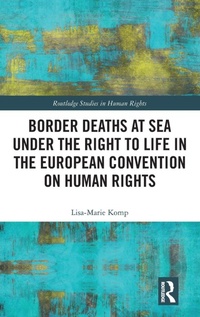
Border Deaths at Sea under the Right to Life in the European Convention on Human Rights
1st Edition
Published on 17. November 2022
Book
Hardback
190 pages
978-1-032-27131-6 (ISBN)
Description
This book focuses on border deaths at sea. It unravels how the interplay of the law of the sea and rules on jurisdiction widen the opportunity for states to make and enforce rules outside their territory, and questions whether this is also accompanied with an obligation to respect the right to life under the European Convention on Human Rights (ECHR) when doing so.
By embarking upon the challenge of analysing a cross-border phenomenon in which direct encounters between state agents and the victims are few through the lens of legal obligations, the book unearths avenues for arguing that the ECHR is applicable to border deaths on the high seas and showcases the Court's creativity in bridging the gap between the Convention and people in need of protection. Furthermore, it demonstrates that the ECHR is applicable to border deaths occurring within the territorial seas of states. It discusses the right to life, as well as the specific obligations of states in respect to border deaths at sea, and demonstrates that in many instances, EU policies fall short of the standards set under the right to life.
This book will be of key interest to scholars, students and practitioners in migrant rights, international human rights law, public international law including, refugee and migration law, maritime law, and security studies.
By embarking upon the challenge of analysing a cross-border phenomenon in which direct encounters between state agents and the victims are few through the lens of legal obligations, the book unearths avenues for arguing that the ECHR is applicable to border deaths on the high seas and showcases the Court's creativity in bridging the gap between the Convention and people in need of protection. Furthermore, it demonstrates that the ECHR is applicable to border deaths occurring within the territorial seas of states. It discusses the right to life, as well as the specific obligations of states in respect to border deaths at sea, and demonstrates that in many instances, EU policies fall short of the standards set under the right to life.
This book will be of key interest to scholars, students and practitioners in migrant rights, international human rights law, public international law including, refugee and migration law, maritime law, and security studies.
More details
Series
Language
English
Place of publication
London
United Kingdom
Publishing group
Taylor & Francis Ltd
Target group
College/higher education
Professional and scholarly
Postgraduate, Professional, and Undergraduate Advanced
Illustrations
1 s/w Tabelle
1 Tables, black and white
Dimensions
Height: 240 mm
Width: 161 mm
Thickness: 16 mm
Weight
482 gr
ISBN-13
978-1-032-27131-6 (9781032271316)
Copyright in bibliographic data and cover images is held by Nielsen Book Services Limited or by the publishers or by their respective licensors: all rights reserved.
Schweitzer Classification
Other editions
Additional editions
Lisa-Marie Komp
Border Deaths at Sea under the Right to Life in the European Convention on Human Rights
Book
05/2024
1st Edition
Routledge
€63.00
Shipment within 10-20 days
Lisa-Marie Komp
Border Deaths at Sea under the Right to Life in the European Convention on Human Rights
E-Book
11/2022
1st Edition
Routledge
€55.49
Available for download
Lisa-Marie Komp
Border Deaths at Sea under the Right to Life in the European Convention on Human Rights
E-Book
11/2022
1st Edition
Routledge
€55.49
Available for download
Person
Lisa-Marie Komp is Lecturer at the VU Amsterdam and Attorney at Law (international law and human rights) at Prakken d'Oliveira Human Rights Lawyers, The Netherlands.
Content
1. Introduction 2. Do European Immigration Policies Cause Border Deaths? 3. The Legal Landscape of Border Deaths at Sea 4. Application of the ECHR to the Extraterritorial Effects of Immigration Policies 5. The Right to Life and Extraterritorial Effects of Immigration Policies 6. Conclusion