

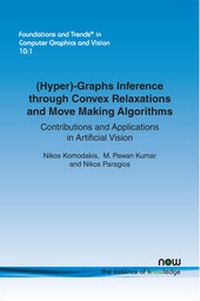
(Hyper)-Graphs Inference through Convex Relaxations and Move Making Algorithms
Contributions and Applications in Artificial Vision
1st Edition
Published on 31. May 2016
Book
Paperback/Softback
118 pages
978-1-68083-138-2 (ISBN)
Description
Computational visual perception seeks to reproduce human vision through the combination of visual sensors, artificial intelligence, and computing. To this end, computer vision tasks are often reformulated as mathematical inference problems where the objective is to determine the set of parameters corresponding to the lowest potential of a task-specific objective function. Graphical models have been the most popular formulation in the field over the past two decades where the problem is viewed as a discrete assignment labeling one. Modularity, scalability, and portability are the main strengths of these methods which once combined with efficient inference algorithms they could lead to state of the art results. This monograph focuses on the inference component of the problem and in particular discusses in a systematic manner the most commonly used optimization principles in the context of graphical models. It looks at inference over low rank models (interactions between variables are constrained to pairs) as well as higher order ones (arbitrary set of variables determine hyper-cliques on which constraints are introduced) and seeks a concise, self-contained presentation of prior art as well as the presentation of the current state of the art methods in the field.
More details
Series
Language
English
Place of publication
Hanover
United States
Target group
Professional and scholarly
Dimensions
Height: 234 mm
Width: 156 mm
Thickness: 6 mm
Weight
178 gr
ISBN-13
978-1-68083-138-2 (9781680831382)
DOI
10.1561/0600000066
Copyright in bibliographic data and cover images is held by Nielsen Book Services Limited or by the publishers or by their respective licensors: all rights reserved.
Schweitzer Classification
Content
1: Introduction 2: Mathematical background: basic tools for MRF inference 3: Move-making algorithms 4: MRF inference based on the primal-dual schema 5: MRF inference based on dual-decomposition. References