

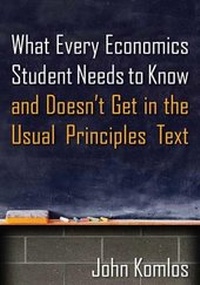
What Every Economics Student Needs to Know and Doesn't Get in the Usual Principles Text
1st Edition
Published on 6. October 2015
Book
Hardback
978-1-138-12678-7 (ISBN)
Description
This short book explores a core group of 40 topics that tend to go unexplored in an Introductory Economics course. Though not a replacement for an introductory text, the work is intended as a supplement to provoke further thought and discussion by juxtaposing blackboard models of the economy with empirical observations.
Each chapter starts with a short "refresher" of standard neoclassical economic modelling before getting into real world economic life. Komlos shows how misleading it can be to mechanically apply the perfect competition model in an oligopolistic environment where only an insignificant share of economic activity takes place in perfectly competitive conditions. Most economics texts introduce the notion of oligopoly and differentiate it from the perfect competition model with its focus on "price takers." Komlos contends that oligopolies are "price makers" like monopolies and cause consumers and economies nearly as much harm. Likewise, most textbook authors eschew any distortions of market pricing by government, but there is usually little discussion of the real impact of minimum wages, which Komlos corrects.
The book is an affordable supplement for all basic economics courses or for anyone who wants to review the basic ideas of economics with clear eyes.
Each chapter starts with a short "refresher" of standard neoclassical economic modelling before getting into real world economic life. Komlos shows how misleading it can be to mechanically apply the perfect competition model in an oligopolistic environment where only an insignificant share of economic activity takes place in perfectly competitive conditions. Most economics texts introduce the notion of oligopoly and differentiate it from the perfect competition model with its focus on "price takers." Komlos contends that oligopolies are "price makers" like monopolies and cause consumers and economies nearly as much harm. Likewise, most textbook authors eschew any distortions of market pricing by government, but there is usually little discussion of the real impact of minimum wages, which Komlos corrects.
The book is an affordable supplement for all basic economics courses or for anyone who wants to review the basic ideas of economics with clear eyes.
Reviews / Votes
"What Every Economics Student Needs to Know and Doesn't Get in the Usual Principles Texts is an important contribution to the host of alternative undergraduate text books...[it] rises above the din of traditional introductory economics text books to extend the field to emerging views that introductory students need." Scott Carson, Turkish Economic Review"John Komlos provides an important complement to--and corrective for--the standard Economics 101 textbook. This book clearly explains why free markets are far from perfect and, indeed, do not exist in the vast majority of the modern economy. Instead of fetishizing economic efficiency, Komlos explains why economics should focus on creating a better society and helping all of us live more fulfilling lives." -- James Kwak, University of Connecticut, co-author of 13 Bankers: The Wall Street Takeover and the Next Financial Meltdown
"A serious student of economics must come to terms with what is worthwhile in what he or she learns and what is not. John Komlos's new book can provide a valuable assist in that effort." -- Alexander J. Field, Santa Clara University
"The 'Great Recession' which began in 2008 was not anticipated by economists, and they remain divided about the remedies. In the meantime, economic stagnation continues. Economics requires a re-think, but this is proving hard. In this excellent book, John Komlos makes a start: he shows what parts of theory remain useful, and which ones have been falsified by experience. He highlights what the new theory will need to explain. Most importantly, he shows that it is necessary to start from current economics in order to reform it. Fluently written, accessible, and highly recommended as a corrective to standard textbooks." -- Avner Offer, University of Oxford
"The real world seldom operates like the diagrams in economics textbooks. Often left out are that human beings often act irrationally, markets have rules and models typically began with the assumption of ' all else being equal.' John Komlos provides a welcome and much needed real world look at the dismal science in his Critique of Pure Economics. In plain language that even high school seniors can grasp, Komlos shows the wishful thinking that infects standard economic texts and builds his case with empirical facts." -- David Cay Johnston, Pulitzer Prize-winning author of The Fine Print: How Big Companies Use "Plain English" to Rob You Blind
More details
Language
English
Place of publication
London
United Kingdom
Publishing group
Taylor & Francis Ltd
Target group
College/higher education
Dimensions
Height: 254 mm
Width: 178 mm
Weight
635 gr
ISBN-13
978-1-138-12678-7 (9781138126787)
Copyright in bibliographic data and cover images is held by Nielsen Book Services Limited or by the publishers or by their respective licensors: all rights reserved.
Schweitzer Classification
Other editions
New editions
Book
01/2019
2nd Edition
Routledge
€223.21
Article exhausted; check for reprint
Additional editions
Book
05/2014
1st Edition
M.E. Sharpe
€63.39
Article exhausted; check for reprint
Person
John Komlos is Professor Emeritus of Economics at the University of Munich.
Content
Part I: Economic Models vs. Reality 1. Introduction 2. Markets Are Neither Omniscient nor Omnipotent Part II: Consumption On and Off the Blackboard 3. The Nature of Demand 4. Is There a Rational Economic Decision Maker? 5. Taste Makers and Consumption Part III: Production On and Off the Blackboard 6. Firms and Competition 7. Returns to the Factors of Production 8. The Case for Regulation of Markets 9. Microeconomic Applications On and Off the Blackboard Part IV: Real-World Macroeconomics 10. What Is Macroeconomics? 11. Macroeconomic Aggregates and Variables 12. Aspects of Macroeconomic Performance 13. Open Economy Macroeconomics 14. Macroeconomic Externalities 15. The Financial Sector and the Great Recession Conclusion: Economics Beyond the Basics