

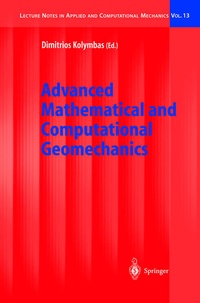
Advanced Mathematical and Computational Geomechanics
Published on 25. August 2003
Book
Hardback
XVI, 315 pages
978-3-540-40547-4 (ISBN)
Description
Geomechanics is the mechanics of geomaterials, i.e. soils and rocks, and deals with fascinating problems such as settlements, stability of excavations, tunnels and offshore platforms, landslides, earthquakes and liquefaction. This edited book presents recent mathematical and computational tools and models to describe and simulate such problems in Geomechanics and Geotechnical Engineering. It includes a collection of contributions emanating from the three Euroconferences GeoMath ("Mathematical Methods in Geomechanics") that were held between 2000 and 2002 in Innsbruck/Austria and Horto/Greece.
More details
Series
Edition
2003 ed.
Language
English
Place of publication
Berlin
Germany
Publishing group
Springer Berlin
Target group
Professional and scholarly
Research
Illustrations
82 s/w Abbildungen
XVI, 315 p. 82 illus.
Dimensions
Height: 241 mm
Width: 160 mm
Thickness: 23 mm
Weight
664 gr
ISBN-13
978-3-540-40547-4 (9783540405474)
DOI
10.1007/978-3-540-45079-5
Schweitzer Classification
Other editions
Additional editions
Dimitrios Kolymbas
Advanced Mathematical and Computational Geomechanics
E-Book
03/2013
Springer
€213.99
Available for download
Dimitrios Kolymbas
Advanced Mathematical and Computational Geomechanics
Book
12/2010
Springer
€213.99
Shipment within 7-9 days
Content
I Material Modelling.- On thermodynamic modeling and the role of the second law of thermodynamics in geophysics.- Some mathematics for the constitutive modelling of soils.- Elasticity in constitutive modeling of soils.- Experimental characterization of localized deformation in geomaterials.- Discontinuous character of rock masses: some open questions related to rock fracture mechanics and scale effects.- Similarity in soil and rock mechanics.- II Modelling of Boundary Value Problems.- Numerical predictions and reality.- Objective integration and geometric properties of hypoplasticity.- Using constitutive models of the rate type in implicit finite-element calculations: error-controlled stress update and consistent tangent operator.- Efficient and Reliable Nonlocal Damage Models.- Regularized formulations of strain-softening plasticity.- Fuzzy data in geotechnical models.