

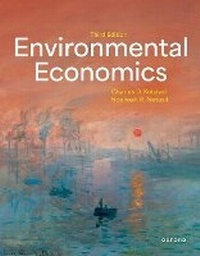
Environmental Economics
3rd Edition
Will be published approx. on 31. March 2026
Book
Paperback/Softback
552 pages
978-0-19-067410-6 (ISBN)
Description
A Classroom-Ready Text for a Rapidly Changing Discipline
Now in its most transformative edition yet, Environmental Economics offers university instructors a thoroughly updated and pedagogically sound resource for teaching advanced undergraduate students., This 25th anniversary, new edition reflects the profound evolution of both environmental policy and economic methodology over the past two decades.
Authored by Charles Kolstad (Stanford University, UC Santa Barbara) and Noelwah Netusil (Reed College), the text is designed for economics majors with a solid foundation in microeconomic theory. It fills a critical instructional niche--rigorous yet accessible, empirical yet intuitive.
Key Teaching Benefits
- Curriculum Fit: Ideal for upper-level undergraduate courses in environmental economics, public policy, or applied microeconomics.
- Empirical Focus: Reflects the field's shift toward data-driven analysis, enabling students to explore causal relationships between economic behavior and environmental outcomes.
- Climate-Centered: Treats climate change as the "mother of all externalities," integrating it throughout the text as a central theme rather than a peripheral issue.
- Global Perspective: Includes international developments--from China and India's rapid growth to global policy responses--broadening student understanding of environmental economics in practice.
This edition of Environmental Economics is more than a textbook--it's a comprehensive teaching tool built for today's data-rich, policy-driven classroom.
Now in its most transformative edition yet, Environmental Economics offers university instructors a thoroughly updated and pedagogically sound resource for teaching advanced undergraduate students., This 25th anniversary, new edition reflects the profound evolution of both environmental policy and economic methodology over the past two decades.
Authored by Charles Kolstad (Stanford University, UC Santa Barbara) and Noelwah Netusil (Reed College), the text is designed for economics majors with a solid foundation in microeconomic theory. It fills a critical instructional niche--rigorous yet accessible, empirical yet intuitive.
Key Teaching Benefits
- Curriculum Fit: Ideal for upper-level undergraduate courses in environmental economics, public policy, or applied microeconomics.
- Empirical Focus: Reflects the field's shift toward data-driven analysis, enabling students to explore causal relationships between economic behavior and environmental outcomes.
- Climate-Centered: Treats climate change as the "mother of all externalities," integrating it throughout the text as a central theme rather than a peripheral issue.
- Global Perspective: Includes international developments--from China and India's rapid growth to global policy responses--broadening student understanding of environmental economics in practice.
This edition of Environmental Economics is more than a textbook--it's a comprehensive teaching tool built for today's data-rich, policy-driven classroom.
More details
Edition
3rd Revised edition
Language
English
Place of publication
New York
United States
Edition type
Revised edition
Dimensions
Height: 235 mm
Width: 191 mm
Weight
1125 gr
ISBN-13
978-0-19-067410-6 (9780190674106)
Copyright in bibliographic data and cover images is held by Nielsen Book Services Limited or by the publishers or by their respective licensors: all rights reserved.
Schweitzer Classification
Persons
Charles D. Kolstad is known for his work on the economics of the environment, particularly energy and climate change. He is an emeritus faculty member at Stanford University and the University of California, Santa Barbara.
Noelwah R. Netusil is known for her work on the economics of land, water, flooding and floodplain management. She is the Stanley H. Cohn Professor of Economics at Reed College in Portland, Oregon.
Noelwah R. Netusil is known for her work on the economics of land, water, flooding and floodplain management. She is the Stanley H. Cohn Professor of Economics at Reed College in Portland, Oregon.