

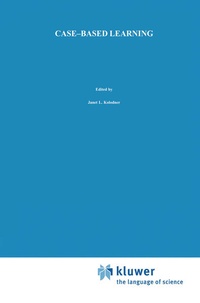
Case-Based Learning
Published on 13. July 2013
Book
Paperback/Softback
III, 171 pages
978-1-4613-6418-4 (ISBN)
Description
Case-based reasoning means reasoning based on remembering previous experiences. A reasoner using old experiences (cases) might use those cases to suggest solutions to problems, to point out potential problems with a solution being computed, to interpret a new situation and make predictions about what might happen, or to create arguments justifying some conclusion. A case-based reasoner solves new problems by remembering old situations and adapting their solutions. It interprets new situations by remembering old similar situations and comparing and contrasting the new one to old ones to see where it fits best. Case-based reasoning combines reasoning with learning. It spans the whole reasoning cycle. A situation is experienced. Old situations are used to understand it. Old situations are used to solve a problem (if there is one to be solved). Then the new situation is inserted into memory alongside the cases it used for reasoning, to be used another time.
The key to this reasoning method, then, is remembering. Remembering has two parts: integrating cases or experiences into memory when they happen and recalling them in appropriate situations later on. The case-based reasoning community calls this related set of issues the i ndexing problem . In broad terms, it means finding in memory the experience closest to a new situation. In narrower terms, it can be described as a two-part problem:
The key to this reasoning method, then, is remembering. Remembering has two parts: integrating cases or experiences into memory when they happen and recalling them in appropriate situations later on. The case-based reasoning community calls this related set of issues the i ndexing problem . In broad terms, it means finding in memory the experience closest to a new situation. In narrower terms, it can be described as a two-part problem:
- assigning indexes or labels to experiences when they are put into memory that describe the situations to which they are applicable, so that they can be recalled later; and
- at recall time, elaborating the new situation in enough detail so that the indexes it would have if it were in the memory are identified.
More details
Edition
Softcover reprint of the original 1st ed. 1993
Language
English
Place of publication
New York
United States
Target group
Professional and scholarly
Research
Illustrations
III, 171 p.
Dimensions
Height: 235 mm
Width: 155 mm
Thickness: 11 mm
Weight
283 gr
ISBN-13
978-1-4613-6418-4 (9781461364184)
DOI
10.1007/978-1-4615-3228-6
Schweitzer Classification
Other editions
Additional editions
Janet L. Kolodner
Case-Based Learning
Book
04/1993
Kluwer Academic Publishers
€213.99
Shipment within 15-20 days
Content
Indexing, Elaboration and Refinement: Incremental Learning of Explanatory Cases.- Derivational Analogy in PRODIGY: Automating Case Acquisition, Storage and Utilization.- Opportunism and Learning.- Integrating Feature Extraction and Memory Search.- Wastewater Treatment Systems from Case-Based Reasoning.