

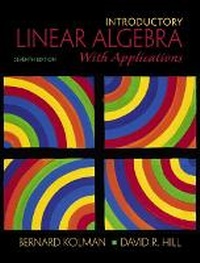
Introductory Linear Algebra with Applications
International Edition
7th Edition
Published on 26. January 2001
Book
Paperback/Softback
577 pages
978-0-13-033706-1 (ISBN)
Description
For undergraduate-level courses in Linear Algebra.
This book provides an applied introduction to the basic ideas, computational techniques, and applications of linear algebra. The most applied of our basic books in this market, this text has a superb range of problem sets. Also, this is the most technology-friendly text on the market.
This book provides an applied introduction to the basic ideas, computational techniques, and applications of linear algebra. The most applied of our basic books in this market, this text has a superb range of problem sets. Also, this is the most technology-friendly text on the market.
More details
Edition
7th edition
Language
English
Place of publication
United States
Publishing group
Pearson Education (US)
Target group
Professional and scholarly
Dimensions
Height: 254 mm
Width: 203 mm
Thickness: 25 mm
Weight
1178 gr
ISBN-13
978-0-13-033706-1 (9780130337061)
Copyright in bibliographic data and cover images is held by Nielsen Book Services Limited or by the publishers or by their respective licensors: all rights reserved.
Schweitzer Classification
Other editions
New editions
Bernard Kolman | David R. Hill
Introductory Linear Algebra
An Applied First Course: International Edition
Book
11/2004
8th Edition
Pearson
€90.36
Article is exhausted; no reprint
Previous edition

Book
03/1997
6th Edition
Pearson Education (US)
€44.56
Article exhausted; check different version
Content
I. INTRODUCTORY LINEAR ALGEBRA.
1. Linear Equations and Matrices.
Linear Systems. Matrices. Dot Product and Matrix Multiplication. Properties of Matrix Operations. Graph Theory (Optional). Solutions of Linear Systems of Equations. Electrical Circuits (Optional). Markov Chains (Optional). The Inverse of a Matrix. Linear Economic Models (Optional). Wavelets (Optional). LU-Factorization (Optional).
2. Determinants.
Definition and Properties. Cofactor Expansion and Applications. Determinants from a Computational Point of View.
3. Vectors in R2 and R3.
Vectors in the Plane. n-Vectors. Introduction to Linear Transformations. Computer Graphics. Computer Graphics (Optional). Cross Products in R3 (Optional). Lines and Planes.
4. Real Vector Spaces.
Real Vector Spaces. Subspaces. Linear Independence. Basis and Dimension. Homogeneous Systems. The Rank of a Matrix and Applications. Coordinates and Change of Basis. Orthonormal Bases in Rn. QR-Factorization (Optional). Orthogonal Complements. Least Squares (Optional).
5. Eigenvalues and Eigenvectors.
Eigenvalues and Eigenvectors. Diagonalization and Similar Matrices. Diagonalization and Symmetric Matrices.
6. Linear Transformations and Matrices.
Definition and Examples. The Kernel and Range of a Linear Transformation. The Matrix of a Linear Transformation.
Cumulative Review of Part I.
II. OTHER APPLICATIONS.
7. Linear Programming.
The Linear Programming Problem; Geometric Solution. The Simplex Method. Duality. The Theory of Games.
8. Applications of Eigenvalues and Eigenvectors.
The Fibonacci Sequence. Differential Equations (Calculus Required). Dynamical Systems (Calculus Required). Intro to Fractals. Quadratic Forms. Conic Sections. Quadric Surfaces.
Appendix A: Introduction to MATLAB.
Appendix B: Complex Numbers.
Complex Numbers. Complex Numbers in Linear Algebra.
Appendix C: Further Directions.
Inner Product Spaces (Calculus Required). Composite and Invertible Linear Transformations.
Answers to Odd-Numbered Exercises and Chapter Tests.
Index.
1. Linear Equations and Matrices.
Linear Systems. Matrices. Dot Product and Matrix Multiplication. Properties of Matrix Operations. Graph Theory (Optional). Solutions of Linear Systems of Equations. Electrical Circuits (Optional). Markov Chains (Optional). The Inverse of a Matrix. Linear Economic Models (Optional). Wavelets (Optional). LU-Factorization (Optional).
2. Determinants.
Definition and Properties. Cofactor Expansion and Applications. Determinants from a Computational Point of View.
3. Vectors in R2 and R3.
Vectors in the Plane. n-Vectors. Introduction to Linear Transformations. Computer Graphics. Computer Graphics (Optional). Cross Products in R3 (Optional). Lines and Planes.
4. Real Vector Spaces.
Real Vector Spaces. Subspaces. Linear Independence. Basis and Dimension. Homogeneous Systems. The Rank of a Matrix and Applications. Coordinates and Change of Basis. Orthonormal Bases in Rn. QR-Factorization (Optional). Orthogonal Complements. Least Squares (Optional).
5. Eigenvalues and Eigenvectors.
Eigenvalues and Eigenvectors. Diagonalization and Similar Matrices. Diagonalization and Symmetric Matrices.
6. Linear Transformations and Matrices.
Definition and Examples. The Kernel and Range of a Linear Transformation. The Matrix of a Linear Transformation.
Cumulative Review of Part I.
II. OTHER APPLICATIONS.
7. Linear Programming.
The Linear Programming Problem; Geometric Solution. The Simplex Method. Duality. The Theory of Games.
8. Applications of Eigenvalues and Eigenvectors.
The Fibonacci Sequence. Differential Equations (Calculus Required). Dynamical Systems (Calculus Required). Intro to Fractals. Quadratic Forms. Conic Sections. Quadric Surfaces.
Appendix A: Introduction to MATLAB.
Appendix B: Complex Numbers.
Complex Numbers. Complex Numbers in Linear Algebra.
Appendix C: Further Directions.
Inner Product Spaces (Calculus Required). Composite and Invertible Linear Transformations.
Answers to Odd-Numbered Exercises and Chapter Tests.
Index.