

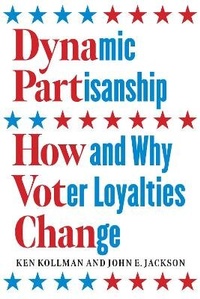
Dynamic Partisanship
How and Why Voter Loyalties Change
Published on 8. October 2021
Book
Hardback
232 pages
978-0-226-76222-7 (ISBN)
Description
Why do people identify with political parties? How stable are those identifications? Stable party systems, with a limited number of parties and mostly stable voter identification with a party, are normally considered significant signals of a steady democracy. In Dynamic Partisanship, Ken Kollman and John E. Jackson study changing patterns of partisanship in the United States, the United Kingdom, Canada, and Australia over the last fifty years in order to disentangle possible reasons for shifting partisanship and party identification. The authors argue that changes in partisanship can be explained by adjustments in voters' attitudes toward issues or parties; the success or failure of policies advocated by parties; or alterations in parties' positions on key issues. They contend that, while all three factors contribute, it is the latter, a party changing positions on a chief concern, that most consistently leads voters to or from a particular party. Their approach provides a deeper knowledge of the critical moving parts in democratic politics.
More details
Language
English
Place of publication
Chicago
United States
Publishing group
The University of Chicago Press
Product notice
sewn/stitched
Cloth over boards
Dimensions
Height: 229 mm
Width: 152 mm
ISBN-13
978-0-226-76222-7 (9780226762227)
Copyright in bibliographic data and cover images is held by Nielsen Book Services Limited or by the publishers or by their respective licensors: all rights reserved.
Schweitzer Classification
Other editions
Additional editions
Kollman Ken Kollman | Jackson John E. Jackson
Dynamic Partisanship
How and Why Voter Loyalties Change
E-Book
10/2021
1st Edition
University of Chicago Press
€42.99
Available for download
Persons
Ken Kollman is the Frederick G. L. Huetwell Professor and professor of political science at the University of Michigan. John E. Jackson is the M. Kent Jennings Collegiate Professor Emeritus of political science and professor emeritus of political science at the University of Michigan.
Content
Contents
Preface
Chapter 1. Introduction: Why Study Dynamic Partisanship?
Chapter 2. Partisanship: Meaning and Measurement
Chapter 3. Consistent Partisanship Models
Chapter 4. The United States
Chapter 5. Australia, Canada, and the United Kingdom: The Setup
Chapter 6. Australia, Canada, and the United Kingdom: Results
Chapter 7. Explaining Partisanship Dynamics
Chapter 8. Parties and Partisanship
References
Index
Preface
Chapter 1. Introduction: Why Study Dynamic Partisanship?
Chapter 2. Partisanship: Meaning and Measurement
Chapter 3. Consistent Partisanship Models
Chapter 4. The United States
Chapter 5. Australia, Canada, and the United Kingdom: The Setup
Chapter 6. Australia, Canada, and the United Kingdom: Results
Chapter 7. Explaining Partisanship Dynamics
Chapter 8. Parties and Partisanship
References
Index