

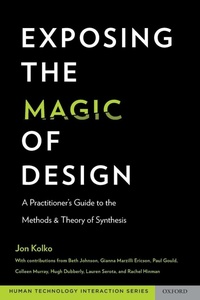
Exposing the Magic of Design
A Practitioner's Guide to the Methods and Theory of Synthesis
Published on 10. September 2015
Book
Paperback/Softback
208 pages
978-0-19-027621-8 (ISBN)
Description
As the world grows increasingly complex--in issues of sustainability, culture, and technology--businesses and governments are searching for a form of problem solving that can effectively respond to unprecedented levels of ambiguity and disorder. Traditional "linear thinking" has been disparaged by the popular media as being inadequate for dealing with the global economic crisis. Traditional forms of marketing and product development have been rejected by businesses that need to find new ways of staying competitive in a global economy. Yet little has been offered as an alternative. It is not enough to demand that someone "be more innovative" without offering the tools to succeed.
This book offers a way of thinking about complicated, multifaceted problems with a repeatable degree of success. Design synthesis methods can be applied in business to produce new and compelling products and services, or these methods can be applied in government with the goal of changing culture and bettering society. In both contexts, there is a need for timely and aggressive action. This text is intended to act as a practitioner's guide to using the magic of design to solve complex problems.
This book offers a way of thinking about complicated, multifaceted problems with a repeatable degree of success. Design synthesis methods can be applied in business to produce new and compelling products and services, or these methods can be applied in government with the goal of changing culture and bettering society. In both contexts, there is a need for timely and aggressive action. This text is intended to act as a practitioner's guide to using the magic of design to solve complex problems.
Reviews / Votes
Structured in three logical parts-theory, business value, and practical guidelines-Kolko's book is a must-read for those looking for a clear explanation of how to move from design research to design solutions." * Mark Vanderbeeken, Senior Partner, Experientia * Exposing the Magic of Design fits perfectly into a long-empty slot on the bookshelves of practitioners and students. His theory of synthesis will engage your brain six ways from Sunday, while the practical, actionable methods will change your process immediately. We have needed this book!" * Steve Portigal, Principal, Portigal Consulting * ...design students, practitioners of design in all disciplines dealing with product development, and business owners have much to gain from reading this volume." * PsycCRITIQUES*
More details
Series
Language
English
Place of publication
New York
United States
Target group
College/higher education
Illustrations
55 illustrations
Dimensions
Height: 234 mm
Width: 156 mm
Thickness: 12 mm
Weight
322 gr
ISBN-13
978-0-19-027621-8 (9780190276218)
Copyright in bibliographic data and cover images is held by Nielsen Book Services Limited or by the publishers or by their respective licensors: all rights reserved.
Schweitzer Classification
Other editions
Additional editions
Book
05/2011
Oxford University Press Inc
€109.20
Available immediately
Person
Jon Kolko is the Founder and Director of Austin Center for Design, a progressive educational institution teaching interaction design and social entrepreneurship. He has held positions of Executive Director of Design Strategy at Thinktiv, a venture accelerator in Austin, Texas, and both Principal Designer and Associate Creative Director roles at frog design, a global innovation firm. He was also a Professor of Interaction and Industrial Design at the Savannah College of Art and Design.
Content
Introduction ; Section One: What is Synthesis? ; Chapter 1: A Theory of Synthesis ; Chapter 2: Sensemaking, Frames, Models and Patterns ; Chapter 3: Abductive Reasoning ; Section Two: Design Synthesis in a Business Context ; Chapter 4: The Value of Synthesis in Driving Innovation ; Chapter 5: The Culture of Synthesis ; Section Three: Methods and Applicability ; Chapter 6: Methods for Making Meaning out of Data ; Chapter 7: Methods for Building an Experience Framework ; Chapter 8: Methods for Creating Empathy and Insight ; Conclusion ; Glossary ; Works Cited ; Index