

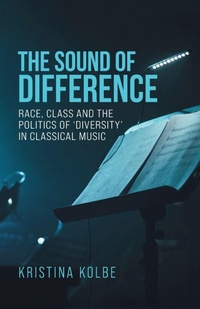
The sound of difference
Race, class and the politics of 'diversity' in classical music
Will be published approx. on 23. June 2026
Book
Paperback/Softback
304 pages
978-1-5261-9810-5 (ISBN)
Description
What happens when the elitist space of 'Western' classical music seeks to diversify itself? And what are the social effects worked through diversity discourses in classical music institutions? The sound of difference addresses these concerns by critically examining how diversity work takes shape in a cultural sector so deeply implicated in hierarchies of class, structures of whiteness, and legacies of imperialism. The book draws from ethnographic and interview data to analyse how diversity discourses become constructed in the organisational and creative processes of music production. From rehearsal and performance practices to the impact of the Covid-19 pandemic on the sector's commitment to change, Kolbe reveals the institutional constraints and precarious labour relations that form around diversity work in classical music and skilfully considers what these processes can tell us about the remaking of class, race, and racism today. -- .
Reviews / Votes
Shortlisted for the BSA Philip Abrams Memorial Prize 2025'Based on a unique ethnographic study of a classical music organisation, The sound of difference provides a rare 'bottom-up' account of how inequalities manifest and persist in the arts. Put simply, it is one of the most sophisticated and nuanced critiques of the operationalisation of 'diversity' in the cultural sector that I have ever read.'
Anamik Saha, Professor of Race and Media, University of Leeds
'A brilliant analysis of diversity work in the classical music sector. Drawing on ethnographic and interview data, Kristina Kolbe asks what happens when the elitist space of classical music seeks to diversify itself. Do diversity discourses in classical music reproduce or challenge existing inequalities? How is it that white middle-class domination perseveres despite an increasingly prominent focus on diversity in the classical music sector? This absolutely timely book is a must-read for anybody with an interest in classical music practice.'
Christina Scharff, Reader in Gender, Media and Culture, King's College London
'As the central question of her book, Kolbe asks: do such diversity initiatives actually work? What impact have they had on dismantling the pervasive racism, sexism, and classism in the sector? Do they produce transformative institutional and even social change, or are such projects temporary feel-good measures or Band-Aid solutions that only reinforce existing hierarchies and inequalities? Moreover, she asks, what impact did the COVID-19 pandemic and the forced shutdown of live performance have on diverse musicians, particularly freelance culture workers whose situation was already precarious? These are timely and important questions, and Kolbe, a sociologist with a background in musicology and classical music performance, is well positioned to investigate them.'
Music and Musical Performance: An International Journal -- .
More details
Series
Language
English
Place of publication
Manchester
United Kingdom
Target group
College/higher education
Professional and scholarly
Illustrations
0 illustrations
Dimensions
Height: 140 mm
Width: 216 mm
Thickness: 16 mm
Weight
353 gr
ISBN-13
978-1-5261-9810-5 (9781526198105)
Copyright in bibliographic data and cover images is held by Nielsen Book Services Limited or by the publishers or by their respective licensors: all rights reserved.
Schweitzer Classification
Person
Kristina Kolbe is Assistant Professor in Sociology of Arts and Culture at Erasmus University Rotterdam -- .
Content
Introduction
1 Thinking through diversity and its discontents
2 When diversity enters classical music: Situating the sector as a social scene
3 From 'white space' to 'diverse space'? How music practitioners reflect on diversity's hopes, tensions, and drawbacks
4 The commodification of diversity in practices of elitism and race-making
5 Making diverse musics: Power, inequality, and subjectivity in practices of composition, rehearsal, and performance
6 How to imagine/stage difference otherwise? (Dis)continuities of Orientalist representations in curatorial praxis
7 Toward a politics of conviviality? Thinking through musical performances as liminal encounters
8 'Diversity' in crisis? Reflecting on COVID-19's impact on institutional commitments to change
Conclusion
Bibliography
Index -- .
1 Thinking through diversity and its discontents
2 When diversity enters classical music: Situating the sector as a social scene
3 From 'white space' to 'diverse space'? How music practitioners reflect on diversity's hopes, tensions, and drawbacks
4 The commodification of diversity in practices of elitism and race-making
5 Making diverse musics: Power, inequality, and subjectivity in practices of composition, rehearsal, and performance
6 How to imagine/stage difference otherwise? (Dis)continuities of Orientalist representations in curatorial praxis
7 Toward a politics of conviviality? Thinking through musical performances as liminal encounters
8 'Diversity' in crisis? Reflecting on COVID-19's impact on institutional commitments to change
Conclusion
Bibliography
Index -- .